One mineral species, several distinctive expressions
Zoisite and Tanzanite
Zoisite mineral; tanzanite is blue-violet gem zoisite.
Zoisite species, color varieties and zoisite-bearing decorative rocks
Loading this page…
Return homePlease wait while the next page arrives.


One mineral species, several distinctive expressions
Zoisite mineral; tanzanite is blue-violet gem zoisite.
Zoisite species, color varieties and zoisite-bearing decorative rocks
Zoisite is an orthorhombic calcium–aluminum silicate containing hydroxyl.
Geology · Human history · Spiritual attributes
Contemporary practitioners give zoisite's contrasting forms distinct associations. The Crystal Council links blue-violet tanzanite with insight and considerate expression, and pink thulite with affection and self-compassion. These are spiritual interpretations rather than effects demonstrated by gemological testing. [1,2]
Colour and presentation give these practices different visual centres. A transparent tanzanite, pink thulite and green ruby-bearing rock share mineralogical connections without requiring an identical personal meaning.
Zoisite is an orthorhombic calcium–aluminum silicate containing hydroxyl. It is dimorphous with clinozoisite: the two have the same ideal chemistry but different crystal structures. Zoisite commonly forms striated prisms or compact aggregates, with a glassy luster and a pearly appearance on some cleavage surfaces. [3]
Its hardness is 6–7 on the Mohs scale, with measured specific gravity around 3.15–3.36. Perfect cleavage in one direction is a crucial durability feature. A cut stone can resist some scratches yet split or chip when struck; a hardness figure alone does not describe how safely it can be worn. [3]
Zoisite occurs in calcium-rich metamorphic rocks, including crystalline schists, eclogites and some blueschist-facies rocks. Its name honors the mineralogical patron Siegmund Zois. The species is geographically widespread, even though commercial tanzanite has a much more restricted source. [3]
What qualifies as tanzanite? The Laboratory Manual Harmonisation Committee's 2025 nomenclature defines tanzanite as vanadium-bearing blue-to-purple zoisite. Other colors should be described as zoisite with an appropriate color designation, not automatically as “yellow tanzanite” or “pink tanzanite.” In zoned material, blue and purple must clearly dominate the visual appearance for the tanzanite name to apply. [4]
That distinction avoids a misleading hierarchy. A yellow or green zoisite is not necessarily defective tanzanite awaiting improvement; it can be appreciated as a different expression of the species. Likewise, “natural” identifies geological origin and does not by itself mean that a gem has never been heated.
Tanzanite's pleochroism produces different colors along different viewing directions. Blue, violet and sometimes yellowish-brown components can coexist within a crystal's optical behavior. Heating commonly reduces the yellow-brown component, leaving the familiar blue-violet combination. The resulting color is not a thin blue surface layer. [4,5]
A cutter must balance the preferred viewing direction against the shape and usable volume of the rough. Two stones cut from comparable material can therefore show different balances of blue and violet. Lighting also matters: cooler illumination can emphasize blue, while warmer illumination may favor violet. Neither effect means that the stone is changing mineral identity. [5]
Routine heat treatment is widespread, and in some cases a laboratory cannot determine whether it occurred. An unsupported “unheated” claim is therefore not established merely because a stone has an unusual color or an attractive crystal shape. A report's actual conclusion matters more than a seller's implication. [4]
Thulite is pink manganese-bearing zoisite. Mindat notes that some material marketed under the name proves to be clinothulite, the corresponding pink variety of clinozoisite. The distinction concerns structure and composition, not which pink is more attractive. Its historical naming is also less simple than a single discovery date: Mindat records an 1812 recognition and an 1817 printed use of the name. [6]
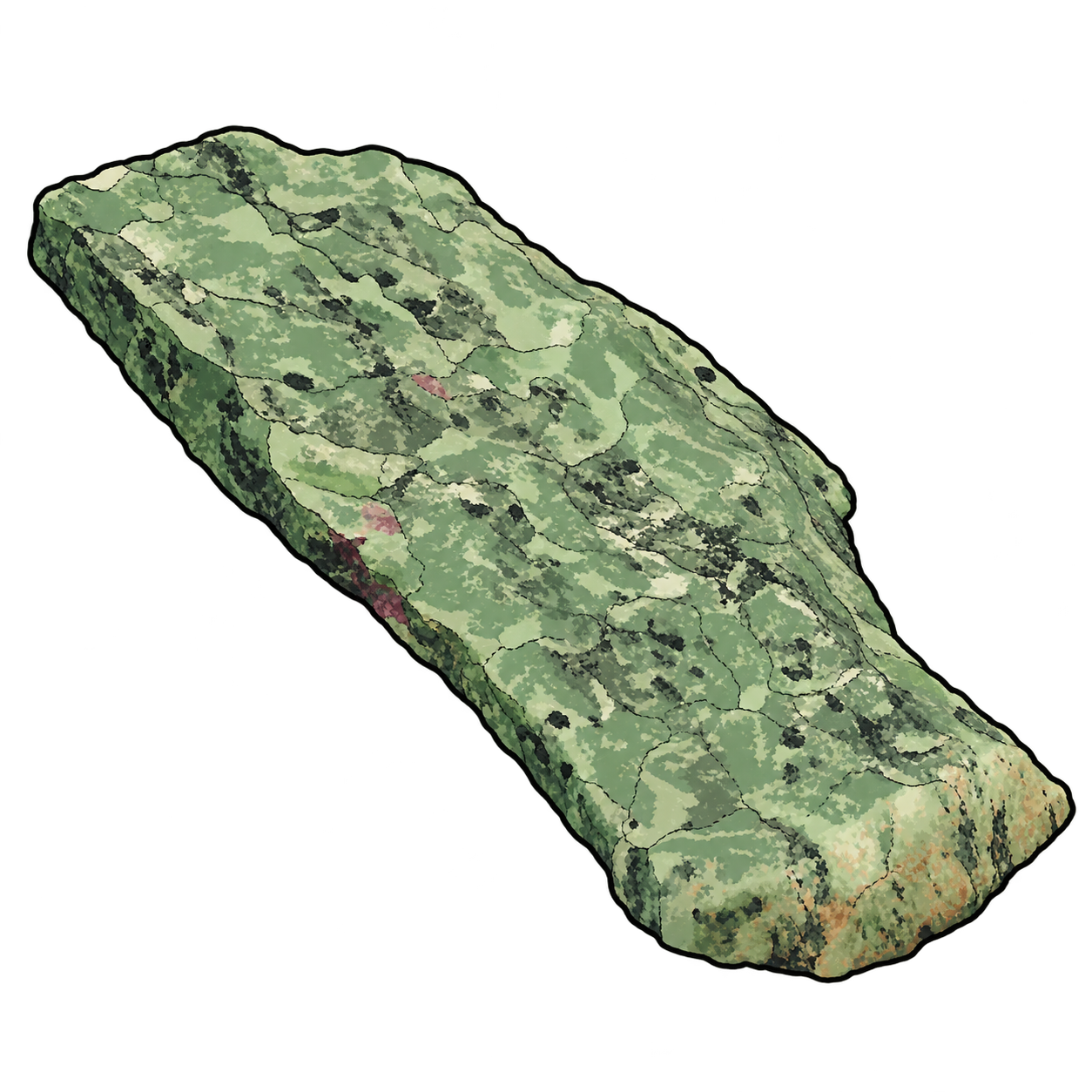
Ruby-in-zoisite is a rock with red corundum set in green zoisite, commonly with dark amphibole. GIA's discussion of Tanzanian material describes the Longido association and its use in carvings. The term anyolite has also been used for green zoisite–amphibole material. It is best to describe the actual components instead of treating every trade-name usage as a precise species definition. [7]
The contrast can be dramatic, but a ruby-bearing carving is not an opaque, lower-grade tanzanite. It contains separate minerals with different properties. Its care must accommodate the host and any fractures, not merely the hardness of the red corundum patches.
GIA recounts the widely told 1967 discovery story in which a Maasai finder brought blue-violet crystals from Merelani to Manuel d'Souza, who registered mining claims. Subsequent identification showed that the material was zoisite rather than the hoped-for sapphire. Tiffany & Co. named and promoted tanzanite in 1968, giving the unfamiliar gem a memorable connection to its country of origin. [8]
That commercial history is recent; the rock's formation is not. Modern popularity also does not require inventing an ancient tanzanite tradition. The stone has acquired genuine cultural significance through contemporary jewelry, collecting and spiritual practice without needing a fictitious antiquity.
GIA rates tanzanite's toughness as fair to poor and advises protection from hard blows. A pendant or carefully protected setting places different demands on it from a ring worn during physical work. Warm soapy water is the recommended cleaning method; steam and ultrasonic cleaners are not recommended. Avoid abrupt temperature changes. [9]
Heat-treated color is stable under normal use, but uncommon surface coatings and fracture fillers introduce separate vulnerabilities. Disclose those treatments to anyone cleaning or repairing the jewel. A ruby-in-zoisite carving or raw cluster should also be inspected for weak seams and repairs before wet cleaning. Support the whole object rather than gripping a projecting crystal or a thin carved section. [9]
thecrystalcouncil.com · Reference for the accompanying text · Reference recorded October 15, 2026
thecrystalcouncil.com · Reference for the accompanying text · Reference recorded October 15, 2026
handbookofmineralogy.org · Reference for the accompanying text · Reference recorded October 15, 2026
lmhc-gemmology.org · Reference for the accompanying text · Reference recorded October 15, 2026
gia.edu · Reference for the accompanying text · Reference recorded October 15, 2026
mindat.org · Reference for the accompanying text · Reference recorded October 15, 2026
gia.edu · Reference for the accompanying text · Reference recorded October 15, 2026
gia.edu · Reference for the accompanying text · Reference recorded October 15, 2026
gia.edu · Reference for the accompanying text · Reference recorded October 15, 2026