Dark prisms, green interiors and the evidence of alteration
Epidote
Calcium aluminium iron silicate in the epidote group.
Calcium-bearing hydroxyl silicate mineral species
Loading this page…
Return homePlease wait while the next page arrives.


Dark prisms, green interiors and the evidence of alteration
Calcium aluminium iron silicate in the epidote group.
Calcium-bearing hydroxyl silicate mineral species
Epidote contains calcium, aluminum, ferric iron, silicon, oxygen and hydroxyl.
Geology · Human history · Spiritual attributes
Modern crystal practice associates epidote with increase and amplification. The Crystal Council describes a focus for abundance, creativity, relationships and opportunities, emphasizing the practitioner's participation. These are contemporary spiritual meanings, not measured properties of the mineral. [1]
Epidote contains calcium, aluminum, ferric iron, silicon, oxygen and hydroxyl. Its silicate structure includes both individual silicon–oxygen tetrahedra and linked pairs. “Epidote” names a mineral species as well as the group of related species to which it belongs; not every member of that group is epidote. [2,3]
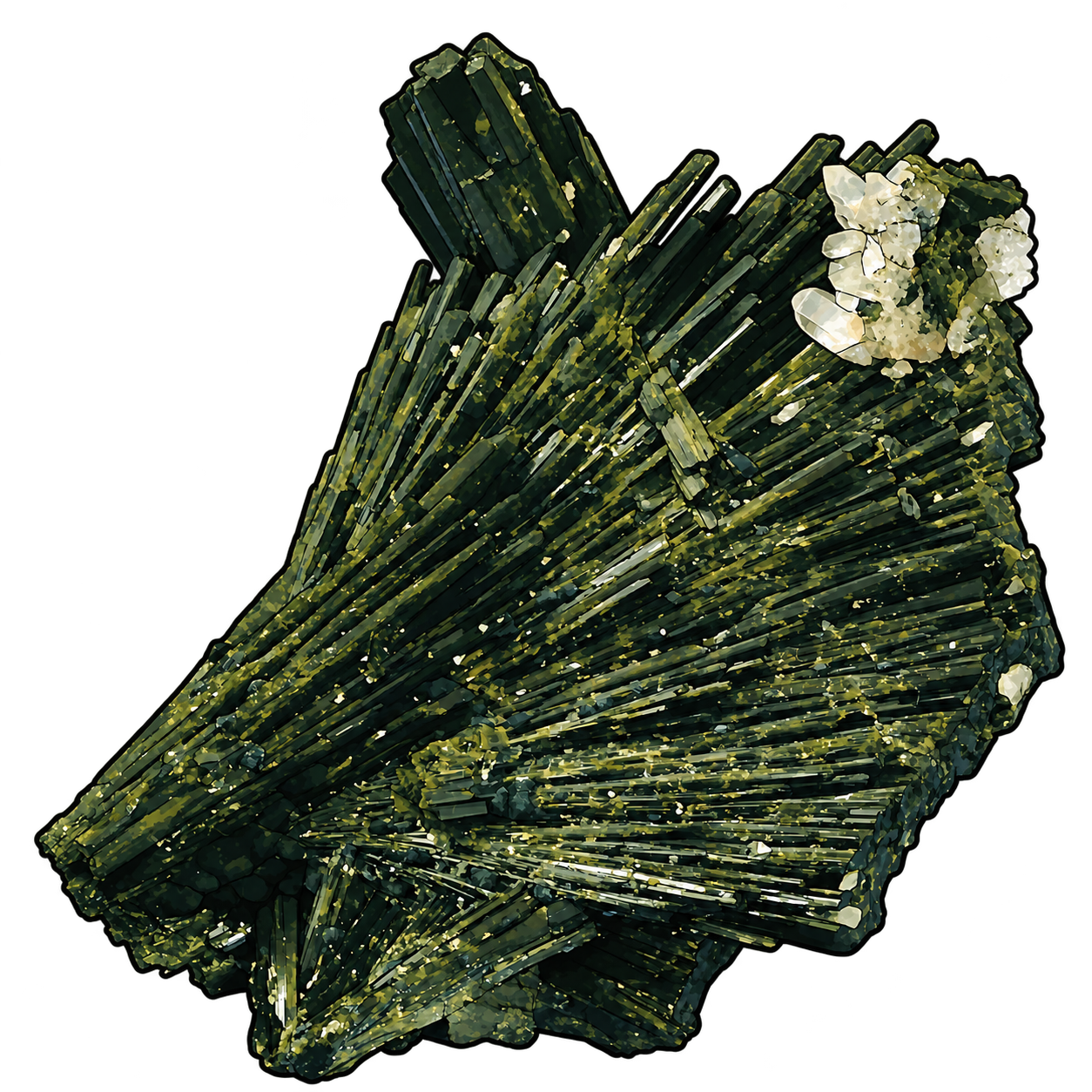
It commonly forms elongated, lengthwise-striated monoclinic prisms, although many occurrences are granular rather than conspicuously crystalline. Mohs hardness is 6–7, measured specific gravity approximately 3.38–3.49, and cleavage is perfect in one direction. Those cleavage planes make projecting crystals vulnerable despite their respectable scratch resistance. [2]
Dark crystals may transmit yellow-green light at thin edges. Strong pleochroism produces directional differences in transmitted colour. [2]
Epidote forms a solid-solution series with clinozoisite. In the ideal clinozoisite composition, aluminum occupies the position taken by ferric iron in ideal epidote; natural compositions can lie between those endpoints. Mineral names depend on the relevant site occupancies, not simply on whether a crystal looks dark green. [3]
Mindat's specialist discussion points out an important identification trap: small amounts of iron can color clinozoisite green before its composition crosses the boundary required for the name epidote. A crystal can also contain zones belonging to different compositions. Consequently, “green equals epidote” is an appealing shortcut but not a rigorous determination. [4]
Retain analytical identification and locality records with a collection specimen. Where the exact composition is unknown, a group or series designation can express that uncertainty accurately.
Geology: more than an isolated green crystal Epidote is an important rock-forming and alteration mineral. It occurs in metamorphic rocks, at contacts involving igneous and calcium-rich sedimentary rocks, and through alteration of plagioclase feldspar. Its surroundings provide information that a detached crystal no longer preserves. [2]
Unakite demonstrates the difference between a mineral and a rock. A USGS account describes the material as a mixture of pink feldspar, green epidote and quartz, with epidote replacing earlier constituents in the examined Virginia occurrences. The name therefore does not mean “massive epidote.” Its contrasting colors belong to several minerals. [5]
That account also describes variation from feldspar-rich material toward quartz-and-epidote rock. The changing proportions produce different patterns on a polished surface.
Knappenwand in Austria is especially associated with lustrous, dark green epidote clusters. Vienna's Natural History Museum records the locality's discovery in 1865 and subsequent commercial exploitation, highlighting large crystals and striking intergrowths. The locality's reputation rests on a particular combination of crystal development and documented history, not on epidote being rare everywhere. [6]
Transparent material can also be faceted, though deep color and cleavage limit its everyday jewelry role. A 2.85-carat Kenyan example documented by GIA is very dark brownish yellow rather than the stereotypical pistachio green. Its measured refractive indices, specific gravity and microscopic fluid inclusions illustrate the evidence available in a gemological examination. A dark faceted appearance alone would not establish its identity. [7]
Crystal specimens and cut stones reward different qualities. A collector cluster can preserve natural terminations and the intersection of several prisms. A faceted stone presents color and internal reflections through a deliberately chosen geometry. Cutting a dramatic cluster would not necessarily improve it; transparency is only one kind of interest.
Lift a cluster by its stable base, not by the longest prism. Fine needles and thin bridges between crystals can break under pressure even when the main mass is sound. A padded support should contact the matrix without loading projecting terminations.
Use a soft brush for accessible dust and avoid forcing fibers between tightly intergrown crystals. Do not use an acid bath to remove pale associates: that can erase part of the specimen's geological context and may damage other materials. Unknown repairs or coatings also rule out casual soaking or solvent cleaning. For faceted epidote, a protective setting and cautious handling are more sensible than relying on hardness alone.
thecrystalcouncil.com · Reference for the accompanying text · Reference recorded October 15, 2026
handbookofmineralogy.org · Reference for the accompanying text · Reference recorded October 15, 2026
mindat.org · Reference for the accompanying text · Reference recorded October 15, 2026
mindat.org · Reference for the accompanying text · Reference recorded October 15, 2026
pubs.usgs.gov · Reference for the accompanying text · Reference recorded October 15, 2026
nhm.at · Reference for the accompanying text · Reference recorded October 15, 2026
gia.edu · Reference for the accompanying text · Reference recorded October 15, 2026