Green Beryl, Revealed Within
Emerald
Green beryl in the gemological emerald range.
Colored beryl gem variety
Loading this page…
Return homePlease wait while the next page arrives.


Green Beryl, Revealed Within
Green beryl in the gemological emerald range.
Colored beryl gem variety
Emerald is the green to bluish-green variety of beryl.
Geology · Human history · Spiritual attributes
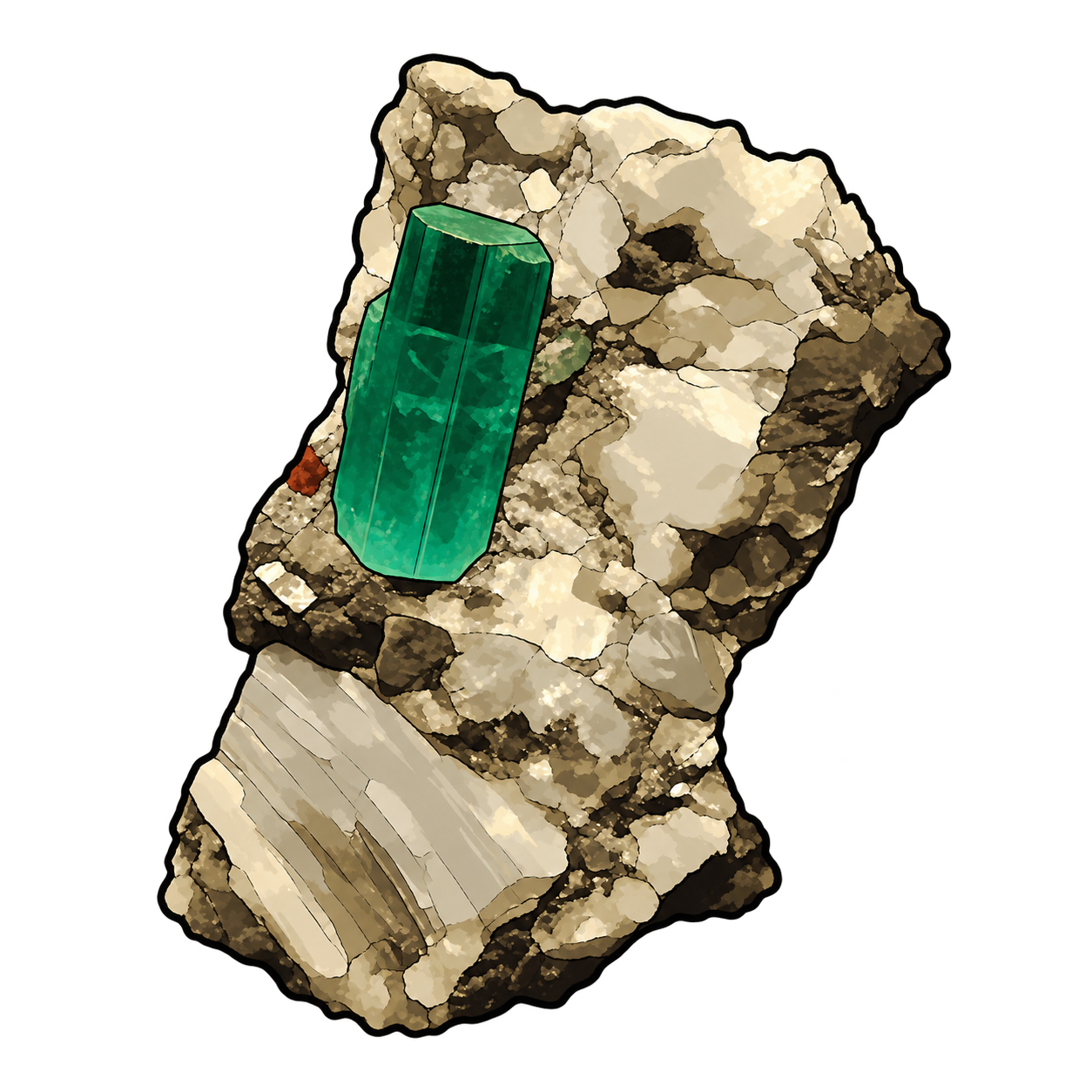
Emerald is the green to bluish-green variety of beryl. Its identity involves both composition and appearance: not every pale green beryl receives the emerald name. GIA compares stones with laboratory standards to judge whether their tone and saturation warrant that designation, while acknowledging differences in trade usage. [1]
Modern crystal practice commonly associates emerald with the heart. The Crystal Council emphasizes love, compassion, self-care and release from attachments that prevent a person from moving forward. Its account supplies a contemporary spiritual interpretation, distinct from emerald's geological properties or the devotional uses of particular historical objects. [2]
A stone can accompany reflection on how these qualities are practiced. It cannot establish another person's sincerity or guarantee reconciliation. Heart-centered symbolism should not be confused with a medical effect on the physical heart.
Chemical formula: Be₃Al₂Si₆O₁₈ Crystal system: Hexagonal Common habit: Prismatic crystals, often with flat terminations Mohs hardness: 7.5–8 Representative specific gravity: Approximately 2.72 Representative refractive index: 1.577–1.583 Typical birefringence: Approximately 0.005–0.009 Color-producing elements: Chromium and/or vanadium, with iron influencing the appearance [3, 4]
Beryl's framework contains stacked rings of silicate units connected through aluminum- and beryllium-bearing sites. Small substitutions help give the mineral its range of varieties. Emerald's green is not a layer of pigment coating a colorless crystal; the relevant elements are incorporated within its structure. [5]
Optical measurements and density support identification, but their representative values are not a universal certificate. Natural variations and overlapping properties require a gemologist to interpret several observations together. The familiar six-sided prism is likewise useful context, not proof that an unidentified green object is emerald.
The trade term jardin, French for garden, describes the mossy appearance of emerald's internal features. It does not mean plant matter is enclosed in the stone. Many emeralds have inclusions visible without magnification; unusually clear examples are scarce. Their presence can be accepted in a fine stone, while dense inclusions or fractures that seriously reduce transparency still affect its appearance and durability. [4]
Color descriptions benefit from precision. Hue identifies the kind of green; tone describes lightness or darkness; saturation describes strength rather than grayness. Very dark material can hide much of its interior. GIA notes that appearance overlaps between producing regions, so “Colombian-looking” color is not sufficient evidence of Colombian origin. [4]
Tiny cavities can preserve more than one phase of material. Colombian emeralds may contain liquid, a gas bubble and a crystal of salt within the same inclusion. These features record the environment of growth, but evaluating origin from inclusions requires expertise and a wider comparison than a single photomicrograph. [3]
Colombia's deposits illustrate why emerald should not be explained with a universal granite-pegmatite model. Mineralizing fluids circulated through sedimentary sequences containing black shale and carbonates. Faulting, fluid pressure and chemical interaction helped produce emerald-bearing veins. [5]
Trapiche emerald has a wheel-like internal arrangement, with six growth sectors separated by inclusion-rich boundaries. The pattern belongs to the material itself; it is not the moving reflected star of an asteriated gem. Pignatelli and colleagues proposed a model connecting pressure release, crystal growth and incorporation or displacement of surrounding matrix. Their 2015 study links the distinctive texture to a specific geological setting rather than treating the pattern as a purely decorative curiosity. [5]
Not every emerald is trapiche, and not every star-shaped appearance has the same cause. A good specimen description should identify what is actually present instead of using optical terms interchangeably.
Emerald mining in Egypt is documented in antiquity. The later movement of Colombian emeralds into European and Asian markets included appropriation during Spanish conquest as well as trade. These histories belong to particular places and periods; a present-day gemstone needs its own documented provenance. [6]
Qatar Museums holds a rectangular emerald bearing Jahangir's name and a date corresponding to 1609–1610 CE. Its catalog places the inscription in a Mughal tradition inherited from Timurid rulers, while noting that emeralds more commonly bore devotional formulas than sovereigns' names. The object is both a gem and a carefully worked surface carrying authority, identity and belief. [7]
Oil, resin and other fillers can make surface-reaching fissures less visible. A clearer appearance does not mean the fractures have ceased to exist. The degree of enhancement is therefore an important disclosure alongside the mineral's identity and growth origin. [8]
GIA uses minor, moderate and significant to describe levels of clarity enhancement, not the emerald's overall quality. Its December 2024 report announcement also distinguishes filler composition: its Type A category may include oil, wax or natural resin, while Type B identifies artificial resin. Some fillers cannot be conclusively identified. These are emerald report categories, not a universal grading scale for every gemstone. [4, 8]
A laboratory-grown emerald and an imitation are different things. The former is manufactured beryl with emerald characteristics; the latter may be another substance made to resemble it. The mere presence of an internal feature does not settle that distinction. Request evidence appropriate to the value and claim being made. [3]
Emerald's hardness is high, but fractures make it less forgiving of knocks than that number suggests. GIA gives toughness as fair to good. Heat can extend fractures; light and chemicals may affect some fillers. Avoid steam and ultrasonic cleaning. Gentle cleaning with lukewarm soapy water is the conservative approach, followed by careful rinsing and drying. [9]
Look at the actual stone in ordinary lighting and examine vulnerable edges. For jewelry, a secure, protective setting matters. For matrix specimens, support the rock rather than gripping the crystal. Preserve treatment reports and acquisition records, and seek professional advice before repolishing, resetting or attempting to remove an old filler. Beauty and informed care are compatible: an emerald need not be flawless to deserve an accurate account of what it is.
gia.edu · Reference for the accompanying text · Reference recorded October 15, 2026
thecrystalcouncil.com · Reference for the accompanying text · Reference recorded October 15, 2026
gia.edu · Reference for the accompanying text · Reference recorded October 15, 2026
gia.edu · Reference for the accompanying text · Reference recorded October 15, 2026
gia.edu · Reference for the accompanying text · Reference recorded October 15, 2026
gia.edu · Reference for the accompanying text · Reference recorded October 15, 2026
collections.qm.org.qa · Reference for the accompanying text · Reference recorded October 15, 2026
gia.edu · Reference for the accompanying text · Reference recorded October 15, 2026
gia.edu · Reference for the accompanying text · Reference recorded October 15, 2026