Violet-blue cordierite and the art of changing perspective
Iolite
Gem-quality cordierite, often violet-blue and strongly pleochroic.
Gem-quality cordierite variety
Loading this page…
Return homePlease wait while the next page arrives.


Violet-blue cordierite and the art of changing perspective
Gem-quality cordierite, often violet-blue and strongly pleochroic.
Gem-quality cordierite variety
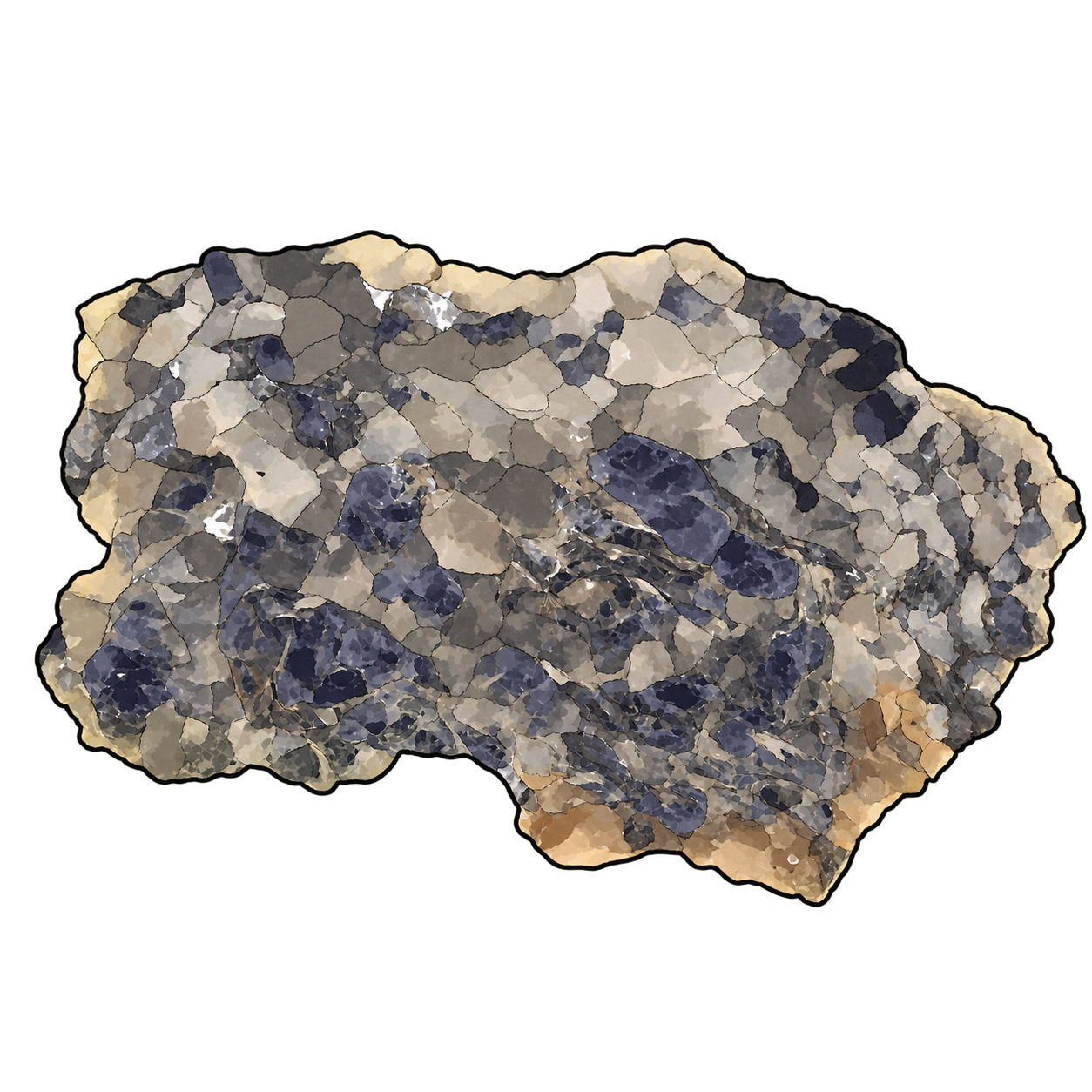
Iolite is gem-quality cordierite, an orthorhombic mineral that often occurs as granular or compact masses rather than conspicuous free-standing crystals.
Geology · Human history · Spiritual attributes
Iolite is associated with inward exploration. The Crystal Council emphasizes intuition, spiritual awareness and self-discovery within a third-eye framework; GIA also records a modern connection with creativity. These are personal and spiritual meanings rather than demonstrated effects of cordierite. [1,2]
Its changing colour provides an apt visual metaphor. One angle does not exhaust the stone's appearance; a turn reveals something the first view concealed. In a personal ritual, that can become an invitation to reconsider a fixed interpretation.
Iolite is gem-quality cordierite, an orthorhombic mineral that often occurs as granular or compact masses rather than conspicuous free-standing crystals. Short prisms can show a superficially six-sided outline, but that appearance does not make cordierite hexagonal. The Handbook of Mineralogy gives hardness 7–7.5 and measured density about 2.60–2.66 g/cm3, with a glassy luster and brittle behavior. [3]
Magnesium–iron substitution links cordierite with iron-rich sekaninaite. Transparent material may become gemstones, while granular specimens preserve its relationship with surrounding minerals. [3]
Pleochroism: color within, not on the surface Iolite's most distinctive optical quality is strong pleochroism. Depending on the direction of transmitted light, a blue-violet gem can appear paler, yellowish, grayish or brownish. This differs from an iridescent surface flash or a gem that changes color because the light source has changed. Keep the illumination steady and rotate the specimen: the viewing direction itself is the variable. [4]
Cutting requires a choice about which direction will face the viewer. A well-oriented stone presents its strongest blue or violet through the top, but another angle may reveal a much less saturated appearance. A single photograph can therefore overstate how uniformly blue a gem looks. Faceted stones, cabochons and carvings all encounter this property; it is part of iolite's identity rather than a flaw that polishing removes. GIA describes iolite as not routinely treated, though that general observation is not an individual guarantee about an undocumented stone. [4]
Not all iolite is prized for complete transparency. Parallel tubular inclusions can produce a cat's-eye when a cabochon is oriented appropriately. Reflective platelets can create aventurescence, a scattering of glints within the gem. Material with reddish or brownish platelets is sometimes called bloodshot iolite. This name describes an appearance, not a separate mineral species. [5]
A 2023 study of British Columbia's Blue Bear occurrence traced chatoyancy to abundant, aligned needle-like fluid inclusions. The same research distinguished them from blocky primary fluid inclusions and later inclusions along healed fractures. That distinction matters: similar-looking lines inside a gem can have different origins, and not every inclusion is a solid mineral needle. The study ties a visible moving band of light to the microscopic record of crystal growth. [6]
Cordierite occurs in metamorphosed clay-rich sediments, high-grade schists and gneisses, and some igneous rocks. A loose gem does not by itself reveal which setting produced it. The associated minerals and host rock supply the context that a polished stone has lost. [3]
The Blue Arrow and Blue Bear localities near Revelstoke offer a documented example beyond a generic claim of “metamorphic origin.” Belley's investigation identified gem cordierite in magnesium- and aluminum-rich rocks derived from hydrothermally altered mafic volcanic material that later underwent high-grade metamorphism. Cordierite occurs there with minerals including gedrite, iron-rich phlogopite, quartz and garnet. The route from altered volcanic rock to gem material is more specific than simply saying that heat and pressure make crystals. [6]
Iolite's name derives from a Greek word for violet; cordierite honors Pierre Cordier. The more adventurous nickname “Viking Compass Stone” belongs to a navigation story whose historical use remains uncertain. GIA presents the account as legend, not a demonstrated fact about an excavated iolite instrument. [2,3]
The underlying optical proposal has been tested. In a 2016 study, researchers measured how accurately participants could orient cordierite, tourmaline and calcite under controlled polarized illumination. They examined the first step of a proposed sky-polarimetric navigation method, including how errors changed with the degree of polarization. Such experiments investigate physical feasibility. They do not establish that Viking navigators actually used a particular mineral, nor do they reproduce every uncertainty of an ocean voyage. The distinction preserves the interest of the hypothesis without turning an experiment into an archaeological discovery. [7]
Iolite's scratch resistance is useful, but cleavage makes it vulnerable to blows and excessive pressure. GIA recommends protection from sudden temperature changes, steam and ultrasonic cleaning; mild soapy water is the preferred cleaning method for suitable jewelry. Pendants, earrings and protective settings reduce exposure to impacts. Its color is ordinarily stable, which is a different question from its resistance to mechanical damage. [8]
For a specimen in matrix, choose care appropriate to the entire object. Preserve the locality label and note whether the piece is granular cordierite, a transparent gem or an inclusion-rich cabochon. These forms illuminate different aspects of one mineral, and none needs to impersonate sapphire or tanzanite to deserve attention.
thecrystalcouncil.com · Reference for the accompanying text · Reference recorded October 15, 2026
gia.edu · Reference for the accompanying text · Reference recorded October 15, 2026
handbookofmineralogy.org · Reference for the accompanying text · Reference recorded October 15, 2026
gia.edu · Reference for the accompanying text · Reference recorded October 15, 2026
gia.edu · Reference for the accompanying text · Reference recorded October 15, 2026
gia.edu · Reference for the accompanying text · Reference recorded October 15, 2026
doi.org · Reference for the accompanying text · Reference recorded October 15, 2026
gia.edu · Reference for the accompanying text · Reference recorded October 15, 2026