Purple silicate, mixed mineral textures, and the importance of genuine identity
Sugilite
A complex potassium-sodium lithium silicate mineral, often sold in mixed massive material.
Mineral species; ornamental specimens may include other minerals
Loading this page…
Return homePlease wait while the next page arrives.


Purple silicate, mixed mineral textures, and the importance of genuine identity
A complex potassium-sodium lithium silicate mineral, often sold in mixed massive material.
Mineral species; ornamental specimens may include other minerals
Sugilite includes brownish-yellow material from Japan and the purple manganese-bearing South African material familiar in jewelry.
Geology · Human history · Spiritual attributes
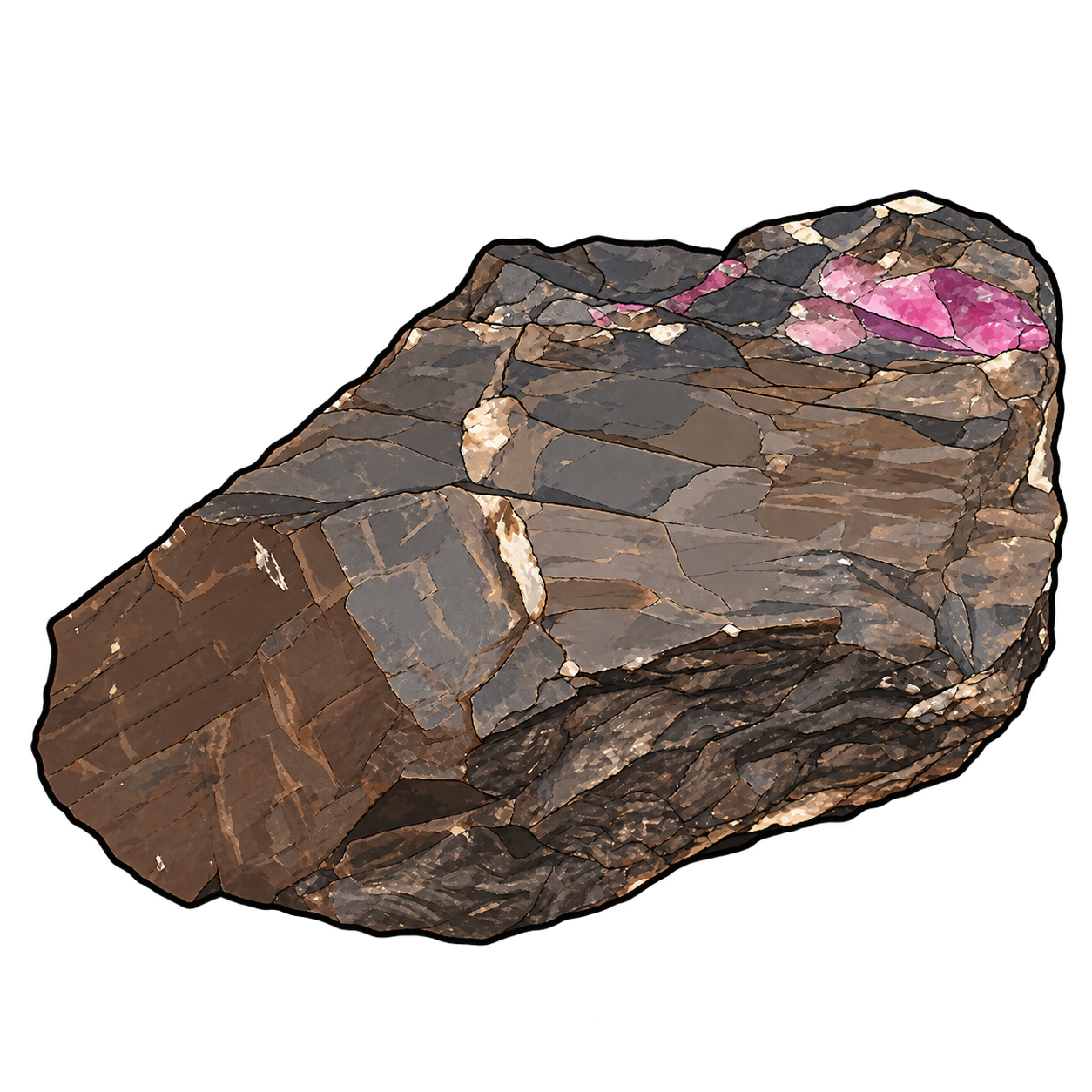
Potassium–sodium–lithium silicate with iron, manganese, and aluminum; ornamental material may be a mixed aggregate. [1][3]
Commonly violet to magenta in jewelry material; mottled, veined, opaque, or translucent. [1][3]
Love, presence, spiritual protection, and intuitive or dream-focused meditation in contemporary practice. [2]
The Crystal Council connects sugilite with love, awareness of the present moment, protection, and meditation. It places the stone within third-eye and crown-oriented practice and interprets it as a companion to dream imagery and inward reflection. These associations describe a modern spiritual system, not measurable effects of the mineral. [2]
The same practitioner recommends pairing sugilite with hematite as a symbolic balance between visionary work and grounding. That pairing can be understood as a chosen ritual language, rather than a reaction between the two materials. No mineral needs to be taped to the body or used in place of appropriate care for these associations to have personal meaning. [2]
Sugilite belongs to the milarite group and crystallizes in the hexagonal system. A commonly used formula is KNa2(Fe3+,Mn3+,Al)2Li3Si12O30. It is usually encountered as compact, interlocking grains; well-formed individual crystals are uncommon. The Handbook of Mineralogy gives hardness around 5.5–6.5, measured density of 2.74–2.79, and poor basal cleavage. [1]
These figures describe the mineral, not every purple composite sold under its name. Other minerals, pores, fractures, or treatments can alter a finished object's response to testing and wear. Lithium's presence in the formula is a chemical fact; it does not make a stone a source of medication or imply that handling it has a pharmacological effect.
The purple of familiar jewelry material is associated with manganese-bearing sugilite. Color can vary across a piece, and the quantity and distribution of other minerals contribute to its texture. A pale patch, black vein, and purple area should not all be assigned the same composition merely because they occupy one cabochon. [3]
The Japanese type occurrence is in aegirine-bearing syenite within granite on Iwagi Islet. Important South African occurrences are associated with bedded manganese deposits near Kuruman, including the Wessels and N'Chwaning mines. These are distinct geological settings, not evidence that sugilite must always form in one particular kind of rock. The handbook also documents occurrences beyond Japan and South Africa. [1]
The species honors Japanese petrologist Ken-ichi Sugi; its formal description appeared in 1977. [1]
An origin statement should remain tied to a reliable record. The artistic illustration does not establish the mine, country, treatment, or composition of a stone offered for sale.
GIA's 1987 investigation of Wessels Mine material separated two broad groups: aggregates predominantly composed of manganese-bearing sugilite, and material in which chalcedony was mixed with and colored by sugilite. The authors treated the latter as a rock composed of both minerals, rather than assigning every specimen the properties of pure sugilite. [3]
Their descriptions included uniform, mottled, layered, and veined appearances. Even apparently even-colored examples contained interlocking grains when examined microscopically. This makes texture informative: the stone's visual continuity does not mean it is a single crystal. The study's historical production estimates should not be mistaken for today's available supply. [3]
For a collection or purchase, distinguish a mineral identity from a marketing grade. A term emphasizing translucency or vivid color may describe appearance without defining an officially recognized variety. Ask what was identified, how it was tested, and whether any additional material or treatment is present.
A 2014 GIA report examined a purple bangle offered as sugilite. Microscopy showed color concentrated along mineral grain boundaries, and optical, density, fluorescence, and infrared results identified dyed marble rather than sugilite. The calcite-based body and added color explained its resemblance without making it the same stone. [4]
This case does not imply that all strongly purple sugilite is dyed. It shows why a convincing color is insufficient evidence. A reputable description should distinguish genuine sugilite-bearing material, treated material, and an imitation made from a different substance. None of those questions can be resolved reliably from saturation in an online photograph alone.
Do not apply acid, solvents, heat, or scratch tests to a finished object as a home authenticity check. They can damage the piece and still fail to answer the question. For a valuable or disputed item, a gemological examination is more useful than a destructive experiment.
Use a soft cloth and conservative cleaning, particularly when the composition or treatment history is uncertain. Avoid steam, ultrasonic cleaners, prolonged soaking, and solvents around possible fillers or dyes. Store pieces separately so that harder gems and metal settings do not abrade their polish.
Good maintenance also includes documentation. Keep the original description, any treatment disclosure, and laboratory report with the object. If its identity is later refined from sugilite to sugilite-bearing chalcedony, that is meaningful information rather than a reason to discard its visual or collecting appeal. An accurate label allows the stone to be appreciated for what it actually is.
handbookofmineralogy.org · Reference for the accompanying text · Reference recorded October 15, 2026
thecrystalcouncil.com · Reference for the accompanying text · Reference recorded October 15, 2026
gia.edu · Reference for the accompanying text · Reference recorded October 15, 2026
gia.edu · Reference for the accompanying text · Reference recorded October 15, 2026