Lithium-rich mica, layered sparkle, and the importance of a precise name
Lepidolite
Field/trade name for lithium-rich micas, not one accepted mineral species.
Conventional group/trade name for lithium-rich mica material
Loading this page…
Return homePlease wait while the next page arrives.


Lithium-rich mica, layered sparkle, and the importance of a precise name
Field/trade name for lithium-rich micas, not one accepted mineral species.
Conventional group/trade name for lithium-rich mica material
Lepidolite is the familiar name for lithium-rich mica material often seen in lilac or pink, with a sheen produced by many thin plates.
Geology · Human history · Spiritual attributes
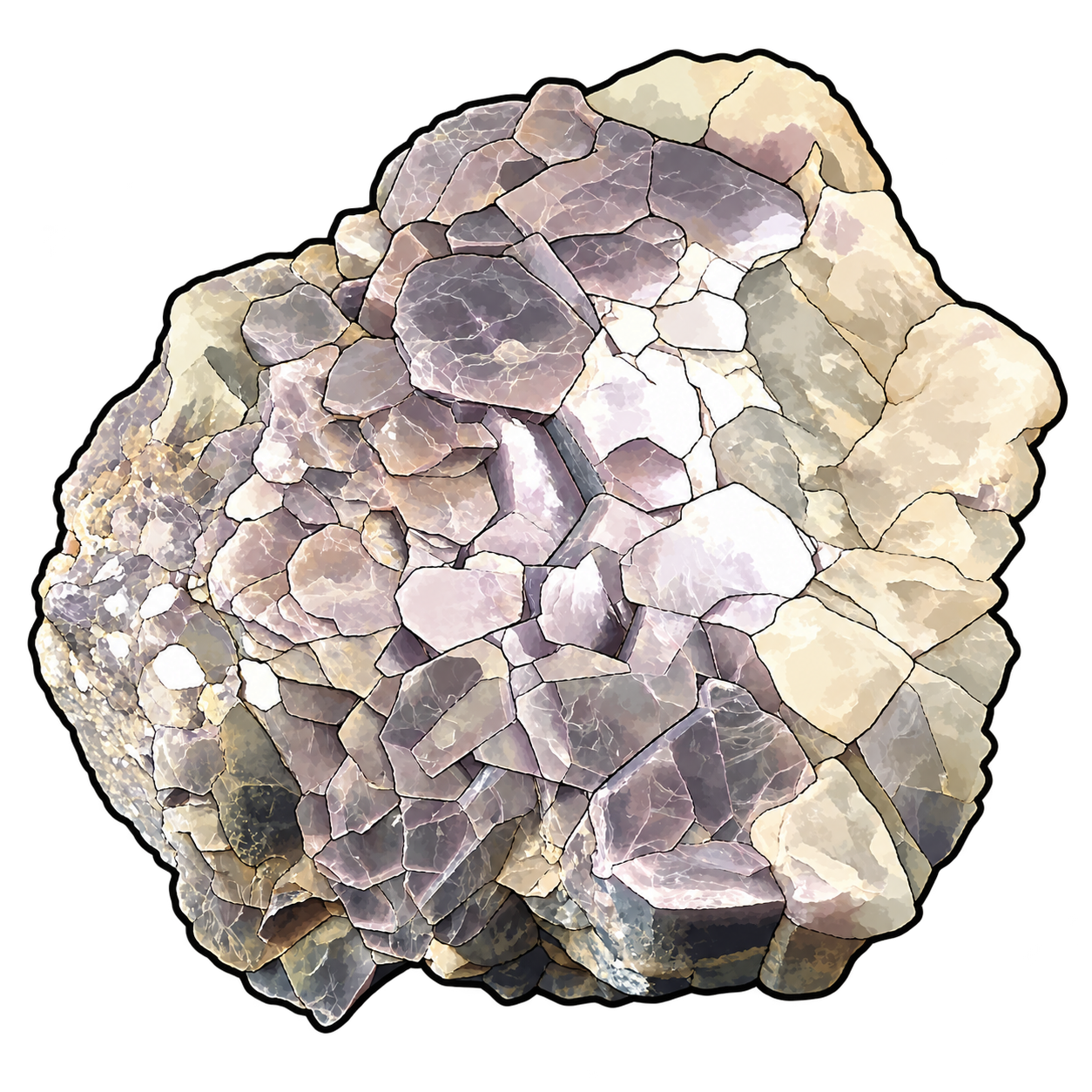
Lithium-rich mica-series material, commonly involving trilithionite and polylithionite compositions. [1][2][4][5][6][7]
Often lilac or pink, with pearly flakes and layered aggregates; color is not a complete identification. [1][2][4][5][6][7]
Calm reflection, patience, self-love, and intuitive or dream-centered practice in contemporary crystal traditions. [3]
Lepidolite is the familiar name for lithium-rich mica material often seen in lilac or pink, with a sheen produced by many thin plates. It can form a glittering mineral mass, discrete mica books, or a component of a polished, mixed-mineral rock. Its layered structure is as important to its identity as its color: these are sheet silicates, not purple quartz crystals. The name is also broader than a single fixed mineral species. [1,2]
The Crystal Council associates lepidolite with calm, self-growth, emotional understanding, and dream awareness. It places the material within several chakra correspondences, especially heart, third-eye, and crown practice. These are modern practitioner interpretations rather than measurable consequences of holding lithium-rich mica. [3]
The presence of lithium in a mineral must not be confused with the effects of a prescribed medicine. A lepidolite specimen is not a source of controlled treatment through touch, and should not be dissolved or ingested. A symbolic ritual can stand on its own: the stone may mark an intention to pause without being asked to perform a medical function.
The mica nomenclature published by Rieder and colleagues in 1998 treats lepidolite as a series name for light-colored, lithium-rich trioctahedral micas around the trilithionite–polylithionite compositional join. For a fully studied sample, a more specific mineral name is preferable. “Lepidolite” remains useful for familiar collector and trade material, but does not supply one exact formula for every specimen. [1]
Polylithionite, one relevant member, has the formula KLi₂AlSi₄O₁₀(F,OH)₂. The Handbook of Mineralogy describes perfect basal cleavage, hardness 2–3, and a pearly to waxy luster in fine-grained material. Its recorded colors extend beyond lavender to include pale pink, cream, colorless, brownish, and other shades. A purple color alone is therefore neither necessary nor sufficient for a precise mica identification. [2]
Mica “books” are stacks of thin layers. The USGS uses this familiar comparison to explain why a specimen can separate into sheets. The sparkling appearance of an aggregate similarly comes from numerous small reflective surfaces, rather than from the glassy, continuous fracture surface expected of quartz. [4]
For handling, exposed flakes matter more than an attractive polish. A mixed rock may have hard supporting minerals while the mica at its surface remains susceptible to peeling and abrasion. Asking whether an object is predominantly mica or a quartz-rich aggregate is more useful than applying one hardness number indiscriminately to the entire object.
Lithium-bearing micas occur in specialized geological environments. The USGS's model of lithium–cesium–tantalum pegmatites places lepidolite among their important lithium minerals, alongside spodumene and petalite. These granitic bodies commonly contain quartz, feldspars, and muscovite, with accessory minerals that may include tourmaline, garnet, and apatite. [5]
Pegmatites can be internally zoned: different minerals concentrate in different parts as the body develops. A specimen combining mica, quartz, and feldspar can therefore preserve relationships between minerals rather than simply a mixture of unrelated fragments. A locality and a description of the host rock give that relationship context; a polished purple object without records cannot reveal all of it. [5]
Not every lithium mica occurrence is identical. The Handbook describes polylithionite in late-stage segregations and replacement veinlets within syenite pegmatites at Russia's Lovozero massif. That specific setting should not be generalized into a claim that all ornamental lepidolite formed there or in the same rock. [2]
Lithium-rich mica has a practical history as a lithium resource. A 1955 USGS review listed lepidolite with other North American pegmatite ores; a modern USGS educational resource still identifies lithium-rich mica among lithium sources. These records connect lepidolite with industrial geology without implying that every small specimen is an economic ore. Grade, quantity, processing, and access determine that separate question. [4,6]
The gem trade also recognizes worked lepidolite. GIA's Summer 1986 Gem News recorded cabochons ranging from light to dark pinkish purple at Tucson, mostly opaque but with some translucent examples. The reported properties belonged to the examined material, not to an ideal composition inferred from a color name. [7]
These uses answer different interests. A mineral collector may value intact plates and the relationship to neighboring minerals; a cutter may seek a compact mass that holds together; a resource geologist evaluates composition and deposit scale. None of those preferences makes the others mistaken.
Look for the texture as well as the hue. Fine mica flakes, a pearly sheen, and layered edges are useful observations, but an exact distinction among lithium-bearing micas may require chemical and structural analysis. It is more honest to retain an appropriately broad label than to invent a precise species from a photograph. [1]
For a polished object, ask which minerals form the body, whether it has been impregnated or coated, and whether a claimed locality is documented. Inspect the surface for loose scales, shallow pits, or open fractures. For an unworked specimen, ask about repairs and preserve its original label. Large, visible plates are particularly attractive because they make the mica structure legible, but they should not be flexed or peeled for demonstration.
Handle a raw specimen by its stable base rather than its mica edges. Keep it away from harder stones and avoid brushing aggressively across the layers. A covered display reduces the need for repeated cleaning. For a finished object with unknown composition or stabilization, begin with a soft dry cloth and seek specific care advice before immersion or chemical cleaning.
Do not assume that a carving is as tough as quartz merely because quartz is present somewhere in it. The most vulnerable exposed component governs practical care. Preserving the thin reflective plates is more important than forcing an immaculate shine onto a naturally textured mineral.
kristallov.net · Reference for the accompanying text · Reference recorded October 15, 2026
handbookofmineralogy.org · Reference for the accompanying text · Reference recorded October 15, 2026
thecrystalcouncil.com · Reference for the accompanying text · Reference recorded October 15, 2026
usgs.gov · Reference for the accompanying text · Reference recorded October 15, 2026
usgs.gov · Reference for the accompanying text · Reference recorded October 15, 2026
pubs.usgs.gov · Reference for the accompanying text · Reference recorded October 15, 2026
gia.edu · Reference for the accompanying text · Reference recorded October 15, 2026