Violet mineral fibers and a remarkable Siberian rock
Charoite
Complex silicate mineral usually sold as purple charoite-bearing rock.
Mineral species; ornamental specimens may include other minerals
Loading this page…
Return homePlease wait while the next page arrives.


Violet mineral fibers and a remarkable Siberian rock
Complex silicate mineral usually sold as purple charoite-bearing rock.
Mineral species; ornamental specimens may include other minerals
Charoite's appeal is not simply that it is purple.
Geology · Human history · Spiritual attributes
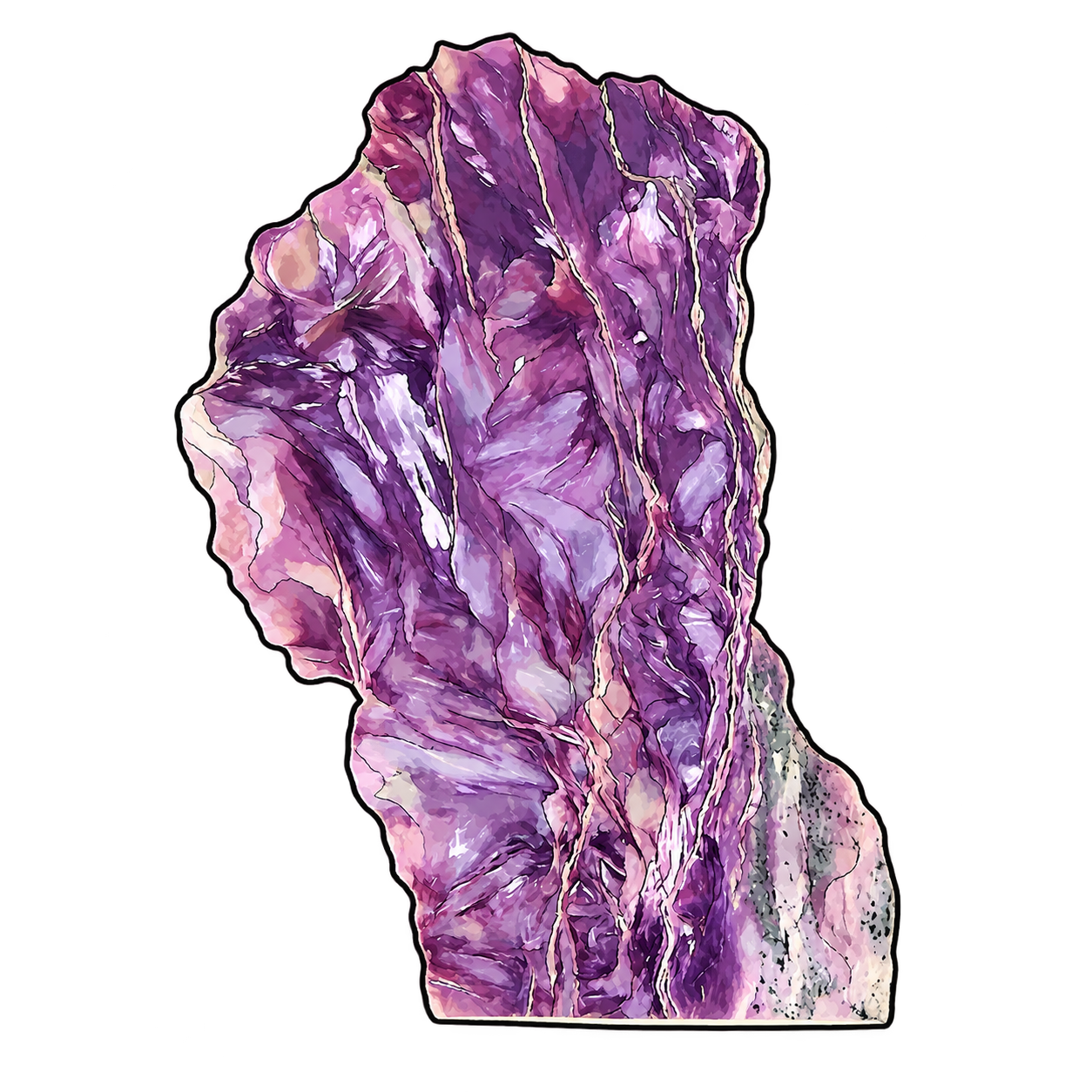
Charoite's appeal is not simply that it is purple. Curved bundles of fine fibers give its polished surfaces a sense of movement, while associated minerals interrupt the violet with contrasting patches and veins. The name refers both to a mineral species and, in everyday commerce, to the ornamental rock in which that mineral is prominent. Keeping those meanings distinct explains why two genuine pieces can look and test differently. [1,3,4]
The Crystal Council presents charoite as a stone of transformation, self-acceptance, love, and inward vision. In its chakra framework, third-eye and crown associations connect it with meditation and symbolic imagery; its protective language belongs to a spiritual understanding of personal boundaries. These are practitioner interpretations, not demonstrated changes to the brain or a physical shield. [2]
Charoite's shifting patterns offer a visual focus for reflection on change. Its symbolic role can be personal and meaningful without implying psychic abilities or medical benefit.
Charoite is monoclinic, fibrous or massive, with complex composition represented as (K,Sr,Ba,Mn)15–16(Ca,Na)32[Si70(O,OH)180](OH,F)4·nH2O. [1]
The handbook records good cleavage in three directions and a measured density of 2.54 for the examined material. Associated minerals and fractures also influence the behavior of an ornamental piece. [1]
Charoite was scientifically interesting long after its introduction as an ornamental material. Researchers used electron-diffraction methods to determine its intricate structure, with the 2010 work subsequently discussed in a chapter on natural nanotube structures. Here, nanotube refers to the arrangement within a crystal, not manufactured carbon nanotubes or a claim that the stone has special consumer health properties. The study demonstrates how a familiar polished object can contain an atomic structure that is difficult to resolve. [5]
At the Murun massif in Yakutia, Russia, charoite occurs in potassium-rich altered rocks along syenite–limestone contacts. Metasomatic chemical exchange changes existing rock; canasite and tinaksite are documented associates. [1]
The resulting ornamental material is geologically varied. A GIA literature abstract describes charoite-rich rock containing numerous other mineral species and explains that differing proportions contribute to changes in color and pattern. A dark patch or pale vein should not automatically be named from a photograph; the same general visual role can be played by different components. [3]
Locality is part of a specimen's provenance, not something established by the purple alone. Preserve reliable supplier or collection records. The fact that a mineral is strongly associated with one famous region does not authenticate the origin of every object offered under its name.
A 2002 GIA investigation examined a cabochon that looked like charoite but had properties closer to quartz. Microscopy and Raman analysis showed that its main body was quartz with lesser feldspar, containing lavender charoite fibers. Dense inclusions supplied the visible purple; sparse ones affected translucency without producing much color. [4]
The object was not simply a plastic imitation, yet calling it pure charoite would have concealed its actual composition. This case is useful when evaluating broad commercial descriptions. A stone can contain genuine charoite and still be predominantly something else. Questions about identity, treatment, and origin are related but separate.
For a buyer, clear descriptions matter more than assurances that a pattern is impossible to imitate. Ask whether the piece is a charoite-rich rock, a mineral specimen, or another material containing charoite. Laboratory testing may be appropriate for a costly or disputed object; decorative swirls alone are not a certificate.
The mineral name refers to the Chara River. Its formal description appeared in 1978 as both a new mineral and a new jewelry stone, linking its scientific recognition with its ornamental appeal. [1]
In design, a broad polished face can reveal patterns that would be interrupted by extensive faceting. Cabochons and other curved objects emphasize the relationship between color, fiber direction, and reflected light. When comparing pieces, consider whether the cut presents a coherent pattern, whether fractures are visible, and how accurately treatment and composition have been described. Saturation is only one part of the object's character.
Protect polished pieces from knocks and abrasive contact. Fibrous structure, cleavage, and mixed minerals make aggressive cleaning unnecessary risk. Use a soft cloth; where a stable surface requires more, use gentle cleaning and dry promptly rather than prolonged immersion. Avoid steam, ultrasonic equipment, solvents, and heat when treatments or vulnerable inclusions are unknown.
Keep rough pieces supported and do not pull apart fibers to examine them. Store a carved or polished object separately from harder stones. If a piece has been repaired, filled, or coated, its care requirements follow that treatment as well as its mineral composition.
handbookofmineralogy.org · Reference for the accompanying text · Reference recorded October 15, 2026
thecrystalcouncil.com · Reference for the accompanying text · Reference recorded October 15, 2026
gia.edu · Reference for the accompanying text · Reference recorded October 15, 2026
gia.edu · Reference for the accompanying text · Reference recorded October 15, 2026
arpi.unipi.it · Reference for the accompanying text · Reference recorded October 15, 2026