Violet quartz, from crystal-lined cavities to carved and faceted gems
Amethyst
Purple quartz.
Quartz color variety
Loading this page…
Return homePlease wait while the next page arrives.


Violet quartz, from crystal-lined cavities to carved and faceted gems
Purple quartz.
Quartz color variety
Amethyst is purple quartz.
Geology · Human history · Spiritual attributes
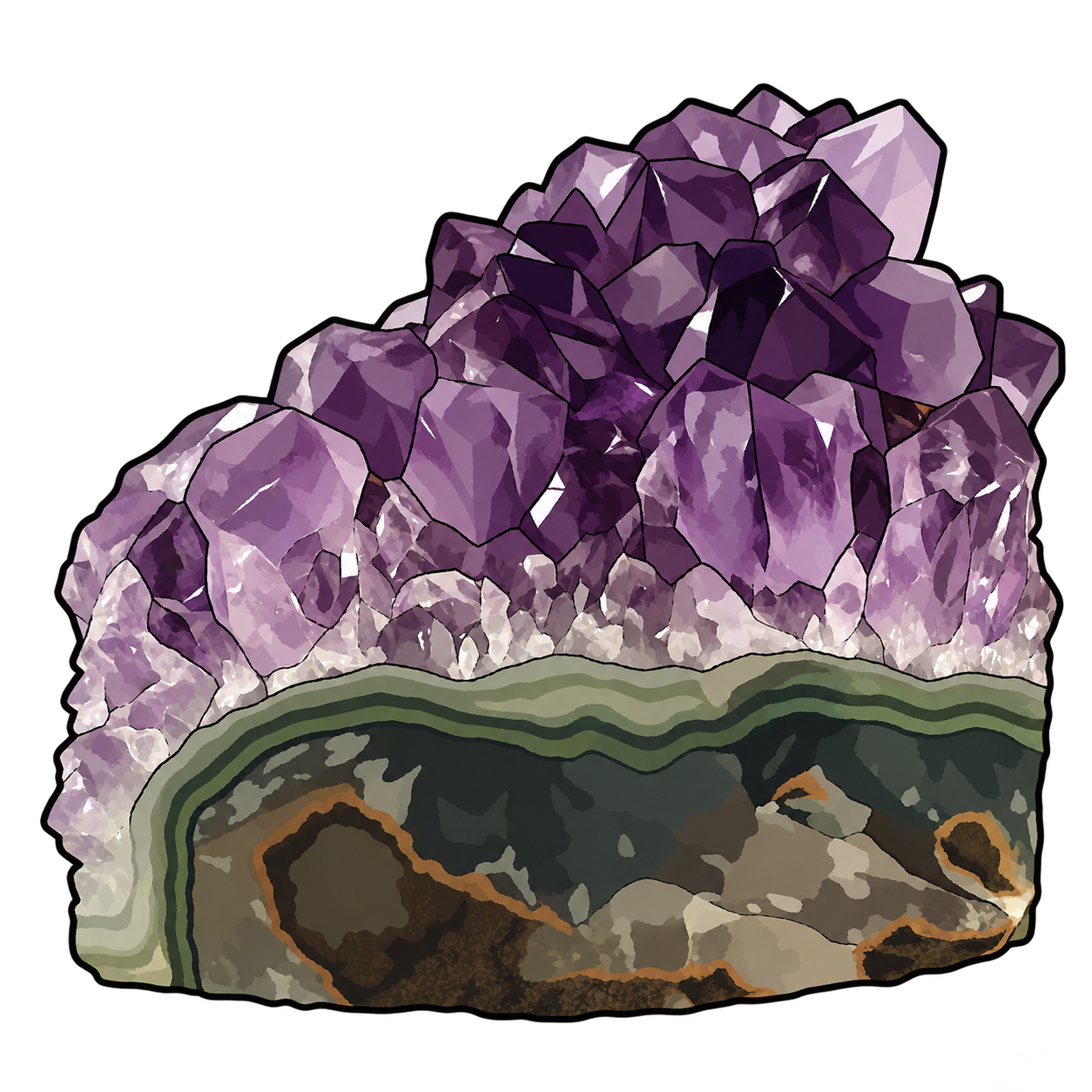
Amethyst is purple quartz. Its color can be a delicate lilac, a cool violet or a richer purple with reddish flashes, sometimes changing noticeably between adjacent growth zones. A faceted gemstone emphasizes light and color; a natural cluster preserves the arrangement of crystals as they grew. Both belong to the same mineral variety, but they reward different kinds of attention. [1]
In contemporary crystal practice, amethyst is associated with a clear mind, spiritual protection and inward attention. It is often used as a meditation companion: a stone held in the hand, worn as a pendant or placed where a person regularly pauses to reflect. Its symbolism concerns the quality of that attention rather than the size or expense of the specimen. [7]
These meanings belong to spiritual practice. Historical stories about amethyst and sobriety are a different kind of evidence: they document beliefs about the stone, not an ability to prevent intoxication or treat addiction. [6]
Amethyst's purple results from iron-related defects in the quartz structure and the effects of irradiation. These changes alter which wavelengths of light the crystal absorbs. The color is therefore not a coating or a purple substance filling an otherwise colorless crystal: it is an optical consequence of the material's atomic-scale structure. [3]
Color need not be uniform. Some crystals show darker tips, pale bases or angular bands, and a cut gem may reveal light and dark areas when viewed from different directions. Such zoning is worth describing rather than disguising. A cutter may work around it to produce a more even face-up appearance, while a mineral collector may value the growth pattern itself. [1, 8]
FORMATION: A CAVITY IS NOT A FURNACE
In volcanic cavities, amethyst can form a lining of crystals around an open interior. Brazil supplies geodes large enough for a person to stand inside. A cut section can reveal both the enclosing rock and the inward-facing crystals. [2]
Research on the Los Catalanes deposits in Uruguay illustrates why the volcanic host should not be confused with the temperature at which its amethyst grew. Investigators used fluid inclusions and oxygen-isotope evidence to infer relatively cool formation, approximately 15–60°C, from low-salinity fluids resembling groundwater. The crystals occupied cavities in much older basalt. This is evidence for those deposits, not a temperature range to assign to every amethyst worldwide. [4]
An amethyst scarab in the Metropolitan Museum of Art, object 22.1.272, dates to approximately 1981–1950 BCE and was excavated at Lisht North in Egypt. The beetle form connects the object with Egyptian ideas of creation and renewal. Its underside is blank. The museum discusses several possible explanations, including an interpretation centered on the material itself and the possibility of a lost inscribed gold base. None should be presented as a settled account of the original owner's intentions. [5]
Greek and Roman traditions associated amethyst with the wine gods Dionysus and Bacchus and with protection against drunkenness. Later uses included religious and royal jewelry. These histories show that the gem carried different meanings in different settings; they do not establish a single spiritual system stretching unchanged from antiquity to contemporary crystal shops. [6]
Heating can change quartz color. Some amethyst becomes yellow or orange and is sold as citrine; heating can also modify the appearance of material that remains purple. Treatment and laboratory growth answer different questions. A mined stone can be treated, while a laboratory-grown crystal is manufactured quartz rather than a mined crystal with an altered color. [8, 10, 11]
Laboratory-grown amethyst can be difficult to distinguish from natural material. Published research describes Fourier-transform infrared spectroscopy as a useful method alongside microscopic examination, while also identifying exceptions that complicate interpretation. A clean interior, an attractive purple or a familiar point shape is not, by itself, proof of natural origin. [10]
When provenance matters, request a clear description of growth origin and any known treatment. For a valuable stone whose identity is disputed, seek a qualified gemological examination rather than relying on photographs or destructive household tests.
For a faceted gem, examine the color in ordinary lighting as well as under a bright display lamp. Very dark material can lose brightness and look nearly black in subdued light. Notice conspicuous zoning and whether inclusions interfere with the appearance you want. These are more informative observations than a color name alone. [8]
For a cluster, look at the entire specimen: the arrangement of points, damaged terminations, exposed edges and stability of the base. Ask whether it has been repaired, assembled or mounted. A close photograph of the best crystals cannot establish the condition of the whole piece. These are practical inspection questions, not a demand that every natural specimen be flawless.
A cut and polished object should be evaluated as workmanship as well as material. Smooth surfaces, intentional proportions and a secure setting can matter more in daily use than an exceptionally deep shade of purple. Keep the seller's description and any treatment disclosure with the purchase record.
Warm water, mild soap and gentle cleaning are suitable for sound amethyst. Avoid sudden temperature changes and steam cleaning. Some amethyst fades under prolonged intense light, so a permanently sunlit windowsill is not an ideal display location. [9]
Ultrasonic cleaning is not universally prohibited for amethyst, but dyed or fracture-filled stones are exceptions to general guidance. Clusters introduce further uncertainties: matrix, repairs and attached material may be less durable than the quartz. When those conditions are unknown, gentle hand cleaning is the more conservative approach. [9]
Lift a substantial specimen by its supported base rather than its points. Store jewelry and loose pieces so that they cannot strike one another or rub against softer materials. A padded, stable display protects the crystal's natural edges without requiring it to be hidden from view.
gia.edu · Reference for the accompanying text · Reference recorded October 15, 2026
gia.edu · Reference for the accompanying text · Reference recorded October 15, 2026
gia.edu · Reference for the accompanying text · Reference recorded October 15, 2026
uni-goettingen.de · Reference for the accompanying text · Reference recorded October 15, 2026
metmuseum.org · Reference for the accompanying text · Reference recorded October 15, 2026
gia.edu · Reference for the accompanying text · Reference recorded October 15, 2026
For collectors, a locality label adds geological context that appearance cannot supply alone. Preserve mine or district information when it is documented. A purple cluster without a reliable history should not acquire a precise locality merely because it resembles a photograph from a famous source.
thecrystalcouncil.com · Reference for the accompanying text · Reference recorded October 15, 2026
gia.edu · Reference for the accompanying text · Reference recorded October 15, 2026
gia.edu · Reference for the accompanying text · Reference recorded October 15, 2026
gia.edu · Reference for the accompanying text · Reference recorded October 15, 2026
gia.edu · Reference for the accompanying text · Reference recorded October 15, 2026
mints.uwc.ac.za · Reference for the accompanying text · Reference recorded October 15, 2026