Rose-colored manganese silicate, with a complex mineral story behind the pink
Rhodonite
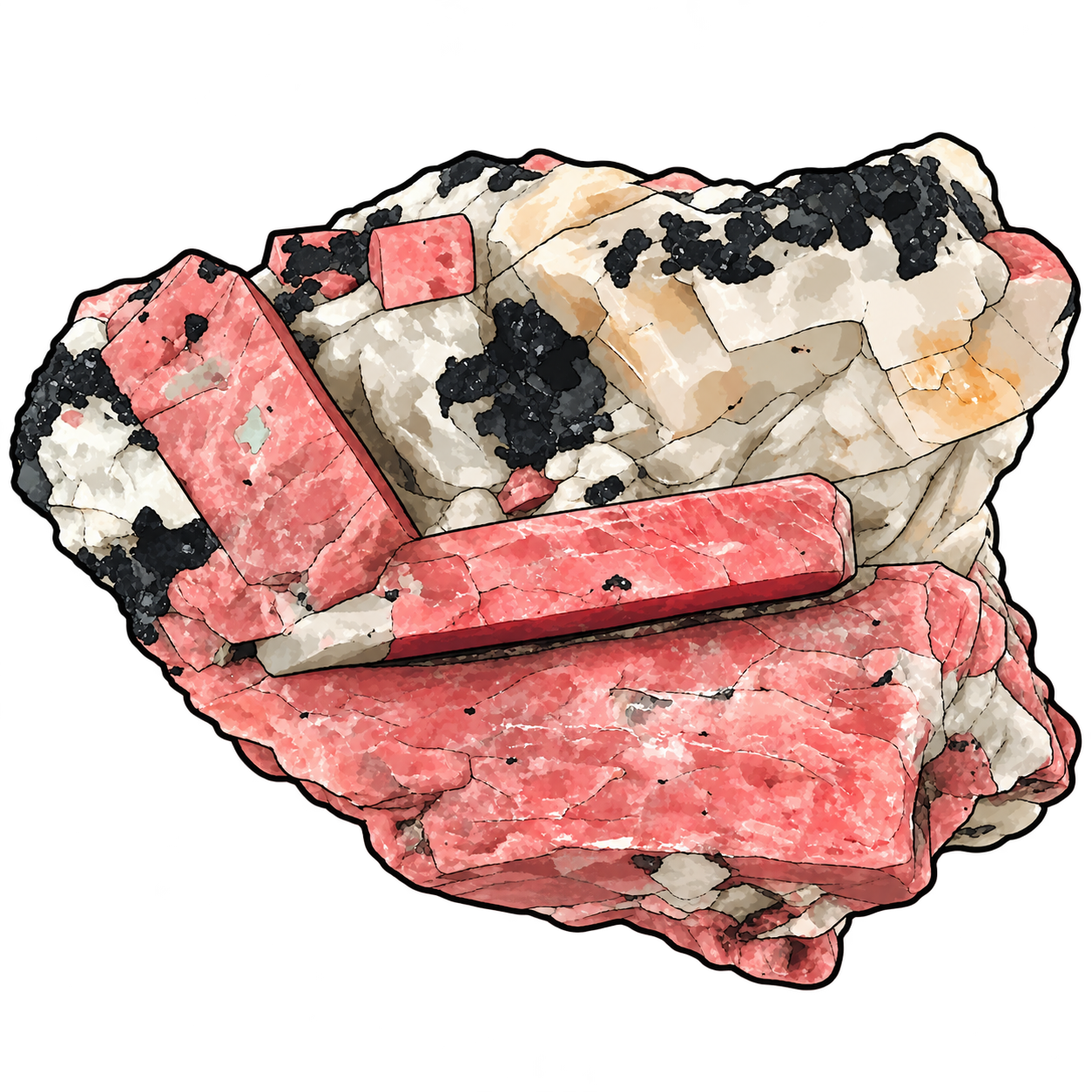
Manganese-rich silicate material, often pink with dark manganese oxides.
Mineral species; ornamental specimens may include other minerals
Loading this page…
Return homePlease wait while the next page arrives.


Rose-colored manganese silicate, with a complex mineral story behind the pink
Manganese-rich silicate material, often pink with dark manganese oxides.
Mineral species; ornamental specimens may include other minerals
Rhodonite appears in pink-and-black aggregates and transparent red crystals.
Geology · Human history · Spiritual attributes
The Crystal Council associates rhodonite with self-love, generosity, compassion, and confidence, and places it within heart- and root-chakra practice. It also gives the stone a role in reflecting on dreams and inner experience. These are contemporary spiritual correspondences, not conclusions about the action of manganese silicate on the body. [3]
A rhodonite kept near a journal can mark the intention to balance care for oneself with care for others. Its role is symbolic and chosen. It is not a treatment for anxiety or depression.
Rhodonite's typical hardness is 5.5–6.5, and measured density is approximately 3.57–3.76 g/cm³. It has strong cleavage, a glassy luster, and a white streak. Its external surfaces may become blackened by manganese oxides. These dark areas are associated material or alteration, not a requirement that every rhodonite crystal must contain black stripes. [1]
The mineral's modern name has a more precise chemical meaning than the convenient older shorthand MnSiO₃. A 2019 IMA-approved nomenclature study distinguishes calcium-bearing rhodonite from related ferrorhodonite and vittinkiite according to the elements occupying specific structural sites. Rhodonite's ideal end-member is CaMn₃Mn[Si₅O₁₅], also written CaMn₄Si₅O₁₅. [4]
This is not merely an alternate spelling of the same formula. Mineral names can become more precise as structure and composition are resolved. An old label may remain useful evidence of collecting history while requiring analytical work before a narrower species assignment is certain.
Hardness is also not the whole durability story. Cleavage makes an otherwise attractive transparent crystal difficult to cut and vulnerable to a well-placed knock. Faceted rhodonite is often better approached as a collector's gemstone than as material for an exposed, everyday ring. [2]
Rhodonite is associated with manganese-bearing deposits produced or modified by hydrothermal, metamorphic, and sedimentary processes. Documented localities include the Urals, Broken Hill in Australia, Franklin in New Jersey, and Morro da Mina in Brazil. The surrounding minerals and geological setting vary, so one formation account should not be imposed on every occurrence. [1]
At Tanatz Alp in Switzerland, a 2020 study examined ornamental rocks containing rhodonite together with pyroxmangite and other manganese-rich minerals. Some visually pink portions were mixtures rather than pure rhodonite. The researchers also emphasized that the original outcrop supplying the studied boulders had not been identified. A well-researched locality can therefore still contain real geological uncertainties. [2]
For a collector, that example explains why a polished “rhodonite” can be a rock dominated by several components. It also cautions against treating a trade label as a complete mineral analysis. The pattern may be genuinely natural while the whole object is not a single mineral species.
A study of transparent Broken Hill material identified inclusions of sphalerite, galena, quartz, and fluorite, as well as hollow tubes and cavities shaped like the host crystal. Some three-phase inclusions contained saline liquid, nitrogen and methane gas, and ilmenite. [5]
Those microscopic features provide evidence about a specimen's growth history. They are not necessarily visible in a shop photograph and should not be assigned to another stone simply because it is also called rhodonite. In a transparent collectible, an inclusion can be a point of interest rather than something to dismiss automatically as a flaw.
Rhodonite and rhodochrosite share rose-related names and may appear together, but rhodochrosite is a carbonate rather than a chain silicate. Pyroxmangite is a more demanding look-alike: its closely related structure can require laboratory techniques to distinguish it reliably. [2]
Treatment disclosure matters even for unusual collector gems. In 2021, GIA documented an 11.32-carat transparent rhodonite with material in fractures that enhanced its apparent clarity. Trapped bubbles helped demonstrate the treatment. Its geographical origin remained unknown; similar needle-like inclusions elsewhere were not sufficient to assign one. [6]
That case offers two useful buying principles: impressive transparency does not prove an untreated stone, and visual resemblance does not prove a locality. Ask separately about identity, treatments, and documented origin. A seller who can answer one of these questions may not have evidence for all three.
With an ornamental aggregate, judge the pink-and-dark pattern as a composition across the whole object. Inspect the polish where contrasting materials meet and check whether a dark line is solid mineral or an open crack. With a crystal, look at the survival of faces and edges, and request disclosure of repairs or fracture filling.
Keep pieces apart from harder jewelry and protect thin projections. For an unfamiliar specimen or a potentially filled gem, choose gentle dry dusting and consult the maker before wet cleaning. Avoid heat, steam, and ultrasonic treatment unless a qualified professional has assessed the particular object. The attractive pink area is only one part of a specimen that may include softer matrix, old fractures, or restoration materials.
handbookofmineralogy.org · Reference for the accompanying text · Reference recorded October 15, 2026
gia.edu · Reference for the accompanying text · Reference recorded October 15, 2026
thecrystalcouncil.com · Reference for the accompanying text · Reference recorded October 15, 2026
doi.org · Reference for the accompanying text · Reference recorded October 15, 2026
gia.edu · Reference for the accompanying text · Reference recorded October 15, 2026
gia.edu · Reference for the accompanying text · Reference recorded October 15, 2026