Ancient carbon-rich rock with a complex microscopic identity
Shungite
Name used for carbon-rich mineraloid and carbon-bearing rock from Karelia.
Carbon-rich geological material and rock assemblages
Loading this page…
Return homePlease wait while the next page arrives.


Ancient carbon-rich rock with a complex microscopic identity
Name used for carbon-rich mineraloid and carbon-bearing rock from Karelia.
Carbon-rich geological material and rock assemblages
Shungite belongs to a family of dark, carbon-bearing rocks rather than to one simple, uniform crystal species.
Geology · Human history · Spiritual attributes
Grounding, protection, energetic clearing and a sense of steadiness in contemporary practice. [5]
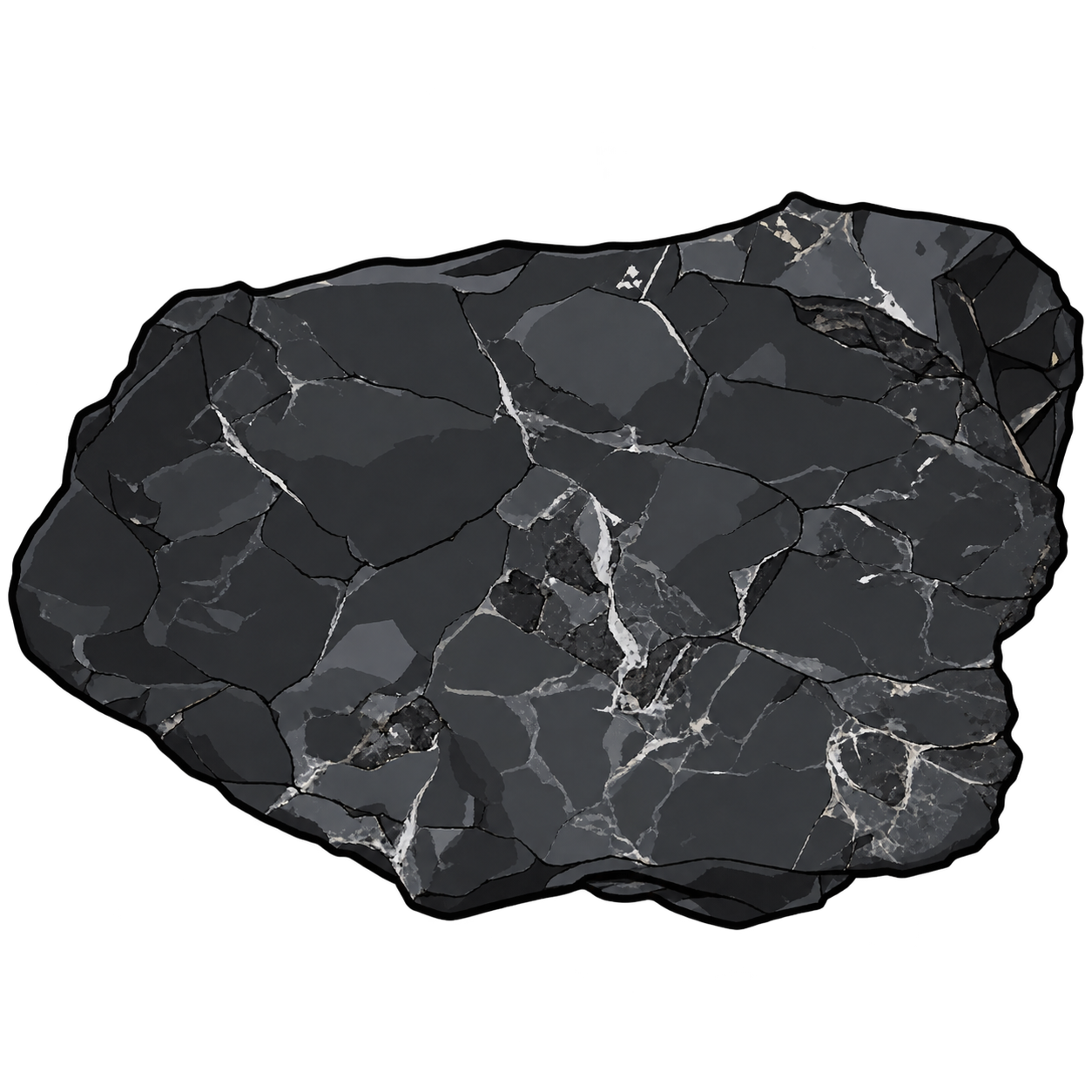
Shungite belongs to a family of dark, carbon-bearing rocks rather than to one simple, uniform crystal species. Some pieces are dull and stony; unusually carbon-rich material may have a bright, almost metallic surface. Its scientific interest lies in the arrangement and origin of its carbon, while its collecting appeal often rests on the spare contrast of black surfaces and pale mineral veins.
The Crystal Council presents shungite as a protective, grounding stone and an aid to clearing unwanted energy. It relates the material to all seven principal chakras. Within that framework, the dark stone functions as a symbol of boundaries and stability rather than as an ornamental display of bright color. [5]
These spiritual associations are distinct from claims about detoxification, drinking-water purification or protection from electronic devices. A personal grounding practice does not require accepting those claims. Someone may use the object as a reminder to pause, reconnect with their surroundings or establish a boundary, without treating it as a medical intervention or radiation shield.
The classic Karelian occurrences include rocks with very different carbon concentrations. Buseck and colleagues' 1997 study describes localized, highly carbon-rich bodies within a much larger carbon-bearing rock sequence. The glassy material they examined was brittle, conductive, relatively light and around 3.5 on the Mohs scale. Those measurements should not be copied indiscriminately onto every product sold as shungite. [1]
The carbon is also not simply a miniature deposit of diamond or well-crystallized graphite. A 2001 X-ray and transmission-electron-microscopy study by Kovalevski, Buseck and Cowley investigated its poorly ordered structure across different samples. The important distinction is between the rock, which can contain several constituents, and the structure of the carbon within it. A single tidy chemical formula conceals that distinction. [2]
For an individual specimen, the useful questions are its documented locality, the nature of its matrix and whether any analytical carbon-content claim accompanies it. Blackness or a silvery sheen is not a laboratory assay. Neither does the word “elite” supply one: it is a trade designation, and a quantitative claim needs an actual measurement tied to the material being sold.
The well-studied rocks around Shunga near Lake Onega belong to an approximately two-billion-year-old geological succession. That is regional geological context, not a direct age measurement made on a retail carving. Buseck and colleagues found evidence consistent with local redistribution of carbon, but the authors themselves differed over the ultimate origin indicated by their data. Presenting that paper as unanimous proof of a single origin would erase a real scientific distinction. [1]
Preserving the uncertainty makes the subject more informative. The age of the enclosing rocks, movement of carbon within them and microscopic organization of that carbon are separate lines of investigation. They need not all be settled by one appealing origin story.
FULLERENES: A REAL DISCOVERY WITH LIMITS Fullerenes are closed carbon structures, familiar from the cage-shaped C60 molecule. Parthasarathy and colleagues reported fullerene evidence in a specific Kondopoga shungite sample in 1998, using several analytical methods. Their paper also discussed earlier reports and unsuccessful detection in other samples. The result is scientifically interesting precisely because it is a sample-based finding, not a blanket certification of all shungite. [3]
“Fullerene-like,” “contains carbon” and “contains a measured amount of isolated fullerene molecules” do not mean the same thing. A product description should not move silently between those terms. Nor does a molecular identification establish a therapeutic effect in a person wearing the rock. The geological material can be appreciated without turning every research finding into a consumer benefit.
A study published in the Journal of Water and Health examined shungite in drinking-water treatment and found that tested samples released several metals into water. This does not quantify every specimen, but it is enough to reject the assumption that an untested decorative piece is automatically suitable for drinking-water use. Do not prepare an elixir from a shop stone or rely on it as a replacement for a certified treatment system. [4]
Likewise, electrical conductivity in a material and useful shielding in an engineered assembly are not evidence that a loose stone beside a telephone protects its owner. Shape, placement, frequency and testing matter to an engineering claim. Spiritual symbolism should not be used as a substitute for that evidence.
Handle thin edges gently and protect polished surfaces from abrasion. A soft dry cloth is a sensible first option for an uncharacterized specimen; avoid soaking and chemical treatments intended to “activate” it. Keep a record of any supplier assay or locality rather than relying on appearance alone.
Shungite's value as a study object comes from the questions it preserves: how carbon accumulated, how it changed and what structures formed within it. Those questions remain compelling without exaggerated promises.
rruff.net · Reference for the accompanying text · Reference recorded October 15, 2026
sciencedirect.com · Reference for the accompanying text · Reference recorded October 15, 2026
sciencedirect.com · Reference for the accompanying text · Reference recorded October 15, 2026
doi.org · Reference for the accompanying text · Reference recorded October 15, 2026
thecrystalcouncil.com · Reference for the accompanying text · Reference recorded October 15, 2026