The red mineral beneath a metallic surface
Hematite
Iron oxide (Fe2O3).
Mineral species; ornamental specimens may include other minerals
Loading this page…
Return homePlease wait while the next page arrives.


The red mineral beneath a metallic surface
Iron oxide (Fe2O3).
Mineral species; ornamental specimens may include other minerals
Hematite can be a polished dark mirror, a cluster of steel-gray plates, a rounded brown mass, or a fine red earth.
Geology · Human history · Spiritual attributes
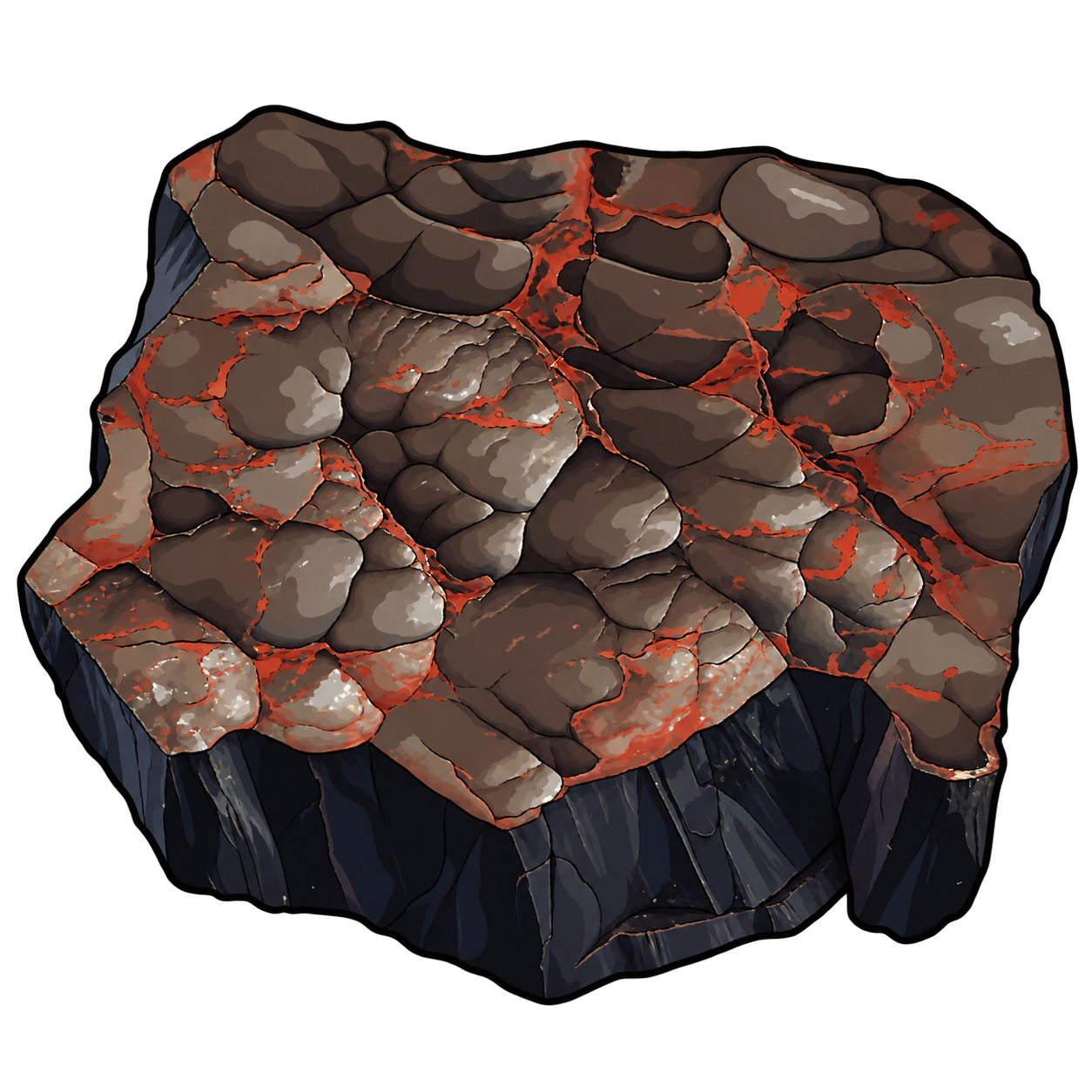
Hematite can be a polished dark mirror, a cluster of steel-gray plates, a rounded brown mass, or a fine red earth. Those appearances belong to the same iron oxide, Fe2O3. Texture changes the way the material reflects light, while its characteristic red to reddish-brown streak provides a link between forms that otherwise seem unrelated. [1]
The Crystal Council associates hematite with grounding, sustained attention, and returning to practical responsibilities. Its root-chakra and earth correspondences give these ideas a contemporary spiritual vocabulary. The stone is presented as an anchor for meditation and intention, not as evidence that iron oxide physically draws away unwanted thoughts. [2]
A short pause with a specimen can mark an intention to become less distracted. The practice is symbolic; it does not establish treatment for a medical condition or a protective force field. Hematite's documented ancient uses also deserve their own context rather than being folded into a single timeless chakra tradition.
Hematite is the alpha form of Fe2O3 and belongs to the trigonal division of the hexagonal crystal family. Crystals may be tabular, rhombohedral, or arranged in rosettes; fine-grained material can instead be dull and earthy. The handbook records hardness around 5–6, measured density 5.26, and brittle behavior. Parting related to twinning should not be confused with a simple statement that every specimen has easy cleavage. [1]
Its relatively high density explains why a compact piece can feel unexpectedly heavy, but weight and metallic luster are not unique identifiers. The red-brown powder is more diagnostic, yet a finished carving or bead need not be scratched to demonstrate it. Professional identification can preserve the object while distinguishing it from a lookalike.
The name refers to blood-red color, not to a proven effect on human blood. A mineral's iron content is not a reason to ingest it or treat it as a nutritional supplement.
Hematite occurs through several geological routes: in certain igneous and metamorphic rocks, hydrothermal veins, iron formations, sedimentary cements, and weathered iron-bearing materials. A red coating and a metallic rosette therefore need not have formed in the same way. [1]
Its significance in planetary geology also depends on context. NASA's account of Opportunity's 2004 detection of gray hematite at Meridiani Planum explicitly notes that terrestrial hematite can form in water-associated settings but also in volcanic environments without water. Identifying the mineral was a reason to investigate its origin, not an automatic proof of one formation process. [6]
That distinction applies equally to a terrestrial collection. Mineral identity is one part of the interpretation; texture, associated minerals, and the surrounding rock provide the rest. A specimen label should not claim a lake deposit, volcanic origin, or mine solely because the material contains hematite.
The Metropolitan Museum of Art holds a 2.2-centimeter hematite heart amulet from Egypt's Late Period, dated 664–332 BCE. [3]
Beside a separate red-jasper example, the museum explains the heart amulet's wider meaning: the heart was understood as a seat of thought, memory, feeling and action, and could testify at judgment before Osiris. The amulet was intended to protect the organ and secure favorable testimony. This context concerns the amulet form, not a claim that all hematite shared one universal spiritual meaning. [4]
A 2000 Gems & Gemology report examined jewelry sold as hematite. Some necklace beads were genuine hematite and only weakly attracted to a magnet. Bracelet beads that clung strongly to one another proved to be manufactured barium iron oxide. Laboratory analysis, not magnetic behavior alone, established the distinction. [5]
This case is more useful than the absolute rule that any magnetic response means fake hematite. Weak attraction can occur in genuine commercial material, while strongly self-attracting beads warrant further investigation. A trade label such as magnetic hematite does not guarantee the natural mineral.
Ask whether a seller is describing natural hematite, a manufactured magnetic material, or another iron-rich stone. A decorative or magnetic object can be useful without being mislabeled. Honest material disclosure protects both its practical use and its collecting value.
Keep polished pieces separate from harder stones and metal edges. Thin plates, rosette margins, and earthy aggregates require gentler handling than a compact bead. Avoid dropping them or testing a specimen by striking it.
Use a soft cloth for a stable polished surface. Do not aggressively wash an earthy specimen or a mixed matrix whose components are unknown. Avoid heat, ultrasonic cleaning, and solvents where repairs, coatings, or delicate intergrowths may be present. Keep powdery material contained rather than brushing it into the air.
A collection record should preserve the material determination, locality, condition, and any treatment. For an archaeological object, provenance and conservation requirements are especially important; a general mineral-cleaning suggestion is not an appropriate treatment plan for an antiquity.
handbookofmineralogy.org · Reference for the accompanying text · Reference recorded October 15, 2026
thecrystalcouncil.com · Reference for the accompanying text · Reference recorded October 15, 2026
metmuseum.org · Reference for the accompanying text · Reference recorded October 15, 2026
metmuseum.org · Reference for the accompanying text · Reference recorded October 15, 2026
gia.edu · Reference for the accompanying text · Reference recorded October 15, 2026
science.nasa.gov · Reference for the accompanying text · Reference recorded October 15, 2026