Porous volcanic rock shaped by escaping gas and cooling melt
Lava Stone
Broad retail name, usually for vesicular volcanic rock.
Broad trade category for volcanic rock
Loading this page…
Return homePlease wait while the next page arrives.


Porous volcanic rock shaped by escaping gas and cooling melt
Broad retail name, usually for vesicular volcanic rock.
Broad trade category for volcanic rock
“Lava stone” is a broad commercial description rather than a precise mineral name.
Geology · Human history · Spiritual attributes
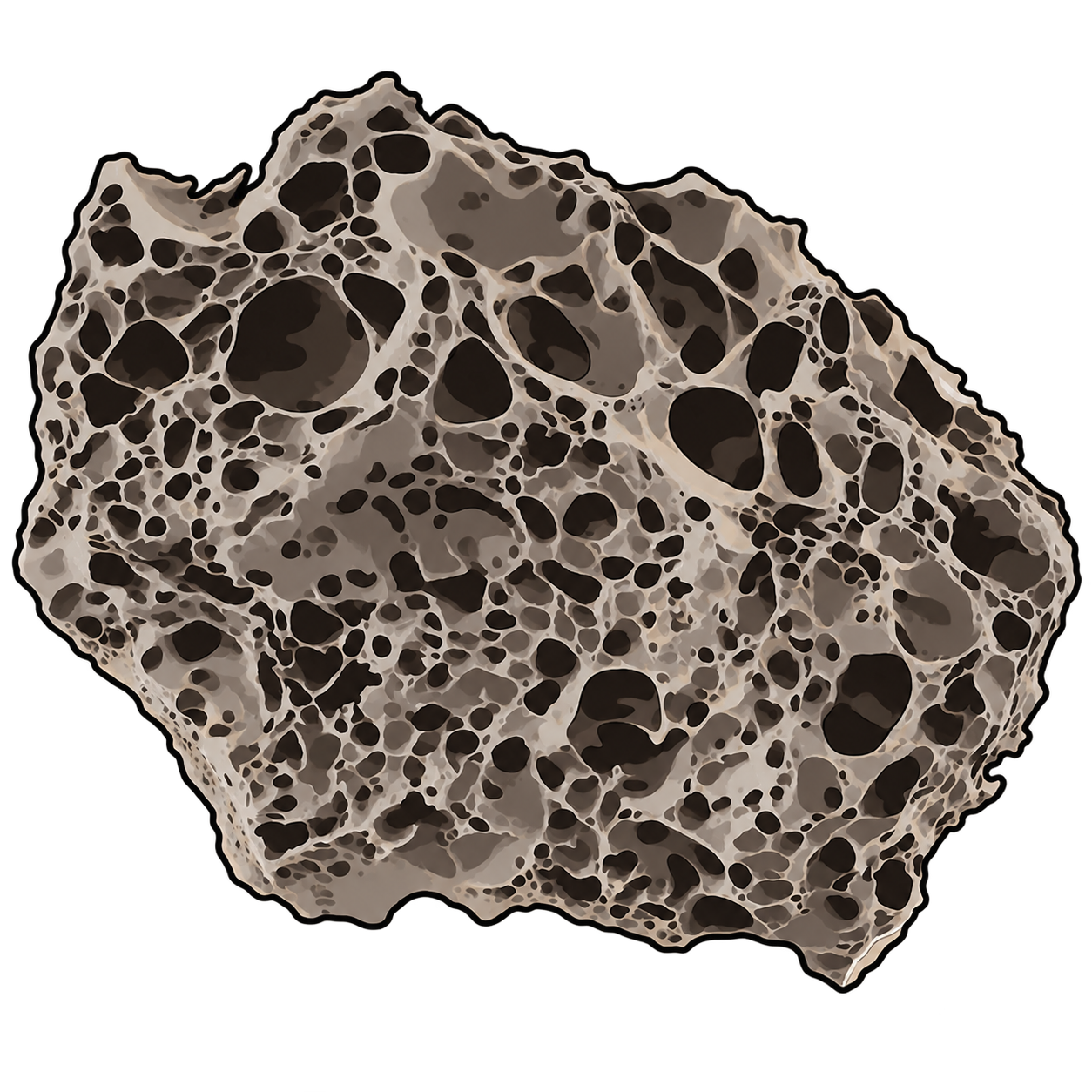
Grounding, resolve, transformation and new beginnings in contemporary crystal practice. [4]
“Lava stone” is a broad commercial description rather than a precise mineral name. In beads and small decorative objects it commonly refers to dark, porous volcanic rock whose cavities remain visible after shaping. Those holes are its defining texture: a solid surface records the former presence of gas within molten material. The trade name alone does not establish a volcano, eruption date, chemical composition or mineral species.
The Crystal Council associates lava rock with transformation and new beginnings, interpreting its volcanic origin through the elements of fire and earth. Its account also places the material within root-chakra practice and connects it with resolve. These are contemporary spiritual interpretations, not measurable consequences of a rock's eruption history.[4]
The symbolism is readily understood without turning it into a physical claim. Molten material becomes something solid enough to hold; a turbulent event leaves a stable object. Someone using lava stone contemplatively may take that contrast as a reminder to translate intention into a practical next step. Its rough texture can serve as an ordinary tactile focus. Neither the texture nor the volcanic origin establishes an ability to treat illness, remove harmful influences or improve the effects of an essential oil.
The National Park Service describes scoria as dark, highly vesicular volcanic material of mafic to intermediate composition. Vesicles are spaces left by gas separating from melt; they may be rounded, stretched or irregular. Scoria can occur among erupted fragments or in rapidly cooled portions of lava flows. “Cinder” is a less formal term commonly used for dark or reddish, air-cooled fragments.[1]
Pumice is also vesicular, but typically has a more delicate glassy structure and a different composition. Some pumice floats because of its abundant void space; porosity alone does not make every piece of lava stone float. These related textures should not be collapsed into one identification.[1]
A rock can contain several minerals and glass, so one formula, crystal system or exact hardness would be misleading for the whole object. The walls around cavities may chip even if their constituent minerals resist scratching. For a bead, the practical questions are whether thin partitions are sound, whether the drilled hole is intact and whether the surface has been coated. A uniform black finish is not sufficient evidence of a natural, untreated surface.
Sunset Crater in Arizona offers a specific example of volcanic deposits that should not be generalized into the origin of every commercial bead. The National Park Service dates its eruption to about 1085 CE and describes the cinder cone together with the Bonito and Kana'a lava flows. A lava flow can develop a solid outer crust while hotter material continues moving beneath it; the cooled landscape preserves more than one texture and more than one stage of movement.[2]
This context clarifies why a porous specimen is only a fragment of a larger story. A geological label can relate it to a flow or deposit, whereas a retail description such as “lava stone” usually cannot. A reliable locality adds information that the holes themselves do not supply.
The same eruption affected people already living in the region. The National Park Service describes displaced communities, buried homes and continuing connections between the landscape and descendant peoples. Sunset Crater became a national monument in 1930.[3]
Those facts are more meaningful than treating volcanic landscapes as empty sources of decorative material. A specimen's legal collecting history and locality should be retained where available. Cultural significance belongs to documented communities and places; it should not be borrowed to provide an unspecified lava bead with a universal sacred pedigree.
Porous surfaces trap dust and residues. Brush gently rather than forcing dirt farther into the cavities, and avoid aggressive scrubbing that can break thin edges. If a finished item can tolerate water, use a brief mild cleaning and allow it to dry thoroughly; stringing, adhesives and surface treatments may require different handling from the rock itself.
Do not assume a porous bead is suitable for ingestible preparations or that any oil applied to it is harmless to skin, finishes or nearby objects. Adding fragrance is a separate use decision, not an intrinsic mineral property. Store a rough specimen where loose particles cannot scratch polished stones, and protect bead strands from impacts that concentrate force at drill holes. The best presentation preserves the texture rather than filling or glossing it without disclosure.
nps.gov · Reference for the accompanying text · Reference recorded October 15, 2026
nps.gov · Reference for the accompanying text · Reference recorded October 15, 2026
nps.gov · Reference for the accompanying text · Reference recorded October 15, 2026
thecrystalcouncil.com · Reference for the accompanying text · Reference recorded October 15, 2026