Volcanic Glass, Sharp Edges and Reflective Depth
Obsidian
Natural volcanic glass, not a crystalline mineral.
Natural volcanic glass
Loading this page…
Return homePlease wait while the next page arrives.


Volcanic Glass, Sharp Edges and Reflective Depth
Natural volcanic glass, not a crystalline mineral.
Natural volcanic glass
Obsidian preserves a different outcome of cooling magma: glass rather than a framework of interlocking mineral grains.
Geology · Human history · Spiritual attributes
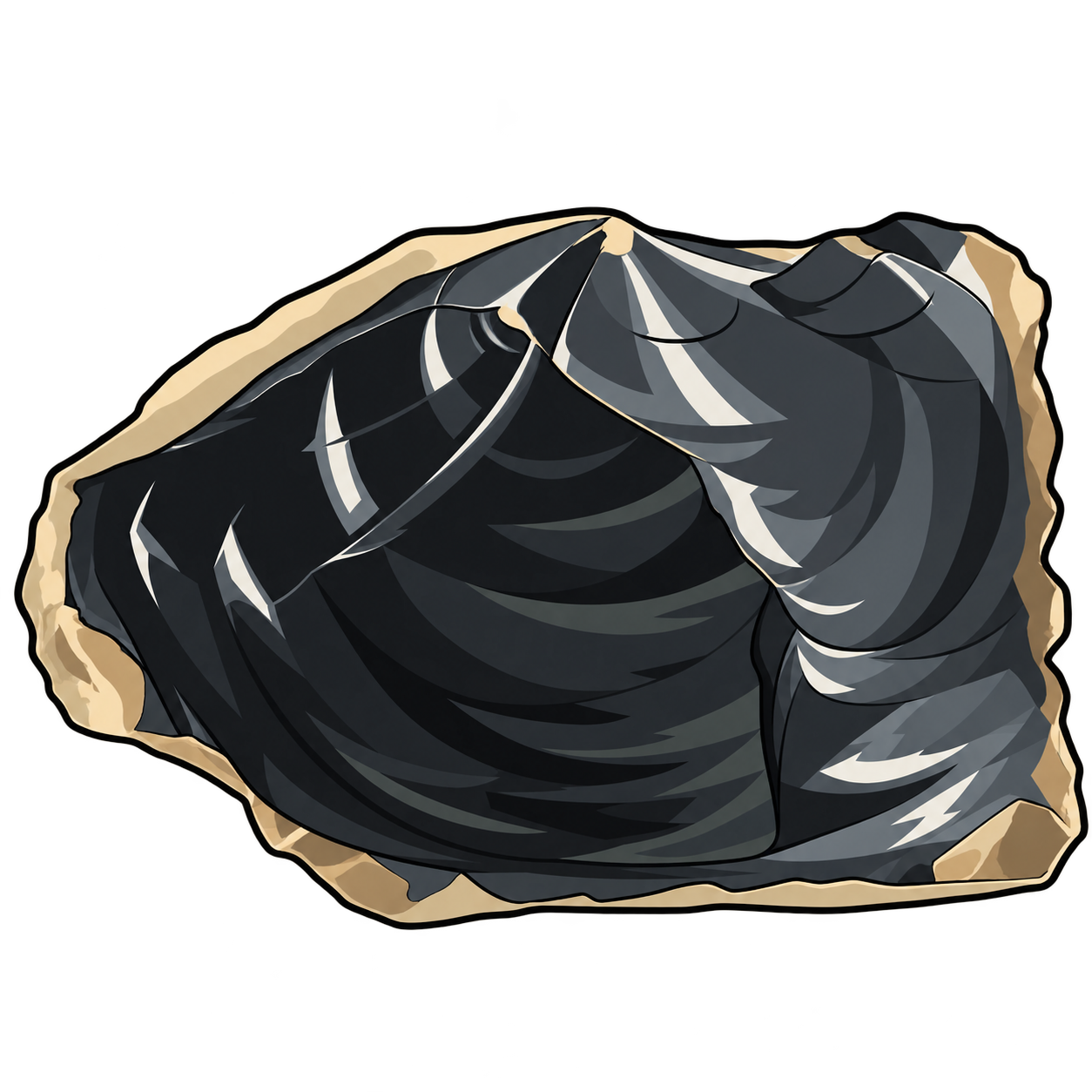
Obsidian preserves a different outcome of cooling magma: glass rather than a framework of interlocking mineral grains. Its dark surface can seem still and uniform, yet curved fractures, flow bands and microscopic inclusions record a lively geological history. A worked edge and a polished mirror reveal two very different possibilities within the same material. [1, 2]
Contemporary crystal traditions often associate black obsidian with grounding, protection and the willingness to confront uncomfortable truths. The Crystal Council also connects it with creativity and transformation. These are spiritual interpretations, not measured forces emitted by volcanic glass. [6]
A smooth stone or mirror may provide a focus for contemplation, but rough obsidian's sharp edges make it unsuitable for casual handling during a distraction. The significance of the object does not require placing a blade against skin or treating spiritual reflection as a substitute for practical support.
Unlike quartz, obsidian has no orderly, repeating crystal structure throughout its glassy body. Its chemistry is ordinarily close to rhyolite rather than pure silicon dioxide: it is a rock material with variable composition, not a mineral with one fixed formula. Tiny crystals can nevertheless occur within the glass. Calling the whole specimen glass does not require every microscopic inclusion to be amorphous. [1, 2]
Darkness is not the defining test. Iron-bearing inclusions and differences in oxidation can contribute black, brown, red or green tones. Some pieces are banded because a viscous melt did not thoroughly mix its bubbles or other internal features. A uniformly black polished stone, by itself, is not sufficient evidence of obsidian identity. [1]
The combination of a highly viscous, silica-rich melt and cooling can prevent extensive crystal growth. This helps explain why thick obsidian bodies are associated with particular volcanic compositions, rather than every lava flow. USGS contrasts these conditions with the generally more fluid basaltic magmas of Hawaiʻi. [1]
Glass is not necessarily permanent on geological timescales. Devitrification is its conversion toward crystalline material; alteration can also change it. The rate depends on chemistry, temperature and water. Friedman and Long's review records that slow alteration has nevertheless allowed some natural glass to persist for tens of millions of years. An old-looking surface is therefore not an age measurement, and a universal maximum age would oversimplify the record. [7]
Mahogany obsidian combines brown and black areas. Snowflake obsidian contains pale, radiating crystalline clusters within the glass. Sheen and rainbow varieties owe their effects to internal features interacting with light; these appearance names do not establish separate mineral species. [2]
Fire obsidian provides a more specific example. GIA's account of material from Glass Buttes, Oregon, describes thin layers rich in nanoscopic magnetite crystals. Interference involving these layers produces vivid color, and the lapidary must orient the cut to reveal it. A particularly striking cabochon is therefore the result of geological structure and informed cutting, not a colored coating by definition. [5]
This distinction also improves a description: a photograph should show how the stone behaves as it turns, rather than imply that an angle-dependent flash is visible continuously. Black bodycolor and a colorful reflection can coexist without contradiction.
Yellowstone's Obsidian Cliff was an important toolstone source for more than 11,000 years. The National Park Service describes its distribution far beyond the quarry, including material in the Hopewell archaeological record of the Ohio Valley. Such movement makes obsidian evidence of human relationships as well as volcanic activity. [3]
Geochemical sourcing compares an artifact with documented geological material. It can support an origin assignment that appearance alone cannot make. The interpretation still depends on the available reference sources, analytical method and archaeological context; a match does not independently describe every person or exchange through which an object passed.
A 2021 study examined several obsidian mirrors in the British Museum using portable X-ray fluorescence. The mirror associated with John Dee closely matched Pachuca obsidian from Mexico; other examined objects matched Ucareo. The authors place these objects within Aztec craftsmanship and the movement of objects into colonial Europe. [4]
The same study discusses mirrors in representations of Tezcatlipoca and the later European interpretation of an object associated with Dee. These are particular historical contexts, not a single universal meaning shared by everyone who used obsidian. Geological provenance and cultural biography answer different questions: where the glass originated is not the same as how a later owner understood it. [4]
Look for the relationship between a glassy surface, curved fractures, banding and any crystalline or vesicular features. Conchoidal fracture can create extremely sharp edges. It is an observation to make with care, not an invitation to break a specimen for identification. [1, 2]
For a purchased piece, retain the stated locality and any information about treatment or manufacture. An attractive black glass sold without provenance should not acquire a famous quarry name merely because the appearance seems plausible. Likewise, an archaeological-looking form is not proof of antiquity; provenance matters especially when a specimen may also be a cultural object.
Keep chipped edges away from fingers and separate loose pieces so that they cannot strike one another. Choose a stable support for rough material and a protected position for polished objects. A clean, soft cloth is preferable to abrasive polishing intended to remove a mark whose cause is unknown.
Avoid impacts, sudden heating and improvised scratch tests. Obsidian's capacity to take a sharp edge is precisely why a dropped or fractured decorative object deserves careful handling. For an old worked object or an artifact, preserve its surface and consult an appropriate conservator rather than attempting to restore a modern shine.
usgs.gov · Reference for the accompanying text · Reference recorded October 15, 2026
geology.com · Reference for the accompanying text · Reference recorded October 15, 2026
nps.gov · Reference for the accompanying text · Reference recorded October 15, 2026
cambridge.org · Reference for the accompanying text · Reference recorded October 15, 2026
gia.edu · Reference for the accompanying text · Reference recorded October 15, 2026
thecrystalcouncil.com · Reference for the accompanying text · Reference recorded October 15, 2026
usgs.gov · Reference for the accompanying text · Reference recorded October 15, 2026