Mineral-filled fractures within a sedimentary concretion
Septarian Nodules
Concretions with internal cracks and later mineral fillings.
Fractured and mineral-filled sedimentary concretion
Loading this page…
Return homePlease wait while the next page arrives.


Mineral-filled fractures within a sedimentary concretion
Concretions with internal cracks and later mineral fillings.
Fractured and mineral-filled sedimentary concretion
Septarian is a name for a patterned concretion, not a separate mineral species.
Geology · Human history · Spiritual attributes
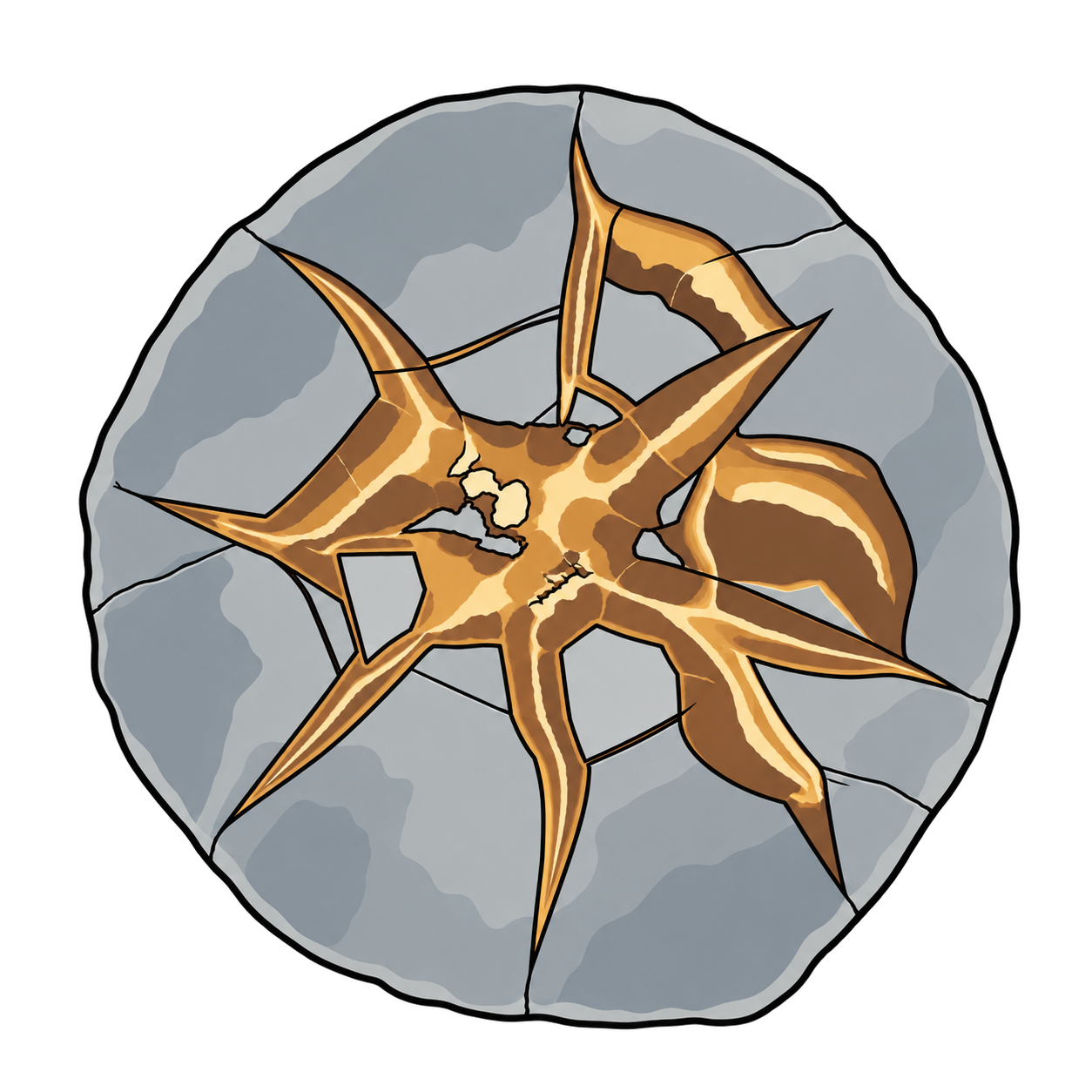
A sedimentary concretion with internal mineral-filled fractures. [1]
Concretions and composite decorative rocks. [1]
Commonly gray or brown host material divided by contrasting calcite-rich veins; composition varies. [1]
Grounding, protection, steadiness during transition and dream reflection in contemporary crystal practice. [3]
Septarian is a name for a patterned concretion, not a separate mineral species. Its appeal comes from contrast: a subdued host rock is divided by brighter mineral-filled cracks, often producing the appearance of a branching map or a network of golden seams. Cutting a nodule exposes this interior architecture; the familiar polished sphere or egg is a lapidary shape rather than the original form of an animal or its egg.
The Crystal Council associates septarian with grounding and protection, placing it within a root-chakra framework and connecting it with personal change, dreams and past-life reflection. These associations describe the source's contemporary practice. They do not establish that septarian grants access to past lives or that its minerals exert a protective force.[3]
The stone's visible structure offers an unusually direct symbolic focus. Fractures that once separated areas of the nodule now form its most conspicuous pattern. A practitioner may read this as a reminder that disruption can become part of a coherent whole rather than something that must be hidden. Grounding, in this setting, can mean returning attention to the present before reflecting on change. This is metaphorical interpretation rather than a guaranteed outcome.
A concretion forms when cement binds sediment into a localized body. In a septarian concretion, internal cracks later become filled, partly or completely, by minerals. The name identifies the fractured structure. It does not require a fixed recipe of three ingredients, nor does it make limestone itself a mineral.
British Geological Survey descriptions of Oxford Clay concretions document gray, fine-grained, clay-bearing limestone nodules with calcite veins and, in some examples, pyritic margins. The same memoir records contrasting fossil preservation: some nodules contain relatively uncrushed fossils, whereas another bed contains crushed material. Such differences help geologists assess whether cementation occurred before or after substantial compaction.[1]
Consequently, a septarian's physical behavior belongs to the entire composite. Veins, host material and any open cavities need not have equal strength. A glossy polish is a surface finish, not proof that the nodule is free of weaknesses. There is no single chemical formula or crystal system for septarian as a whole; those properties belong to its individual minerals.
Septarian fractures should not automatically be explained as surface mud cracks produced by drying in the sun. T. R. Astin's study of carbonate concretions from shale and mudstone proposed tensile fracturing during burial and compaction, involving high internal fluid pressure and low horizontal stress. Its examples include the London Clay and Kimmeridge Clay; some fractures were interpreted to form at roughly 50 metres of burial.[2]
That study provides a mechanism for particular geological settings, not a depth or age applicable to every decorative nodule. The useful distinction is between the formation of the concretion, the opening of cracks and the later precipitation of vein minerals. A polished piece displays the results together, but they need not have happened simultaneously.
A central vein that divides into finer branches gives a different visual impression from a network of similarly sized compartments. An open cavity may preserve projecting crystals, while a fully filled seam can be cut flush with its host. These features should be described individually rather than assuming every nodule contains a hollow crystal chamber.
Cut orientation also matters. Two slices from one irregular three-dimensional network may look surprisingly different, and a sphere exposes the pattern across several orientations at once. The pattern is therefore a record of internal structure revealed by cutting, not a painted outline or a standardized design repeated throughout the rock.
“Dragon egg” is a modern ornamental name sometimes applied to egg-shaped septarian pieces. It describes presentation, not biological origin. A locality or geological formation, when documented, is more informative than a generalized claim that all septarians formed in one period or in the same ancient sea.
Dust with a soft brush, taking care around crystal-lined openings. Avoid acidic cleaners and abrasive scrubbing. Keep water exposure brief if the piece contains porous host material, repairs or an uncertain surface treatment; dry it carefully afterward. A large sphere needs a stable stand, and a split nodule should rest on a support that does not press against thin crystal edges. Its strongest visual feature—the contrast between seams and host—is also a reason to treat it as a mixed material rather than an indestructible solid.
webapps.bgs.ac.uk · Reference for the accompanying text · Reference recorded October 15, 2026
cambridge.org · Reference for the accompanying text · Reference recorded October 15, 2026
thecrystalcouncil.com · Reference for the accompanying text · Reference recorded October 15, 2026