The carbonate that builds in another way
Aragonite
A calcium-carbonate polymorph distinct from calcite.
Orthorhombic calcium carbonate mineral species and aggregate forms
Loading this page…
Return homePlease wait while the next page arrives.


The carbonate that builds in another way
A calcium-carbonate polymorph distinct from calcite.
Orthorhombic calcium carbonate mineral species and aggregate forms
Aragonite and calcite have the same chemical formula but different atomic arrangements.
Geology · Human history · Spiritual attributes
Calcium carbonate, CaCO₃. [2]
Orthorhombic carbonate mineral; aragonite group. [2]
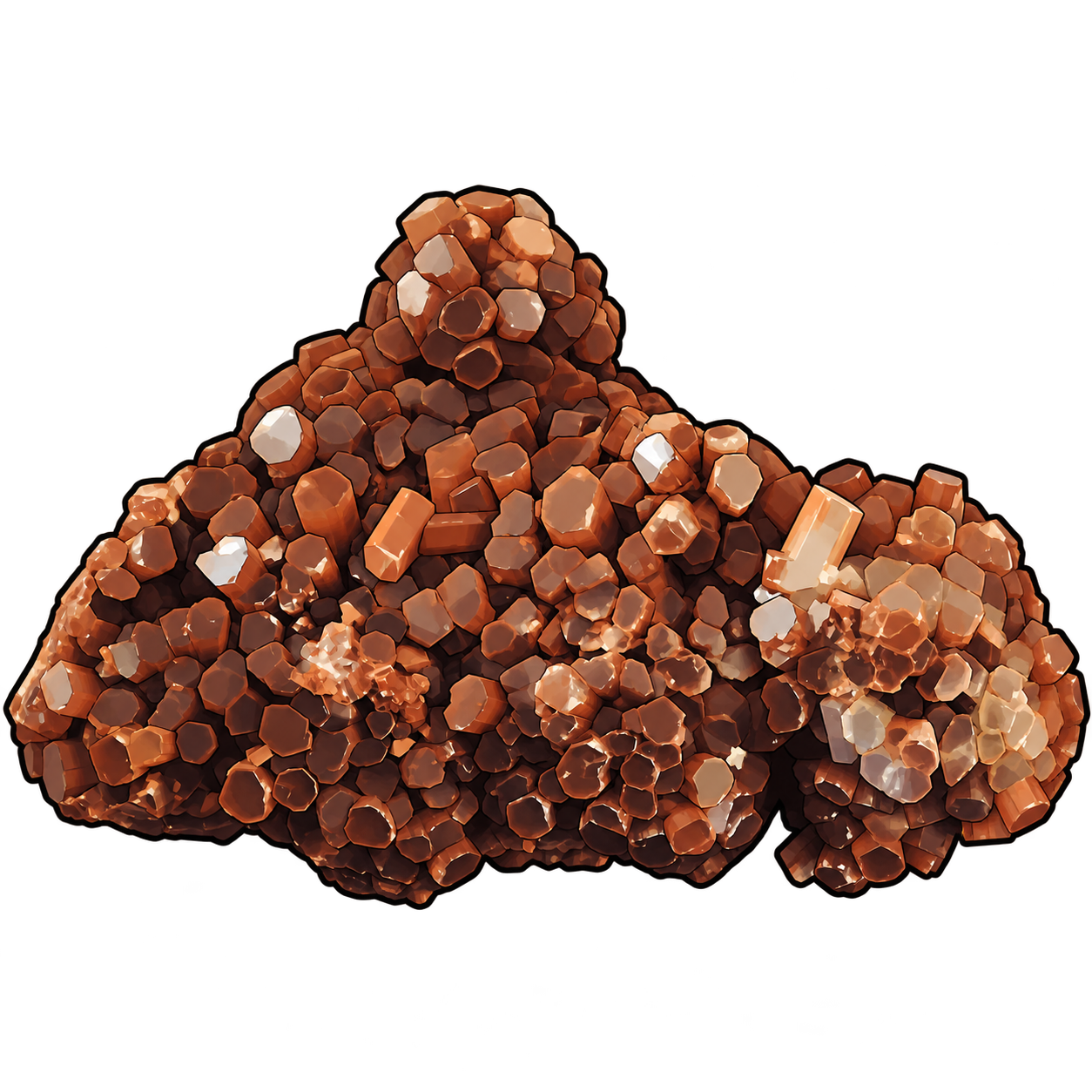
Radiating clusters, apparently six-sided twins, needles, crusts and banded masses. [2]
Grounding, inner balance, focus, confidence and connection with nature in contemporary crystal practice. [1]
Modern crystal practice associates aragonite with steadiness and the integration of competing concerns. The Crystal Council places it within a whole-chakra balancing framework, connecting the stone with deliberate change and a stronger sense of personal direction. These are spiritual interpretations rather than measured effects of calcium carbonate. [1]
A radiating cluster supplies a particularly apt visual image: many outward directions joined within one structure. For contemplation, a fragile specimen can rest securely nearby rather than being held by its projecting crystals. The practice gives attention a visible focus while respecting the object's delicate form.
Aragonite and calcite have the same chemical formula but different atomic arrangements. Aragonite is orthorhombic, whereas calcite is trigonal. This relationship is called polymorphism: chemical composition alone is not enough to identify the mineral structure. [2]
Aragonite has Mohs hardness 3.5–4, density near 2.95 g/cm³, glassy lustre and distinct cleavage. Brittle crystals form needles, prisms or plates; aggregates may be fibrous or branching. Repeated twinning can produce an apparently six-sided outline within this orthorhombic mineral. [2]
The mineral occurs in marine deposits, hot springs and caves, and in some high-pressure, low-temperature metamorphic rocks. Living organisms also construct shells and skeletal parts from it. These settings produce materials with very different textures, from a free-growing crystal to a finely organized biological composite. [2]
The familiar brown radiating clusters sold as “Sputnik aragonite” are aggregates, not a separate mineral species. Looking closely at the ends and intersections reveals how individual growths contribute to the whole. Pseudohexagonal twins can appear as compact columns, while needle-like material produces a completely different silhouette. [1,2]
In caves, aragonite often forms frostwork: delicate sprays resembling ice crystals or spiny plants. The National Park Service notes that similar-looking frostwork can also consist of calcite, gypsum or other minerals. The term describes a formation's appearance, while identification determines its substance. Aragonite frostwork frequently grows from other deposits, creating fine needles at the tips of rounded cave features. [3]
These forms help explain why specimens should be compared at more than one scale. The outline of a whole cluster, the shape of an individual crystal and the texture of a polished surface reveal different information. A colour name or familiar commercial silhouette can be useful descriptively without being a complete identification.
Nacre—the layered material commonly called mother-of-pearl—contains aragonite tablets organized with organic components. In a 2021 study, Jiseok Gim and colleagues examined cross-sections through small Akoya keshi pearls. They found that growth can compensate for irregularities: an unusually thick tablet tends to be followed by a thinner one, and vice versa. [4]
The resulting order is neither random nor perfectly repetitive across the entire pearl. Local corrections preserve a consistent structure over intermediate distances even while defects and fluctuations persist. This explains why nacre is scientifically interesting as a constructed material, not simply as calcium carbonate with an attractive surface. Its organization emerges during biological growth and has inspired research into synthetic composites. [4]
Different organisms use the carbonate minerals differently. Natural History Museum researchers describe bryozoan groups with calcitic, partly aragonitic or fully aragonitic skeletons. Their work examines how these choices relate to seawater chemistry and acidification. Aragonite is more soluble than calcite under comparable relevant conditions, so the identity of the skeletal mineral matters when assessing environmental change. [5]
Aragonite was named by Abraham Gottlob Werner in 1797 for Molina de Aragón, Spain. Mindat explicitly distinguishes the town from the province of Aragón, an often-repeated geographical confusion. The name records a particular place in mineralogical history, while the mineral itself occurs widely. [6]
Aragonite is metastable relative to calcite under ordinary surface conditions and can convert to calcite over geological time. Transformation does not mean that a carefully stored specimen must rapidly fall apart; it describes a relationship between structures and changing conditions. In old carbonate material, the present mineral can differ from the one that originally formed, making mineral identification and interpretation of the original shape complementary parts of the record. [6]
Support the main body, leave projections clear of pressure, and avoid acids, abrasion and vigorous cleaning. Dust gently around a sound base. [2,5]
Keep the locality and any treatment information with the specimen. A careful record preserves the distinction between a naturally grown cluster, a polished carbonate object and an organism-built material—three ways in which the same mineral can enter a collection.
thecrystalcouncil.com · Reference for the accompanying text · Reference recorded October 15, 2026
handbookofmineralogy.org · Reference for the accompanying text · Reference recorded October 15, 2026
nps.gov · Reference for the accompanying text · Reference recorded October 15, 2026
pmc.ncbi.nlm.nih.gov · Reference for the accompanying text · Reference recorded October 15, 2026
nhm.ac.uk · Reference for the accompanying text · Reference recorded October 15, 2026
mindat.org · Reference for the accompanying text · Reference recorded October 15, 2026