Ancient marine life preserved within carbonate rock
Fossil Limestone
Carbonate rock containing visible fossils.
Fossil-bearing sedimentary carbonate rock
Loading this page…
Return homePlease wait while the next page arrives.


Ancient marine life preserved within carbonate rock
Carbonate rock containing visible fossils.
Fossil-bearing sedimentary carbonate rock
Fossil limestone holds the remains of organisms within the stone that accumulated around them.
Geology · Human history · Spiritual attributes
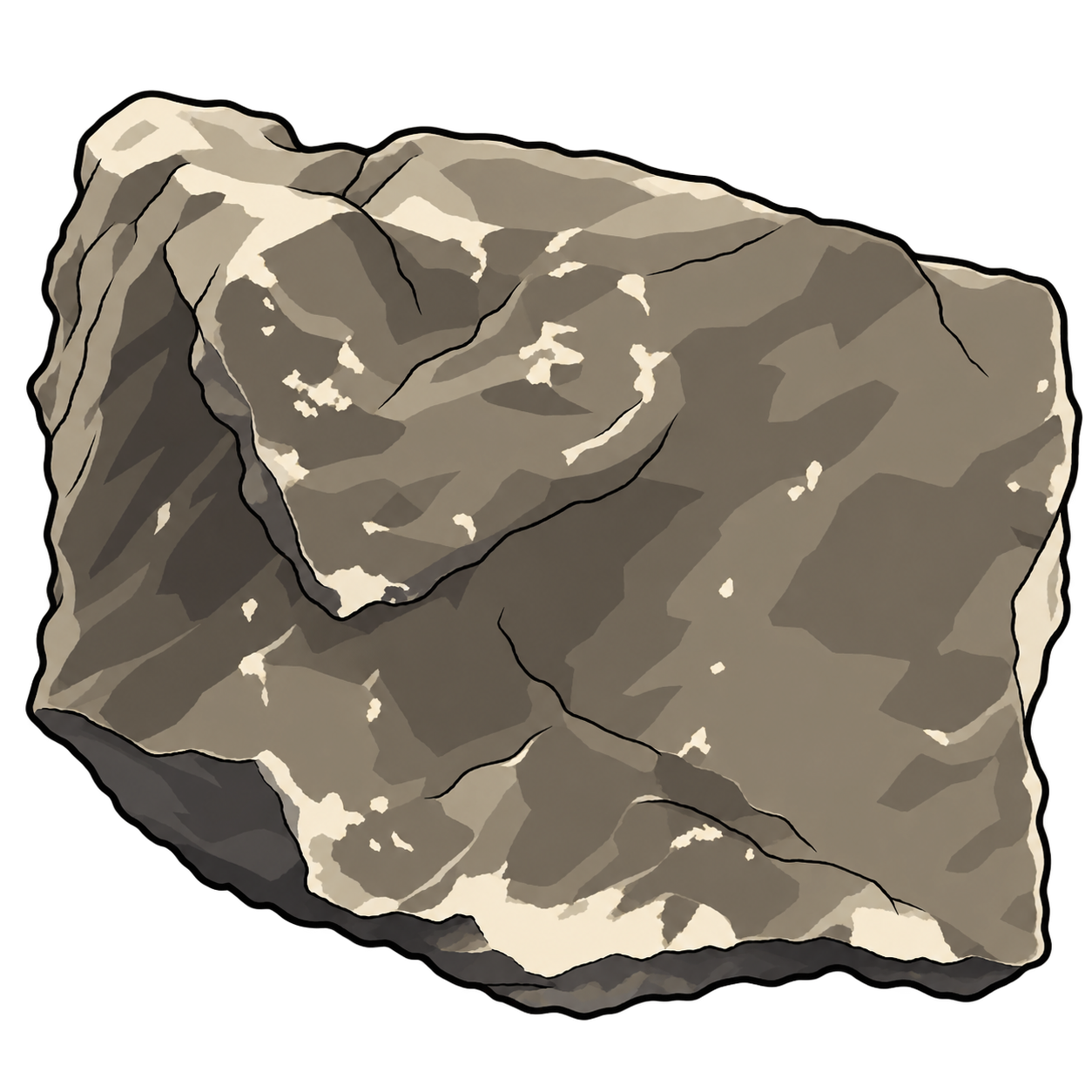
Fossil limestone holds the remains of organisms within the stone that accumulated around them. Shell outlines, broken skeletal pieces and occasionally recognizable colonies or stems interrupt a pale, gray or brown matrix. Its interest lies in that relationship: the fossil records a living structure, while the surrounding rock records its burial and preservation. A small fragment may therefore contain more than one kind of evidence, even when it lacks a spectacular complete fossil.
Fossil stones are used in contemporary crystal practice as symbols of continuity across change. The Crystal Council's account of Orthoceras associates that particular fossil material with grounding, the root chakra, transformation and access to ancient knowledge. These are practitioner interpretations of fossils, not established attributes of every limestone or evidence that a specimen carries recoverable personal memories.[4]
For fossil limestone, the most coherent symbolic theme is the relationship between an individual life and a much longer history. An organism's remains become part of a larger rock; what once belonged to a living body persists in altered form. A person may use that visible relationship as a focus for remembrance, patience or consideration of their place in a family or community. Such use is contemplative rather than a claim that the stone changes health or predicts events. Specific spiritual traditions should be named and documented rather than inferred merely from the fossil's age.
The Florida Geological Survey describes limestone as cemented calcite, fossil fragments and other biologically derived material. Coquina is the especially shell-rich variety, composed almost entirely of cemented shell pieces. These categories describe a rock's ingredients and texture, not one perfectly uniform substance.[1]
Calcite, CaCO3, has Mohs hardness 3 and reacts with dilute hydrochloric acid. That does not give every fossil limestone precisely the same resistance to wear: pores, fractures and any harder replacement minerals also matter. Acid testing is destructive and should not be performed on a finished carving or valued fossil. Silica replacement can preserve a fossil's shape while changing its material; a silicified fossil in limestone should not be described as though both fossil and host necessarily remain calcite.[1]
Close observation is more useful than a single generalized property number. Note whether the surface contains whole shells, small broken pieces, smooth fossil outlines or empty molds. Compare the fossil with the surrounding matrix. A polished surface may reveal internal sections that look very different from the organism's external form; a circular or crescent-shaped patch alone does not establish its identity.
Fossils and their host rock preserve different parts of a sequence. The organism lived before its remains were buried; the sediment subsequently became rock, and later fluids or deformation could alter it further. A geological label should therefore distinguish the age and formation of the host from any later mineral replacement or fracture filling. The appearance of a decorative slab cannot provide those dates by itself.
Crinoidal limestone offers an instructive example of fragmented preservation. Crinoids are marine animals related to sea stars, not plants, despite the flowerlike appearance that gives them the name sea lilies. Their jointed stalks can separate into individual disk-shaped ossicles. The National Park Service illustrates isolated and joined crinoid pieces from the roughly 270-million-year-old Kaibab Formation: small fragments may be all that remain visible of a once-complex animal.[2]
Coquina also has a documented architectural history. At Castillo de San Marcos in St. Augustine, builders used shell-rich stone quarried on Anastasia Island. Construction began in 1672. The National Park Service explains how the relatively yielding, porous material absorbed the impact of cannon fire instead of shattering like a more brittle masonry surface, a behavior demonstrated during the 1702 siege.[3]
This is a specific relationship between a rock's fabric and its use. It is not evidence that all fossil limestone behaves like coquina: a dense polished slab and a porous shell aggregate can respond very differently to impact and weathering. The building example makes texture consequential rather than merely decorative.
Retain locality, formation and fossil identification with a specimen whenever those details are documented. “Fossil limestone” is an appropriate broad description when a more precise identification is unavailable. A seller's ornamental name should not substitute for an identified fossil group, and a shell-shaped mark should not be assigned to a species from a casual visual resemblance.
Use a soft brush for loose dust and avoid acids, abrasive cleaners and prolonged soaking. Examine porous or repaired pieces before introducing water; a brief wipe followed by careful drying is preferable to immersion when construction is uncertain. Support a slab across its base rather than lifting it by a projecting fossil or thin edge. Keep any original label with the object: once separated, its geological context may be impossible to reconstruct.
floridadep.gov · Reference for the accompanying text · Reference recorded October 15, 2026
nps.gov · Reference for the accompanying text · Reference recorded October 15, 2026
nps.gov · Reference for the accompanying text · Reference recorded October 15, 2026
thecrystalcouncil.com · Reference for the accompanying text · Reference recorded October 15, 2026