The mineral that makes a double image
Calcite
Calcium carbonate (CaCO3).
Calcium carbonate mineral species with varied habits and decorative aggregates
Loading this page…
Return homePlease wait while the next page arrives.


The mineral that makes a double image
Calcium carbonate (CaCO3).
Calcium carbonate mineral species with varied habits and decorative aggregates
Calcite is calcium carbonate with a trigonal structure.
Geology · Human history · Spiritual attributes
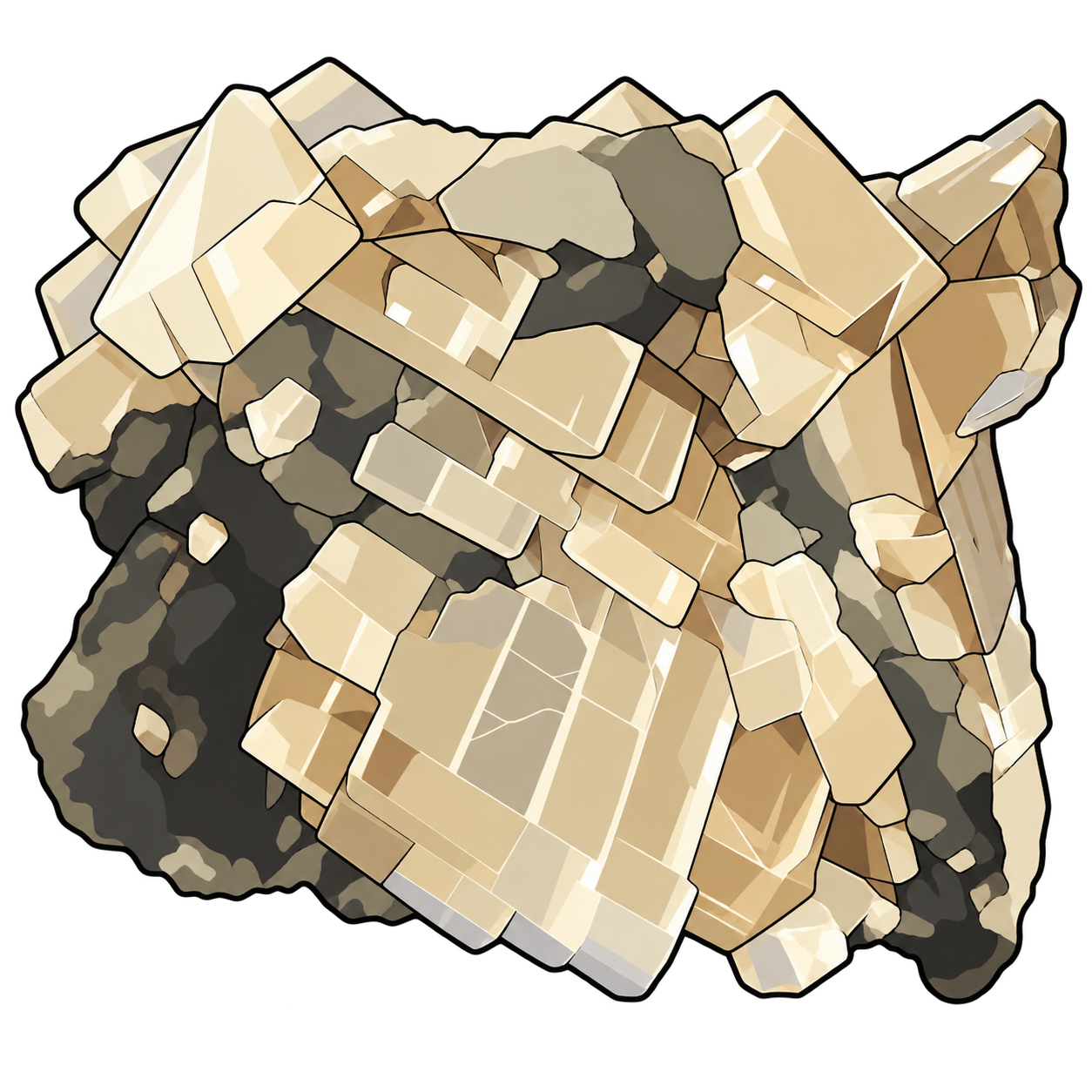
Calcite's contemporary meanings are often organized by colour. The Crystal Council connects orange, honey and blue material with different aspects of creative and emotional life. These are spiritual correspondences, not demonstrated medical or cognitive effects. [1–3]
The honey-calcite practice described by the Council is unusually concrete: identify a project's difficulties, reflect with the stone, and write down possible responses afterward. The mineral serves as a focus for that reflective routine. Orange and blue varieties provide different visual cues, emphasizing outward creative expression or a quieter examination of feelings. These meanings can coexist within a collection without implying that colour changes the mineral's fundamental chemistry.
Calcite is calcium carbonate with a trigonal structure. Its remarkable variety of crystal forms includes rhombohedra, thin or thick plates, pointed scalenohedra and complex combinations. It can also form stalactitic, granular or massive deposits. Twinning adds further variation to the outward shape. [4]
Its Mohs hardness is 3 and density approximately 2.71 g/cm³. Perfect cleavage produces slant-sided rhombohedral fragments, whose angles distinguish them from cubes. A smooth face may be a surface produced during growth or one exposed by breakage. Calcite is brittle despite being easy to scratch. Its lustre ranges from glassy to pearly on some surfaces. [4]
Calcite and aragonite share CaCO₃ but have different structures. Calcite is widespread in limestone, marble, chalk, sedimentary cements, veins and caves. [4]
Transparent calcite can split incoming light into two rays that travel differently through the crystal. The difference between their refractive indices is called birefringence. In calcite the difference is large enough that a printed line viewed through a suitable clear piece appears doubled. The two images arise from light taking different optical paths, rather than from an internal mirror or a second printed line. [5]
The effect depends on orientation and clarity. Opaque material remains calcite even though it cannot demonstrate a visible double image. In a classroom demonstration, a polarizing filter can selectively suppress one image and then the other, showing that the two rays have different polarization directions. This makes a small natural crystal a particularly accessible introduction to the behaviour of light. [5,6]
Exceptionally clear calcite is commonly called Iceland spar. Leo Kristjánsson's history identifies the Helgustaðir quarry in eastern Iceland as a principal source for more than two centuries. The material became important to optical investigation and instruments, while also entering mineralogical collections. Its Icelandic name, silfurberg, refers to its silvery appearance. [7]
The value of such material lay in optical quality rather than simply size. A large crystal full of fractures or inclusions cannot perform the same task as a smaller, exceptionally clear piece. The history of Iceland spar consequently joins field collecting with precise laboratory needs: experimental work depended on a naturally occurring material that had to be found, selected and transported. [5–7]
Calcite's response to water chemistry shapes landscapes. Water carrying dissolved carbon dioxide can become weakly acidic and dissolve limestone. When mineral-bearing water enters an air-filled cave and loses carbon dioxide, calcite may precipitate again. The National Park Service describes this process behind many familiar cave formations. [8]
Drips, films and splashes distribute that growth differently. A ceiling drip can build a stalactite; material deposited where drops land can build a stalagmite. Flowing films produce sheets and layered forms. Their shapes record the movement of water as well as mineral crystallization. The same chemistry explains why acidic cleaning products are unsuitable for calcite specimens and polished carbonate surfaces. [8]
Names such as honey, orange and blue primarily describe appearance. Cobalt-bearing calcite makes a compositional claim. GIA's examination of pink and reddish-purple examples found cobalt in both, while one also contained substantial manganese. The study illustrates why similar pink colours need not have identical chemical explanations, and why colour alone cannot establish the concentration or identity of a colouring element. [9]
Calcite's softness limits routine jewellery use, but skilled cutters can fashion spectacular display gems. The Smithsonian holds a 1,865-carat calcite from Balmat, New York, cut by Art Grant. A faceted specimen reveals the material's optical character while preserving a clear link to its locality and maker. [10]
thecrystalcouncil.com · Reference for the accompanying text · Reference recorded October 15, 2026
thecrystalcouncil.com · Reference for the accompanying text · Reference recorded October 15, 2026
thecrystalcouncil.com · Reference for the accompanying text · Reference recorded October 15, 2026
handbookofmineralogy.org · Reference for the accompanying text · Reference recorded October 15, 2026
open.edu · Reference for the accompanying text · Reference recorded October 15, 2026
instructional-resources.physics.uiowa.edu · Reference for the accompanying text · Reference recorded October 15, 2026
jardvis.hi.is · Reference for the accompanying text · Reference recorded October 15, 2026
nps.gov · Reference for the accompanying text · Reference recorded October 15, 2026
gia.edu · Reference for the accompanying text · Reference recorded October 15, 2026
naturalhistory.si.edu · Reference for the accompanying text · Reference recorded October 15, 2026