Brass-colored geometry, reflective history, and a mineral that rewards careful storage
Pyrite
Iron sulfide (FeS2).
Mineral species; ornamental specimens may include other minerals
Loading this page…
Return homePlease wait while the next page arrives.


Brass-colored geometry, reflective history, and a mineral that rewards careful storage
Iron sulfide (FeS2).
Mineral species; ornamental specimens may include other minerals
Pyrite's cubes can look manufactured, but their geometry belongs to natural crystal growth.
Geology · Human history · Spiritual attributes
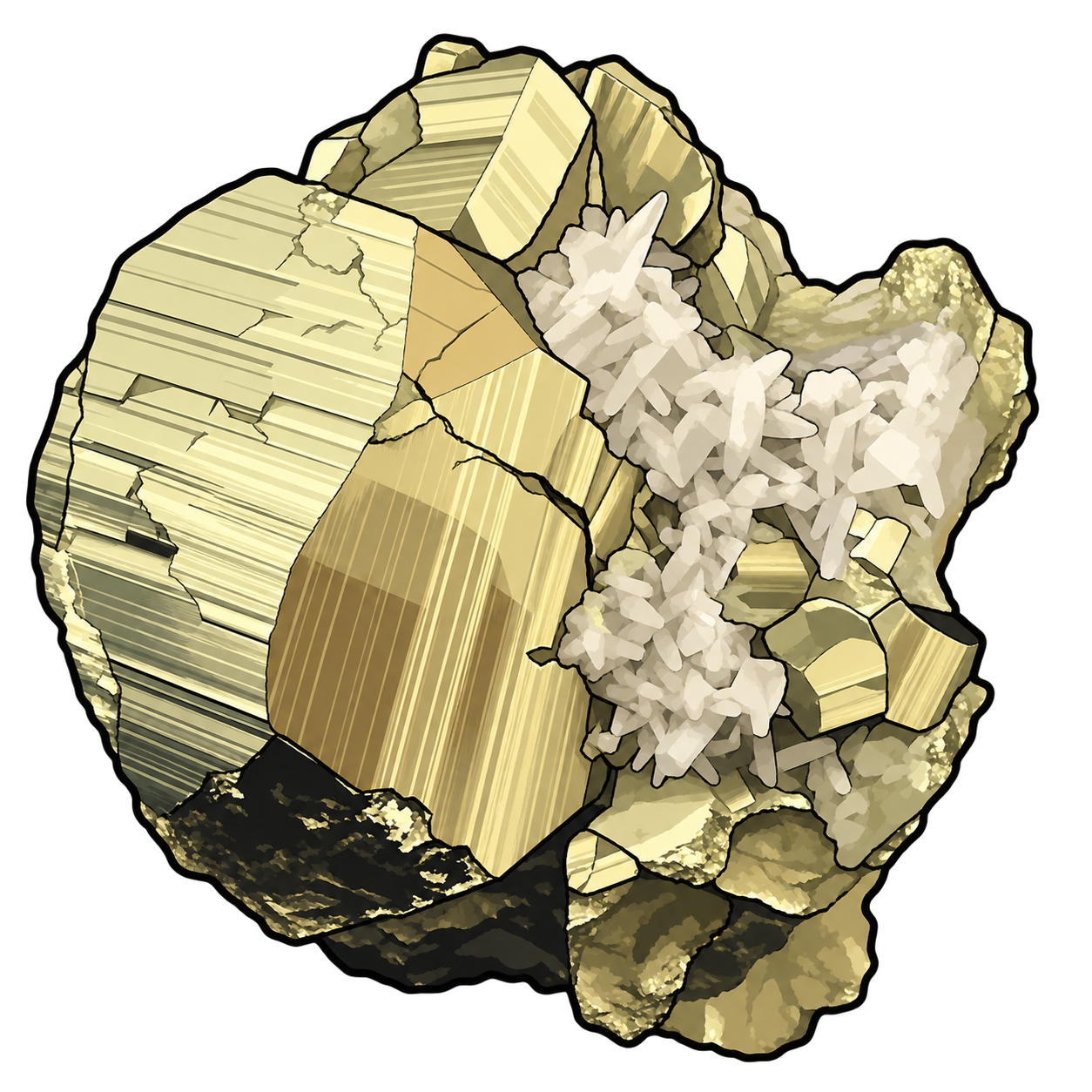
Pyrite's cubes can look manufactured, but their geometry belongs to natural crystal growth. The mineral also forms octahedra, twelve-faced pyritohedra, rounded aggregates, and fine-grained masses. Its brass-yellow shine explains the familiar comparison with gold; its chemistry, brittleness, and behavior identify it as something entirely different. [1]
The Crystal Council links pyrite with personal will and the solar plexus, emphasizing determination and the effort needed to pursue a goal. Its manifestation practice includes stating an intention and returning to it through meditation or carrying a reminder. These are contemporary spiritual associations, not evidence that a mineral guarantees wealth or achievement. [2]
The source's emphasis on dedication is important: a stone may symbolize commitment, but it cannot perform the task. A displayed specimen can serve that role without being carried where it might chip or deteriorate. Historical pyrite mirrors belong to a different cultural setting and should not be presented as proof of modern solar-plexus correspondences.
Pyrite is FeS2 with cubic symmetry. The handbook records hardness of 6–6.5, density near 5.02, brittle tenacity, and a greenish-black to brownish-black streak. Its metallic appearance does not make it malleable like gold. Surface striations and combinations of crystal faces can create complex forms while remaining consistent with its underlying symmetry. [1]
Marcasite shares the FeS2 composition but has a different structure. Chalcopyrite is another distinct mineral, containing copper as well as iron and sulfur. These comparisons show why neither color nor a short chemical formula is always enough to identify a specimen. [1]
The name refers to fire and the sparks that can be struck from the mineral. That historical association is not a reason to strike a valuable specimen: impact can damage crystals and release fragments. A collector can understand the name without sacrificing an intact face.
Pyrite forms in many settings, including hydrothermal veins, igneous rocks, metamorphic deposits, and sedimentary replacements. It can be associated with numerous other sulfides as well as quartz, calcite, or barite. Identical-looking brassy crystals may therefore have very different geological contexts. [1]
The external shape is only one part of that history. A compact crystal group and a porous fine-grained aggregate can behave differently in storage. This matters especially where pyrite occurs within fossils or a vulnerable matrix: the attractive mineral and the object containing it need to be considered together. [4]
Maintain a reliable locality and acquisition record rather than assigning origin from cube shape alone. A prepared specimen may also include repaired crystals or a modified matrix; those interventions belong in its description.
Karl Taube's study of Teotihuacan mirrors describes circular mosaics made from pyrite pieces attached to stone backings, often slate. Their original reflective surfaces have frequently deteriorated, which helps explain why some excavated objects were initially mistaken for other kinds of artifacts. [3]
Taube interprets archaeological examples and imagery as evidence for roles in costume and divination, not simply personal grooming. The crafted arrangement matters: separate mineral pieces became a reflective surface through skilled assembly, and the resulting object acquired meaning in a specific social and ritual setting. [3]
The surviving mosaics belong to a particular Mesoamerican craft and ritual history, distinct from modern crystal-shop correspondences.
Natural History Museum conservators writing for NatSCA describe how pyrite oxidation can damage fossils and mineral collections. Oxygen and moisture contribute to the process, producing products that may harm the specimen, its labels, and storage materials. Porous fine-grained material can be more susceptible than compact crystals. [4]
Warning signs include new expansion cracks and pale yellow or white crystal growth. A shiny specimen is not guaranteed to remain stable, but neither is every pyrite cube destined to crumble. Condition and environment matter. The museum's treatment program uses controlled conservation methods; those should not be improvised at home with household chemicals. [4]
For a private collection, prevention begins with dry, stable storage and periodic inspection. If deterioration appears, isolate the affected object from neighboring material and seek conservation advice. Record the change with photographs and preserve the label separately from damaging residues if necessary.
Do not identify gold by shine alone or test a polished object by destructive scraping. A gemologist or mineral specialist can choose appropriate methods for the material and its value. Ask about coatings, repairs, and treatments when a specimen has an unusually uniform or vivid surface.
Avoid soaking pyrite, especially porous or fossil-bearing pieces. Do not use salt-water rituals, steam, ultrasonic cleaning, or aggressive chemical brighteners on a collection specimen. A dry protected display is generally preferable to repeated cleaning. Keep it away from food preparation and avoid breathing dust from damaged material.
The aim is to preserve both the mineral and its context: crystal faces, matrix, labels, and condition history. Pyrite's beauty lies in more than its metallic gleam, and an accurate record remains valuable even when a surface changes with age.
handbookofmineralogy.org · Reference for the accompanying text · Reference recorded October 15, 2026
thecrystalcouncil.com · Reference for the accompanying text · Reference recorded October 15, 2026
mesoweb.com · Reference for the accompanying text · Reference recorded October 15, 2026
natsca.blog · Reference for the accompanying text · Reference recorded October 15, 2026