A Shared Structure, a Remarkable Palette
Garnet
A group of related silicate minerals.
Silicate mineral group with end members, solid solutions and gem varieties
Loading this page…
Return homePlease wait while the next page arrives.


A Shared Structure, a Remarkable Palette
A group of related silicate minerals.
Silicate mineral group with end members, solid solutions and gem varieties
Garnet is a mineral family, not a synonym for dark red.
Geology · Human history · Spiritual attributes
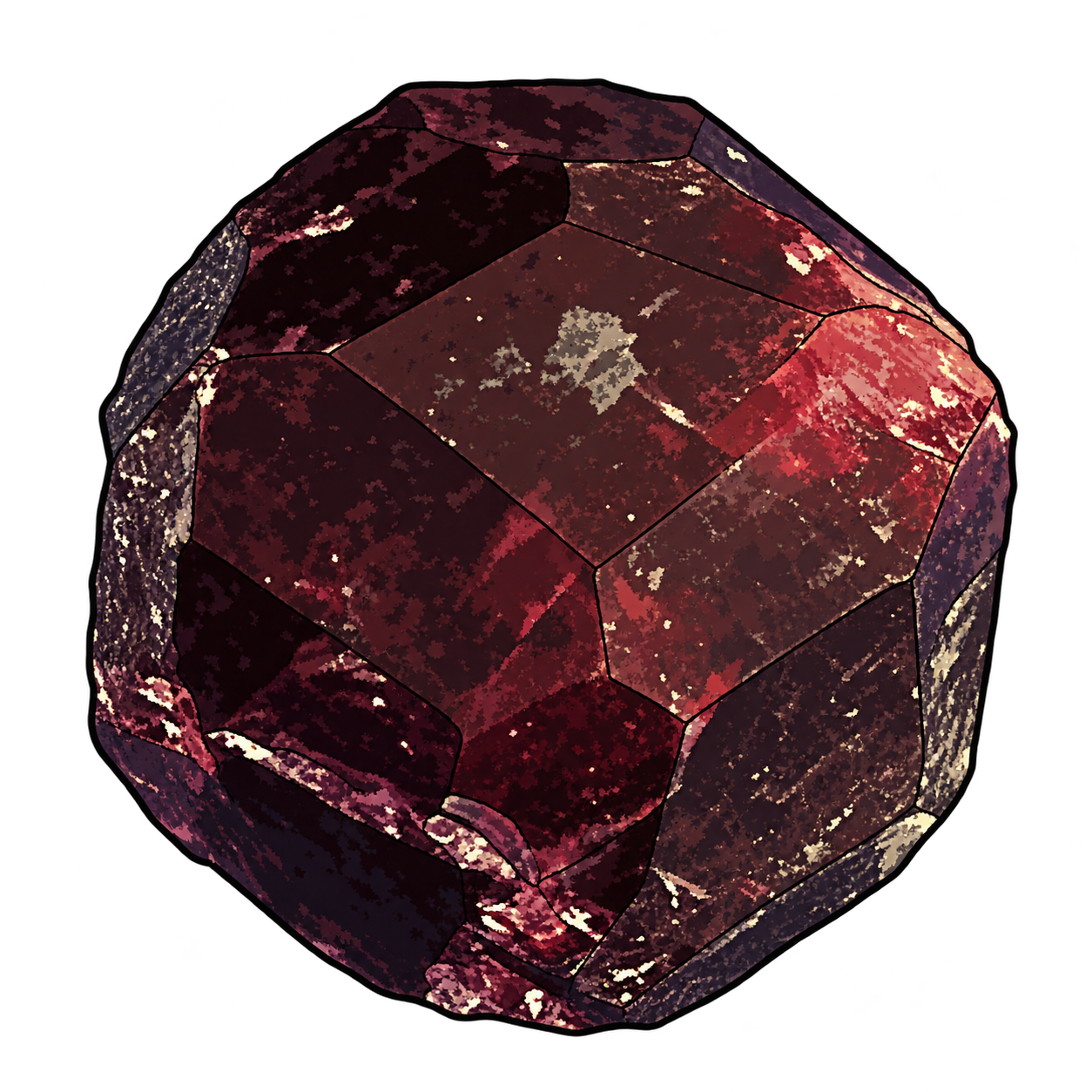
Garnet is a mineral family, not a synonym for dark red. Its gemstones include orange, green, purple-red and color-changing material as well as the familiar reds. Members share a structural framework but differ in chemistry, and natural crystals commonly combine more than one end-member composition. [1]
Contemporary red-garnet symbolism emphasizes vitality and purposeful action. The Crystal Council associates garnet with strength, grounding, motivation and self-discipline, using earth and fire imagery to frame these qualities. The associations are particularly centered on red material and need not be imposed on every color in the family. [2]
Some practitioners hold a stone while stating an intention aloud. The object gives that intention a tangible focus; it does not independently accomplish the goal. These spiritual associations should not be confused with medical claims about blood, circulation or physical energy.
Crystal system: Cubic Common habit: Dodecahedral or trapezohedral crystals; also grains and massive aggregates Representative formulas: Almandine Fe₃Al₂(SiO₄)₃; grossular Ca₃Al₂(SiO₄)₃; andradite Ca₃Fe₂(SiO₄)₃ Mohs hardness: Approximately 6.5–7.5, depending on type Fracture: Commonly uneven to conchoidal Tenacity: Brittle despite useful jewelry durability Optical character: Normally isotropic, with anomalous strain effects in some material [3–6]
The formulas describe idealized compositions, not a requirement that every natural crystal be chemically pure. Almandine forms compositional series with pyrope and spessartine; grossular and andradite also admit substitution. This is why a laboratory description can legitimately use a combined name rather than choosing a single familiar label. [3–5]
The differences are measurable. The Handbook of Mineralogy gives a refractive index near 1.830 for its almandine description, 1.734 for grossular and 1.887 for andradite. Corresponding density values also differ substantially. These are useful examples of variation, not universal readings for all natural mixtures. The higher refractive index of one member does not automatically make every specimen of it more attractive. [3–5]
Almandine commonly forms twelve-faced dodecahedra or trapezohedra, but rounded grains belong to the same mineral. A natural crystal face is a growth surface; a smooth curved break is fracture. Confusing the two can lead to mistaken judgments about whether a specimen was cut or damaged. Garnets generally lack the prominent cleavage seen in feldspars, although parting can occur in some material. [3, 4]
Several familiar names describe varieties rather than separate species:
Two green garnets can therefore have different chemistry, and two red gems need not have identical properties. Uvarovite often occurs as tiny green crystals that are attractive in clusters but too small for conventional faceting. The family is broader than the handful of varieties most often seen in jewelry counters. [1]
Almandine is particularly characteristic of mica schists and gneisses produced by regional metamorphism. It also occurs in other settings and can survive weathering as loose grains in sediment. A crystal retained in its original rock can preserve relationships with mica, staurolite or other associated minerals that a loose gemstone no longer shows. [3]
Grossular is common in calcium-rich rocks altered by heat and chemical exchange, including metamorphosed limestones. Associated minerals can include calcite, epidote, diopside and vesuvianite. Andradite likewise occurs in skarns and other calcium-rich settings, but also in serpentinites and some alkaline igneous rocks. A locality and matrix description can consequently be more informative than color alone. [4, 5]
Some garnets display asterism, a star-like reflection; others show a cat's-eye effect or change color under different illumination. These are specific optical phenomena, not features of every garnet. The GIA Gübelin Gem Project documents this range alongside identified specimens of several species and mixtures. [8]
For a star stone, compare its appearance under a small directional light with its appearance in diffuse daylight. For color-change material, compare genuinely different light sources rather than relying on two heavily processed photographs. An attractive optical effect should be evaluated separately from surface damage and internal fractures.
Inclusions are not always unwelcome. GIA notes that certain demantoids contain curved “horsetail” inclusions that can contribute to their appeal, while hessonite often has a distinctive internally turbulent appearance. A generic demand for complete visual clarity would overlook qualities valued in particular varieties. [7]
GIA records the use of carved garnets in Roman signet rings and the rise of the Bohemian garnet industry after important deposits became known around 1500. That regional industry reached its height in the nineteenth century. Older descriptions using the word carbuncle require caution because the term was applied to several red materials, not a precisely defined modern garnet species. [9]
The British Museum's Sutton Hoo scabbard boss, object 1939,1010.27, shows how craftsmanship can transform the visual effect. Its early seventh-century design places shaped garnets in gold cells over patterned gold foil. The visible red surface is part of a layered construction: the stone, reflective backing and metal divisions all contribute. [10]
Choose a gem for the color and brightness it shows in ordinary conditions, not only under a concentrated display light. A very dark red stone may show less detail at normal viewing distance than its close-up photograph suggests. Consider cut, face-up size, surface condition and intended setting together. The trade name alone cannot rank the quality of an individual piece.
GIA places garnet toughness in the fair-to-good range and advises protection from hard blows. Clean with lukewarm soapy water and a soft brush; rinse and dry. Avoid steam cleaning. Ultrasonic cleaning is inappropriate for fractured or fracture-filled stones, and the conservative hand-cleaning method avoids having to assume that a stone is untreated and intact. [6]
Store jewelry separately and handle matrix specimens by the supporting rock rather than a projecting crystal. A faceted tsavorite, a star cabochon and a garnet on fragile mica have different vulnerable features even though all belong to the same family.
gia.edu · Reference for the accompanying text · Reference recorded October 15, 2026
thecrystalcouncil.com · Reference for the accompanying text · Reference recorded October 15, 2026
handbookofmineralogy.org · Reference for the accompanying text · Reference recorded October 15, 2026
handbookofmineralogy.org · Reference for the accompanying text · Reference recorded October 15, 2026
handbookofmineralogy.org · Reference for the accompanying text · Reference recorded October 15, 2026
gia.edu · Reference for the accompanying text · Reference recorded October 15, 2026
gia.edu · Reference for the accompanying text · Reference recorded October 15, 2026
gia.edu · Reference for the accompanying text · Reference recorded October 15, 2026
gia.edu · Reference for the accompanying text · Reference recorded October 15, 2026
britishmuseum.org · Reference for the accompanying text · Reference recorded October 15, 2026