Manganese carbonate in rose-colored bands and exceptional red crystals
Rhodochrosite
Manganese carbonate (MnCO3).
Mineral species; ornamental specimens may include other minerals
Loading this page…
Return homePlease wait while the next page arrives.


Manganese carbonate in rose-colored bands and exceptional red crystals
Manganese carbonate (MnCO3).
Mineral species; ornamental specimens may include other minerals
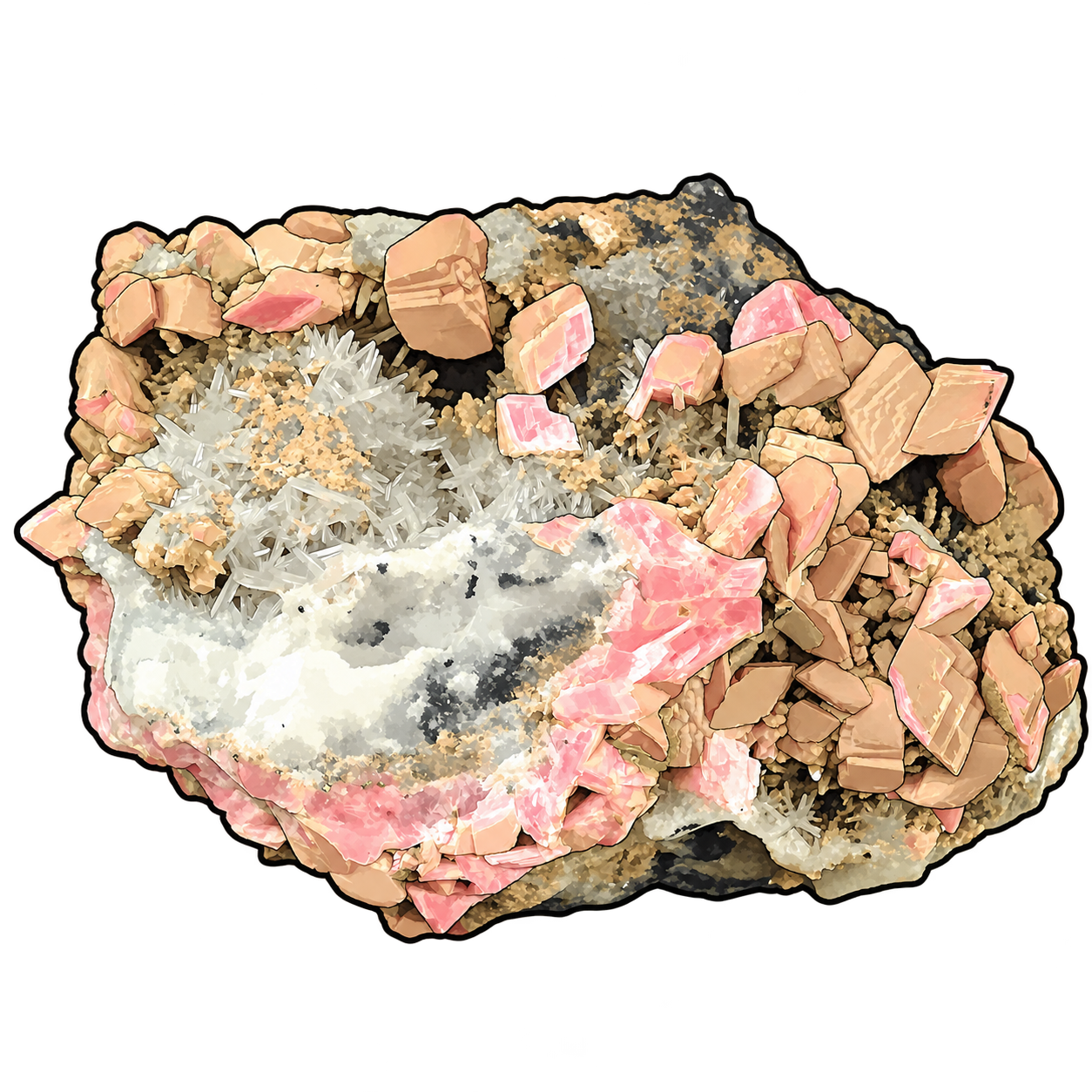
Rhodochrosite ranges from pink-and-white banded aggregates to transparent red crystals.
Geology · Human history · Spiritual attributes
The Crystal Council presents rhodochrosite as a stone of self-love, peace, and new beginnings, associating it with heart-centered meditation. Its interpretation emphasizes treating oneself with the care one hopes to offer others. These correspondences belong to modern crystal practice rather than to mineral science. [3]
A piece can mark an intention to approach difficult memories with self-compassion. That contemplative use is distinct from treatment for trauma.
Rhodochrosite is a carbonate rather than the similarly named silicate rhodonite. Its Mohs hardness is about 3.5–4, density approximately 3.7 g/cm³, and cleavage is perfect in rhombohedral directions. It can be transparent to translucent, with a glassy luster on crystals and a pearlier appearance in aggregates. Not every specimen is saturated pink: yellowish, grayish, or brownish colors also occur. [1]
Its ideal formula is MnCO₃, but natural material may contain other elements in place of some manganese. An ornamental object can also contain neighboring minerals rather than one uniform composition. The name therefore identifies a mineral, while the appearance of a whole slab may record a more varied assemblage. [1,4]
Cleavage is central to its handling. It describes structurally favored break directions, not visible decoration. A thin corner or an incipient internal separation may fail under pressure even where the polished surface appears intact. The ability to facet rhodochrosite is a demonstration of lapidary skill, not evidence that it has become a hard-wearing stone.
Rhodochrosite forms in several settings, including low- to moderate-temperature hydrothermal veins, metamorphic deposits, carbonatites, and sediments. Capillitas in Argentina is noted for ornamental banded material; Colorado, Peru, and South Africa have yielded notable crystals. The rhombohedral shape is one natural habit, not the only one. [1]
Banded material often displays curved or concentric growth patterns when cut. The relationship between the cut and the original mass determines whether those patterns appear as arcs, nearly parallel stripes, or rings. A transparent crystal provides a different kind of record: its external faces and internal inclusions can preserve information that polishing a large decorative surface would remove. [2]
SWEET HOME: A RECORD OF CHANGING VALUE The Sweet Home mine near Alma, Colorado, began as a silver mine in 1872. A 2023 GIA report describes how rhodochrosite, initially an impediment to silver processing, later became the celebrated object of collecting. The report traces a 7.94-carat cut stone back to a fragment saved after an 1888 shaft collapse; Glenn Vargas cut it in 1981. This is a particular object's documented history, not a date assigned to all Sweet Home material. [5]
The Denver Museum of Nature & Science's 2022–2026 collections plan identifies the Alma King and the Coors Pocket rhodochrosite wall among its important Sweet Home holdings. Such records preserve the connection between a specimen, a mine, and its collecting history. They are more useful than an unsupported claim that a red crystal “must be Colorado.” [6]
Natural-looking bands are not proof of natural rhodochrosite. A 2019 study compared two genuine stones with two imitations composed of pressed gibbsite and calcite. The imitations differed in structure and measured properties, with mineral particles bound into a patterned material. The authors used several analytical methods rather than relying on the visual similarity alone. [4]
An imitation made from natural mineral powders is still an imitation of a naturally grown rhodochrosite object. Ask whether a piece is solid natural material, reconstructed or pressed material, or treated stone. If a high-value crystal or gem is being sold with a mine attribution, ask what records support that attribution separately from its mineral identity.
Choose a banded piece for the balance of pattern, finish, and soundness; choose a crystal with attention to faces, contacts, repairs, and its original matrix. A small complete crystal can be more informative than a larger damaged one. Keep labels and treatment disclosures with the object rather than relying on memory.
The detailed GIA study of Sweet Home gems emphasizes gentle handling and excludes ultrasonic, steam, buffing, and mechanical cleaning. It describes room-temperature soapy-water cleaning for appropriate jewelry, followed by gentle rinsing and a very soft cloth. That advice should not be extended automatically to a repaired specimen, fragile matrix, or an object with unknown treatment. [2]
For those objects, start with dry dusting and consult the preparator or jeweler. Avoid acid cleaners and protect the stone from impacts and abrasive storage. Jewelry that receives little contact—such as a carefully made pendant—offers a more realistic use than an exposed daily-wear ring. There is no need to sacrifice an intact collector crystal merely to make it wearable.
handbookofmineralogy.org · Reference for the accompanying text · Reference recorded October 15, 2026
gia.edu · Reference for the accompanying text · Reference recorded October 15, 2026
thecrystalcouncil.com · Reference for the accompanying text · Reference recorded October 15, 2026
my.gia.edu · Reference for the accompanying text · Reference recorded October 15, 2026
my.gia.edu · Reference for the accompanying text · Reference recorded October 15, 2026
dmns.org · Reference for the accompanying text · Reference recorded October 15, 2026
Colorado formally designated rhodochrosite its state mineral in legislation approved in 2002. That civic recognition is distinct from a geological classification: the mineral occurs beyond the state's borders. [7]
content.leg.colorado.gov · Reference for the accompanying text · Reference recorded October 15, 2026