Pink quartz for carving, jewelry and collecting
Rose Quartz
Pink massive quartz / silicon dioxide
Quartz color variety
Loading this page…
Return homePlease wait while the next page arrives.


Pink quartz for carving, jewelry and collecting
Pink massive quartz / silicon dioxide
Quartz color variety
Rose quartz is the familiar pink variety of quartz, usually encountered as cloudy masses rather than sharply pointed natural crystals.
Geology · Human history · Spiritual attributes
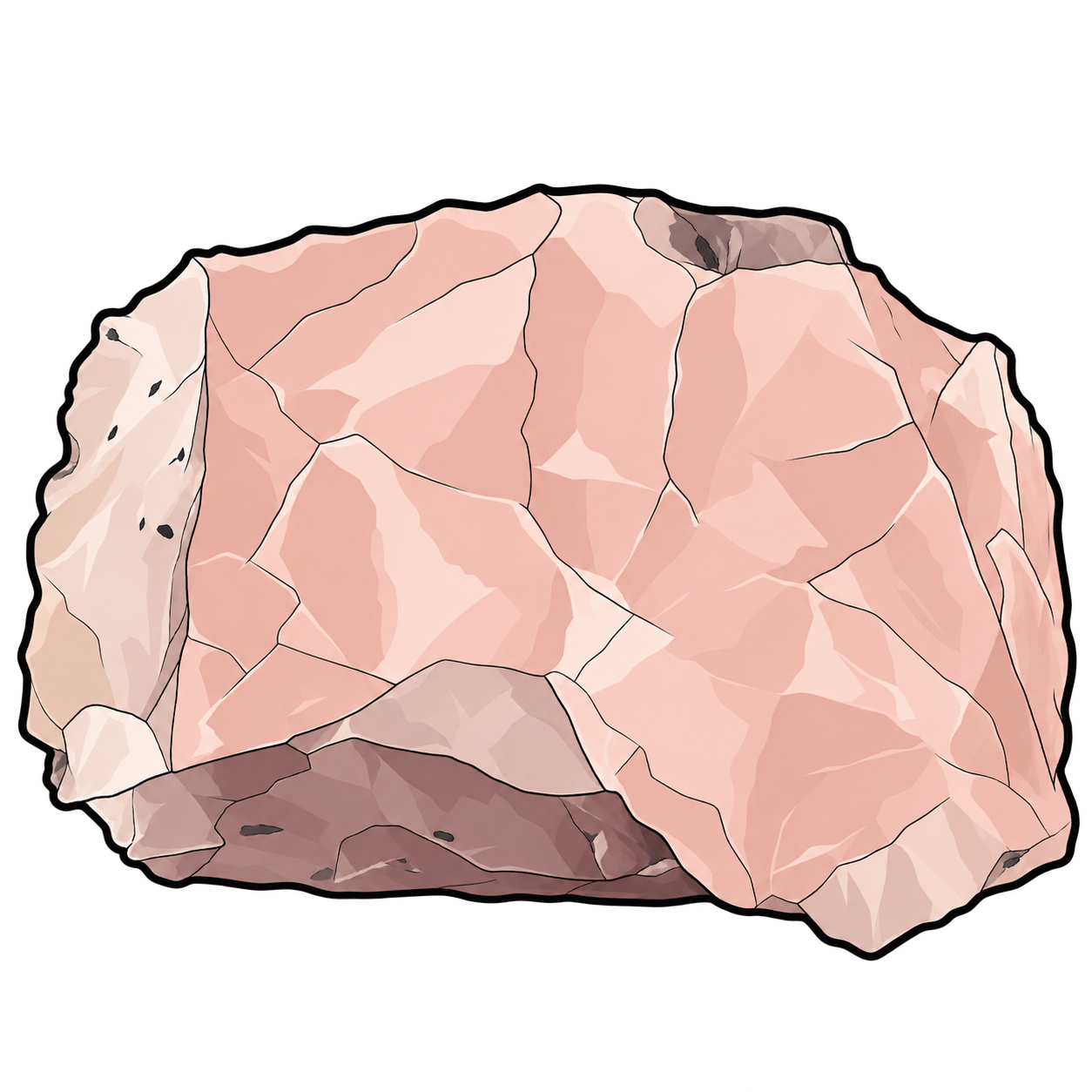
Rose quartz is the familiar pink variety of quartz, usually encountered as cloudy masses rather than sharply pointed natural crystals. Its color ranges from a nearly white blush to a more pronounced rose. It is widely shaped into beads, cabochons and carvings, and contemporary crystal practice associates it with love, compassion and forgiveness. [5, 10]
Rose quartz is associated with the heart in contemporary crystal practice. Its use extends beyond romance to friendship, self-respect and a willingness to give and receive care. Practitioners may carry a small stone, wear it as jewelry or use it as a focus for reflection. [5, 6]
Heather Askinosie's practices combine rose quartz with breathing, an affirmation and questions about forgiveness. Margaret Ann Lembo places pink stones within a heart-centered symbolism of love and friendship. These are contemporary spiritual approaches, not evidence that every historical rose-quartz object had the same meaning. [5, 6]
Chemical formula: SiO₂ [11] Crystal system: Trigonal [12] Mohs hardness: 7 [11] Specific gravity: Approximately 2.66; GIA gives a range of 2.64–2.69 [11] Cleavage: No readily developed cleavage in ordinary specimens [12] Refractive indices: Approximately 1.544–1.553 [11] Typical form: Massive; usually translucent rather than fully transparent [11]
The familiar material occurs predominantly in masses rather than well-shaped natural crystals. Its microscopic inclusions produce cloudy translucence, making it particularly suited to cabochons and carvings. A finished object's outline may therefore be the cutter's design rather than an original crystal form. [11]
Research by Julia Goreva, Chi Ma and George Rossman examined fibers extracted from massive rose quartz from 29 localities. The fibers were only about 0.1–0.5 micrometers wide, yet their optical absorption corresponded with the host's pink color. Their properties closely resembled dumortierite, although the analytical results did not support simply calling every inclusion ordinary dumortierite. [3]
This is more precise than attributing the color to an unspecified impurity. The material's tiny inclusions are part of its identity, not automatically a defect. They also help explain why a clouded piece can have an attractive, even appearance without the transparency expected of a faceted rock crystal. [1, 3]
Uncommon transparent pink quartz can form well-shaped crystals and obtain its color through a different mechanism involving color centers. Some examples fade in natural light. These specimens should not be assumed to behave like the familiar massive material merely because both are sold under a pink-quartz name. [1]
For a collection, preserve the distinction on the label. A carved rose-quartz tower and a natural cluster of pink quartz may both be beautiful, but they represent different growth forms and can require different display precautions.
Rose quartz commonly occurs in pegmatites and can also occur in hydrothermal veins. Brazil, Madagascar, India and Sri Lanka are documented sources. [1]
Pegmatitic and vein material can supply substantial blocks for carving, but an object's final shape is not a map of its geological growth. A bowl, sphere or heart demonstrates what the cutter made from the available mass. For rough specimens, retain any locality record and distinguish naturally exposed surfaces from sawn or polished faces.
A country name is useful provenance only when supported by the specimen's history. Color alone cannot establish a particular mine. If locality is central to the purchase, ask for a source record rather than relying on a regional name attached to an otherwise undocumented carving.
Some rose quartz displays a six-rayed star, while less common examples show additional rays. The effect is often especially visible with illumination behind the stone, called diasterism; more opaque spheres can also show a star in reflected light. Not every piece develops a visible star. [4]
For a star specimen, request views under the lighting used to reveal the effect. Notice whether the rays meet clearly and how the star moves as the piece turns. A photograph optimized for the star may tell little about ordinary body color, while a softly lit photograph may conceal the star altogether.
Color and size also interact. A thicker piece can show a stronger pink than a thin slice of comparable material. Compare specimens of similar dimensions under the same light, and examine the whole object rather than judging it from the most saturated area in one photograph. Internal fractures, uneven color and polish can matter as much as the depth of pink. [8]
An eighteenth-century Chinese vase in the Metropolitan Museum of Art provides a documented example of rose quartz in Qing-dynasty hardstone carving. The vessel, object 02.18.856, stands 14.9 centimeters high. It establishes a specific historical use of the material without requiring a speculative account of the maker's beliefs. [9]
Different forms make different demands on the stone. A vessel needs sufficient material for both its outer shape and its hollow interior. A sphere requires a consistent curve and a good polish across the entire surface. Beads must be drilled without leaving fragile edges, while a cabochon can be oriented for an optical effect.
These distinctions give a collector more useful criteria than shape names alone. A polished heart may be chosen for its symbolism; a rough piece for its geological context; a carved vessel for design and workmanship. None needs to imitate the qualities of another to be successful.
Inspect edges, drill holes and thin projections for chips. Ask about repairs and treatments, especially when color intensity is a major part of the description. Rose quartz is sometimes irradiated to enhance its pink. A seller's treatment disclosure is more informative than an assurance based only on how natural the color looks. [7, 8]
For ordinary sound rose quartz, use warm water, mild soap and a soft cloth or brush. Avoid steam and ultrasonic cleaning. Store pieces so that they cannot rub against harder gems or strike one another. A valuable carving with repairs or a fragile setting may need more conservative care than an unmounted tumbled piece. [7]
Ordinary massive rose quartz is generally stable to light and heat, but that guidance should not be extended uncritically to rare pink crystalline quartz. For a light-sensitive collector specimen, follow its documented requirements and avoid prolonged bright display. Protect any quartz object from sudden temperature changes and unnecessary impact. [1, 7]
gia.edu · Reference for the accompanying text · Reference recorded October 15, 2026
authors.library.caltech.edu · Reference for the accompanying text · Reference recorded October 15, 2026
igc-gemmology.org · Reference for the accompanying text · Reference recorded October 15, 2026
energymuse.com · Reference for the accompanying text · Reference recorded October 15, 2026
llewellyn.com · Reference for the accompanying text · Reference recorded October 15, 2026
origin.prod.gia.edu · Reference for the accompanying text ·
origin.prod.gia.edu · Reference for the accompanying text · Reference recorded October 15, 2026
metmuseum.org · Reference for the accompanying text · Reference recorded October 15, 2026
geology.com · Reference for the accompanying text · Reference recorded October 15, 2026
gia.edu · Reference for the accompanying text · Reference recorded October 15, 2026
mints.uwc.ac.za · Reference for the accompanying text · Reference recorded October 15, 2026