Pink Beryl, from Crystal to Jewel
Morganite
Pink to orange-pink beryl.
Colored beryl gem variety
Loading this page…
Return homePlease wait while the next page arrives.


Pink Beryl, from Crystal to Jewel
Pink to orange-pink beryl.
Colored beryl gem variety
Morganite is beryl in shades of pink, rose, peach and pale violet.
Geology · Human history · Spiritual attributes
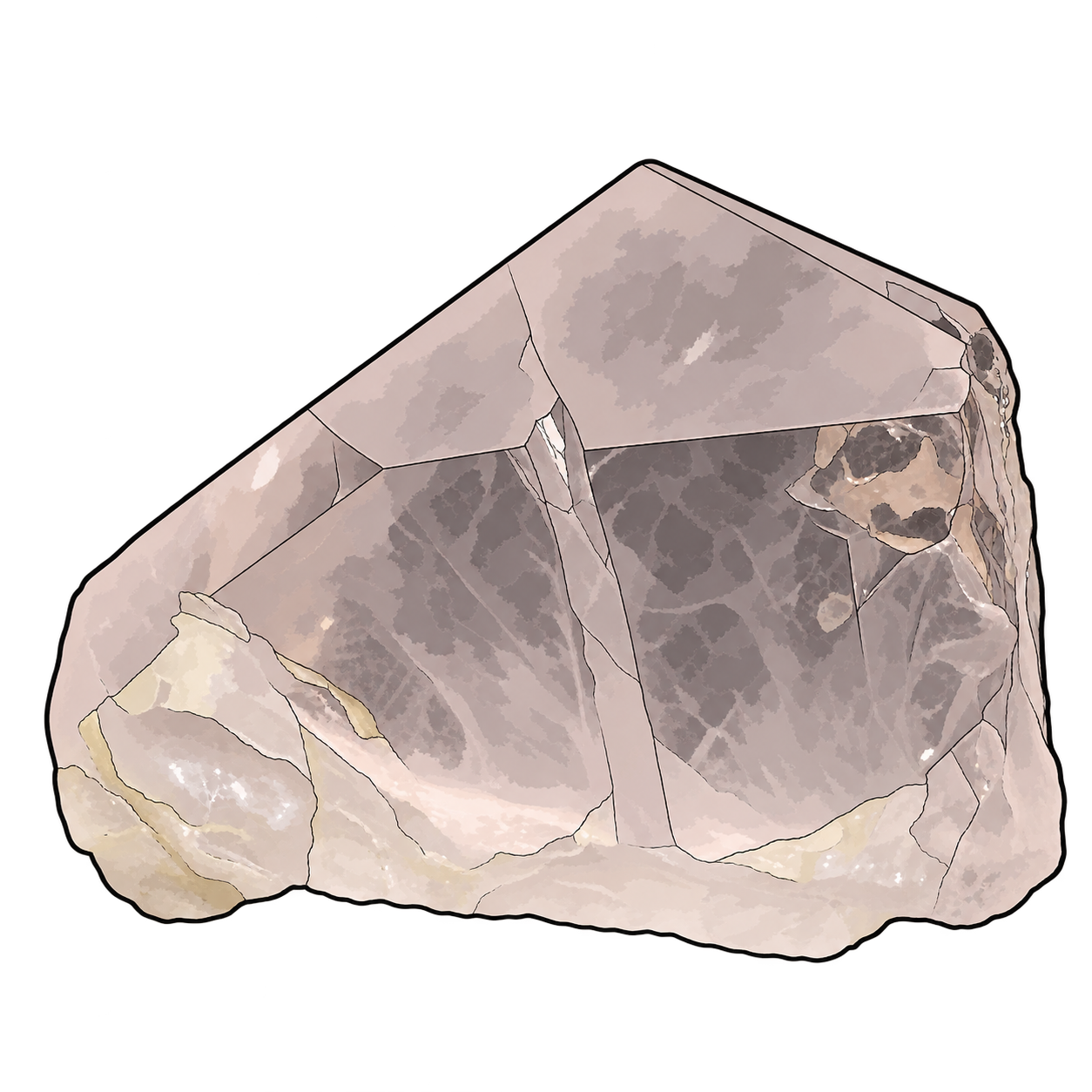
Morganite is beryl in shades of pink, rose, peach and pale violet. Trace manganese contributes the color to a mineral whose chemically pure form is colorless. The pastel range is characteristic, but neither every specimen nor every finished gem is an identical soft pink. [1]
Morganite's modern spiritual associations center on affection and the willingness to remain receptive. The Crystal Council describes it as a heart-associated stone, connecting its pink color with compassion, courage and a gentler response to difficult feelings. These are contemporary beliefs, not established effects of manganese or beryl. [2]
Some practitioners use pink-light visualization during meditation with morganite. Such a practice may be personally meaningful without proving that a crystal emits a healing force. Claims that it resolves trauma or treats illness should not replace appropriate support or care.
Morganite shares beryl's ring-silicate framework. The structure accommodates substitutions and contains channels that can hold alkali ions and molecules. This helps explain why a concise ideal formula is not a complete chemical inventory of every crystal. The particular combination of trace elements and structural occupants can influence measured properties. [4]
The numbers above are useful gemological reference ranges, not instructions to identify a stone by color alone. Morganite is doubly refractive, and its directional pink tones influence cutting. A cutter's chosen orientation can emphasize a stronger bluish pink or a paler appearance even within the same rough. [3, 5]
Manganese also participates in the color of other beryls, but that does not make pink morganite and red beryl interchangeable. Spectroscopic research distinguishes manganese-related color behavior in these materials. A shared element can behave differently according to its oxidation state and structural setting. [4]
Heating is widely used to reduce yellow or orange components and emphasize pink. GIA notes that this treatment is not ordinarily detectable by standard gemological testing. An absence of detectable treatment is therefore not automatically proof of an untreated history. Peach-colored material can be attractive in its own right, and some collectors specifically prefer it. [5]
Faceted morganite is commonly free of inclusions visible to the unaided eye. More included or translucent material can be carved or made into cabochons. Pale color often becomes more evident in a larger piece, but a heavier stone should still be judged for its proportions and actual face-up appearance. Size and color are related without being equivalent measures of quality. [5]
A photograph can exaggerate subtle pink through warm illumination, a colored background or image processing. For a pastel gem, seeing it against a neutral background is particularly useful. The question is not whether the strongest possible pink can be made to appear, but what the stone looks like under the conditions in which it will be enjoyed.
Morganite occurs in pegmatites, where conditions can allow very large crystals to develop. Minas Gerais in Brazil is an important source; documented material also comes from Madagascar, Afghanistan and other localities. GIA's examples include substantial collector crystals as well as large cut gems, showing that good-sized rough is not limited to a single unusual discovery. [6]
A crystal specimen preserves features that cutting may remove: its outer faces, zones of changing clarity and any attached minerals. A faceted jewel instead selects and organizes a portion of the original material. Keeping those descriptions separate avoids treating every polished outline as a natural growth form.
GIA records George Frederick Kunz proposing the name morganite at the New York Academy of Sciences on December 5, 1910. It honored J. P. Morgan's patronage of gem collections and the arts and sciences. The name reflects an early twentieth-century collecting network rather than the beginning of the mineral's existence or human experience of pink beryl. [7]
The Rose of Maine, found in the Bennett quarry at Buckfield in 1989, was a large, somewhat orange-toned crystal. Its name might suggest pure rose pink, but the reported appearance is a useful reminder that morganite's range includes warmer colors. A memorable specimen name should not replace a material description. [7]
The Smithsonian's NMNH G11785 is a 1,377-carat orange-pink morganite from Minas Gerais, cut by Elvis “Buzz” Gray. The museum identifies a 448.64-carat sister stone from the same gem pocket. Its record emphasizes color, clarity and cutting as well as size. [8]
The comparison is instructive: two objects sharing a pocket history can still have different proportions and visual effects. A documented connection is more informative than a vague claim that a stone comes from an exceptional region. Museum records also preserve the maker's contribution, recognizing that a finished gem is both natural material and a crafted object.
Morganite is suitable for jewelry when protected from scratches and hard impacts. Its color is stable under ordinary light, but GIA advises against heat exposure. Lukewarm soapy water is a conservative cleaning method. Steam or ultrasonic cleaning may be unsuitable for stones with fractures, liquid inclusions or rare fracture filling. [9]
For a mounted piece, gently clean behind the stone where residue can dull the appearance, without forcing a brush against loose prongs. For a specimen, protect thin edges and any fragile attached minerals. Neither a pale color nor high transparency calls for aggressive cleaning: preserving the surface is more important than trying to intensify a naturally delicate pink.
naturalhistory.si.edu · Reference for the accompanying text · Reference recorded October 15, 2026
thecrystalcouncil.com · Reference for the accompanying text · Reference recorded October 15, 2026
gia.edu · Reference for the accompanying text · Reference recorded October 15, 2026
ssef.ch · Reference for the accompanying text · Reference recorded October 15, 2026
gia.edu · Reference for the accompanying text · Reference recorded October 15, 2026
gia.edu · Reference for the accompanying text · Reference recorded October 15, 2026
gia.edu · Reference for the accompanying text ·
naturalhistory.si.edu · Reference for the accompanying text · Reference recorded October 15, 2026
gia.edu · Reference for the accompanying text · Reference recorded October 15, 2026