A blue ornamental rock
Lapis Lazuli
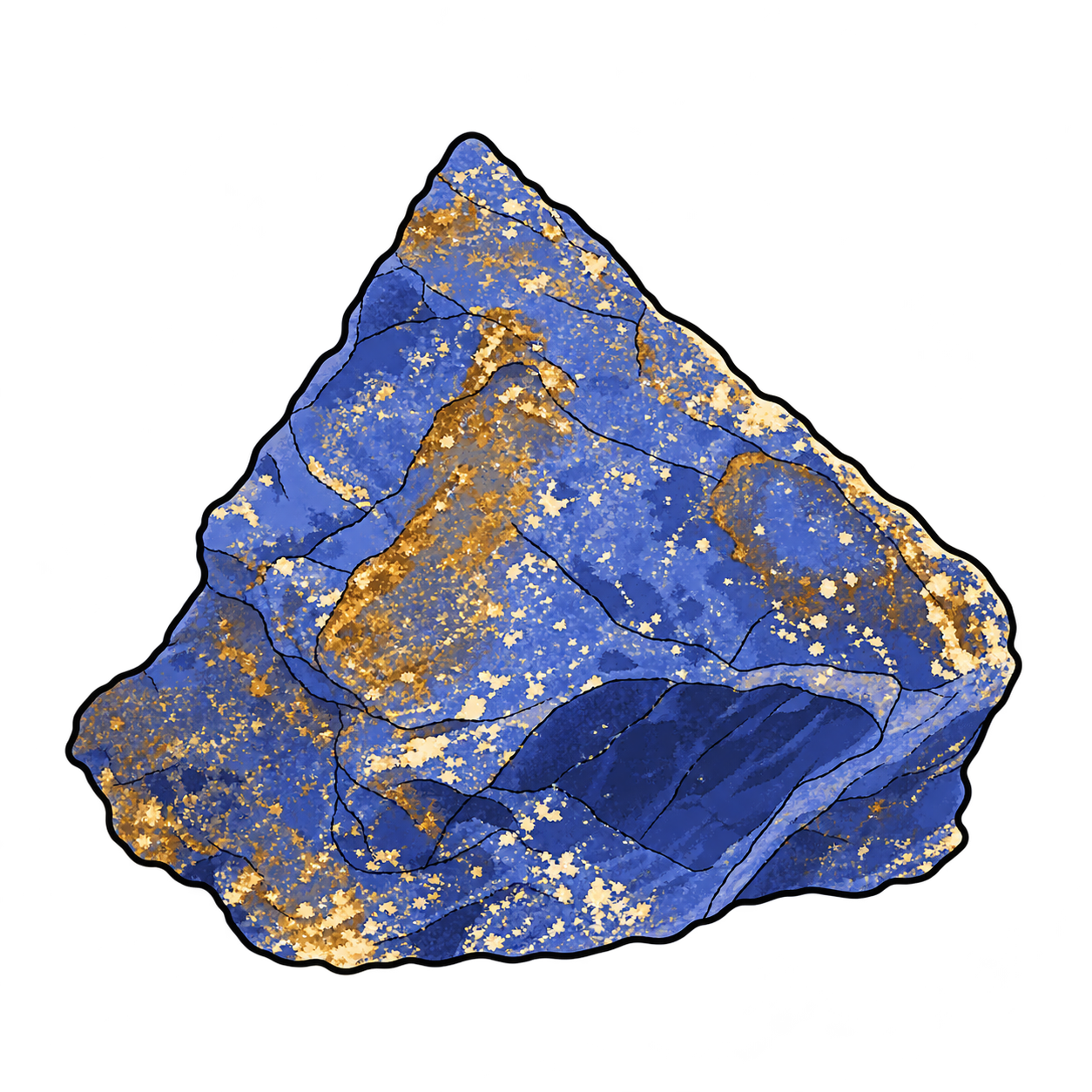
A rock containing blue lazurite with variable calcite, pyrite and other minerals.
Natural ornamental rock assemblage
Loading this page…
Return homePlease wait while the next page arrives.


A blue ornamental rock
A rock containing blue lazurite with variable calcite, pyrite and other minerals.
Natural ornamental rock assemblage
Lapis lazuli is an opaque blue rock used for jewelry, carving, inlay and pigment.
Geology · Human history · Spiritual attributes
Wisdom · Truth · Communication · Intuition · Inner vision [5]
Lapis lazuli is an opaque blue rock used for jewelry, carving, inlay and pigment. It combines several minerals rather than forming a single crystal: blue areas are interspersed with pale material and, often, metallic flecks of pyrite. Its distinctive appearance has made it a prized ornamental material, while contemporary crystal practice associates it with wisdom, intuition and truthful expression. [1, 2, 5]
In contemporary crystal practice, lapis lazuli is associated with understanding and expression: recognizing what one believes, then finding the confidence to articulate it. It is commonly linked with the third-eye and throat chakras and used in meditation or worn as a reminder of a personal intention. [5]
These associations describe a modern spiritual framework. The ancient objects made from lapis have their own cultural histories; their existence does not establish that their makers used today's chakra correspondences.
Composition: Variable mixture of blue sodalite-group minerals and accessory minerals Crystal system: No single system for the whole rock Mohs hardness: Commonly reported around 5–6; softer constituents occur Specific gravity: Approximately 2.75, varying with composition Transparency: Usually opaque Surface appearance: Granular or dull when rough; takes a smooth polish Typical optical reading: A spot refractive index near 1.50, with other readings possible on different constituents [1–4]
Lazurite is the blue mineral most often named in introductory descriptions of lapis, and the mineral belongs to the sodalite group. More detailed research also identifies closely related haüyne as important in material from some deposits. A useful description therefore distinguishes the rock from its constituent minerals rather than assigning the entire piece a lazurite formula. Pale calcite, brassy pyrite and other minerals contribute to its texture and appearance. [1, 3, 13]
A mixed rock does not respond uniformly to scratching. Softer calcite-rich areas can wear differently from the blue portions, and veins can provide weak points. The familiar hardness range is a practical guide, not a promise that every part of a carving has the same resistance. Density also varies with the mineral proportions. Two pieces of the same dimensions need not have precisely the same weight. [2]
Gemological measurements can differ according to the area tested. A spot reading obtained from a blue portion need not match one taken over a different mineral. Identification therefore considers the aggregate's texture, inclusions and several properties together. Neither a blue color nor a single bright metallic fleck is a sufficient authenticity test. [11, 12]
Lapis develops in metamorphic environments associated with carbonate rocks. Heat and mineral-bearing fluids alter the original rock and allow a new mineral assemblage to form. Lazurite can occur with calcite, pyrite, diopside, forsterite and other minerals. This explains why lapis is usually encountered as a granular mass or a worked piece rather than as a large, isolated blue crystal. [2, 3]
The Sar-e-Sang deposits of Badakhshan, Afghanistan, are particularly well known. Other documented sources include the Lake Baikal region of Russia and deposits in Chile. Material from different deposits can contain different proportions and combinations of accessory minerals; those differences are part of the rock's geological identity, not simply variations in jewelry grade. [3, 11]
A locality claim should come from a trustworthy record. Color and pyrite distribution can help describe a piece, but an attractive photograph cannot by itself establish the mine or country from which it came.
Blue and violet-blue body colors are central to the appeal of lapis. Fine jewelry material often emphasizes a strong, even blue with little visible pale mineral. Small, well-distributed pyrite flecks can be attractive, while extensive pale veining produces a different visual effect. A mineral collector may deliberately choose a boldly banded piece that would not fit the usual ideal for a uniformly colored cabochon. [1, 6]
Lapis should not be confused with lazurite as an individual mineral, or with lazulite, a separate phosphate mineral. Sodalite is another blue ornamental material and may resemble lapis, but visual similarity does not make the names interchangeable. Likewise, a manufactured imitation is not natural lapis simply because it contains metallic particles. GIA has documented an imitation whose visible pyrite initially suggested lapis until further testing showed otherwise. [2, 3, 12, 14]
The Queen's Lyre from Ur, dated by the British Museum to about 2600 BCE, includes lapis in its bull's hair, beard and eyes. The surviving decoration belongs to an instrument whose wooden structure and strings have been reconstructed. The blue beard is a striking feature, but the museum does not assign it a known symbolic meaning. [7]
A much smaller example is an Egyptian amulet from Lisht North in the Metropolitan Museum of Art. Measuring only eight millimeters high and dated approximately 1981–1640 BCE, it shows how lapis was worked into intimate objects as well as elaborate decoration. Its archaeological record supports its identity and context without revealing the personal intention of its wearer. [8]
Lapis supplied the raw material for natural ultramarine, an exceptionally valued blue in European painting. Producing the pigment meant separating the desired blue from the rock's other constituents, not merely grinding any blue fragment. Getty's reconstruction of a fourteenth-century recipe uses crushed stone, beeswax and resin as part of that extraction process. [9]
The National Gallery traces the color from lapis mined in Badakhshan to the development of artificial French ultramarine in the nineteenth century. Its discussion includes the rich blue robe in Pierre Mignard's 1691 portrait of the Marquise de Seignelay. The history of lapis therefore includes both preserving the stone in a carving and transforming it into a painter's material. [10]
Decide whether your priority is uniform color, a distinctive mineral pattern, fine carving or documented provenance. For a cabochon, inspect the polish and the edges as well as the central blue area. For a carving, look at thin projections, veins and any repaired breaks. Beads should be examined around their drill holes, where chips may be less obvious in a display photograph.
Ask whether the material has been dyed, waxed, oiled, impregnated or reconstructed. These are different interventions: a treatment alters a natural material, while an imitation substitutes another material for it. Disclosure is more informative than a vague claim that a piece is “real.” A rich color is not itself proof of treatment, and pale veins do not establish that a piece is untreated. [4, 6, 12]
Clean gently with warm, mildly soapy water, first checking a small inconspicuous area if the treatment history is uncertain. Dry with a soft cloth and keep lapis from rubbing against harder stones. Avoid steam and ultrasonic cleaning. [4, 6]
Heat and solvents can damage waxes or other treatments. Do not use alcohol or nail-polish remover as a home authenticity test: even if a test reveals dye, it may leave the object permanently altered. For an antique, repaired carving or piece with an unfamiliar surface finish, follow the supplier's or conservator's instructions rather than assuming ordinary gem-cleaning methods are suitable. [4]
origin.prod.gia.edu · Reference for the accompanying text · Reference recorded October 15, 2026
geology.com · Reference for the accompanying text · Reference recorded October 15, 2026
handbookofmineralogy.org · Reference for the accompanying text · Reference recorded October 15, 2026
gia.edu · Reference for the accompanying text · Reference recorded October 15, 2026
thecrystalcouncil.com · Reference for the accompanying text · Reference recorded October 15, 2026
origin.prod.gia.edu · Reference for the accompanying text · Reference recorded October 15, 2026
britishmuseum.org · Reference for the accompanying text ·
metmuseum.org · Reference for the accompanying text · Reference recorded October 15, 2026
getty.edu · Reference for the accompanying text · Reference recorded October 15, 2026
nationalgallery.org.uk · Reference for the accompanying text · Reference recorded October 15, 2026
gia.edu · Reference for the accompanying text · Reference recorded October 15, 2026
cms.gia.edu · Reference for the accompanying text · Reference recorded October 15, 2026
gia.edu · Reference for the accompanying text · Reference recorded October 15, 2026
handbookofmineralogy.org · Reference for the accompanying text · Reference recorded October 15, 2026