Iridescent copper minerals beneath a shared trade name
Peacock Ore: Bornite and Chalcopyrite
A retail label commonly applied to iridescent copper-iron sulfides.
Appearance-based trade category for copper-iron sulfide specimens
Loading this page…
Return homePlease wait while the next page arrives.


Iridescent copper minerals beneath a shared trade name
A retail label commonly applied to iridescent copper-iron sulfides.
Appearance-based trade category for copper-iron sulfide specimens
Peacock ore is a name for an appearance, not a single mineral species.
Geology · Human history · Spiritual attributes
Transformation, opportunity, fresh beginnings and spiritual communication in contemporary chalcopyrite practice. [4]
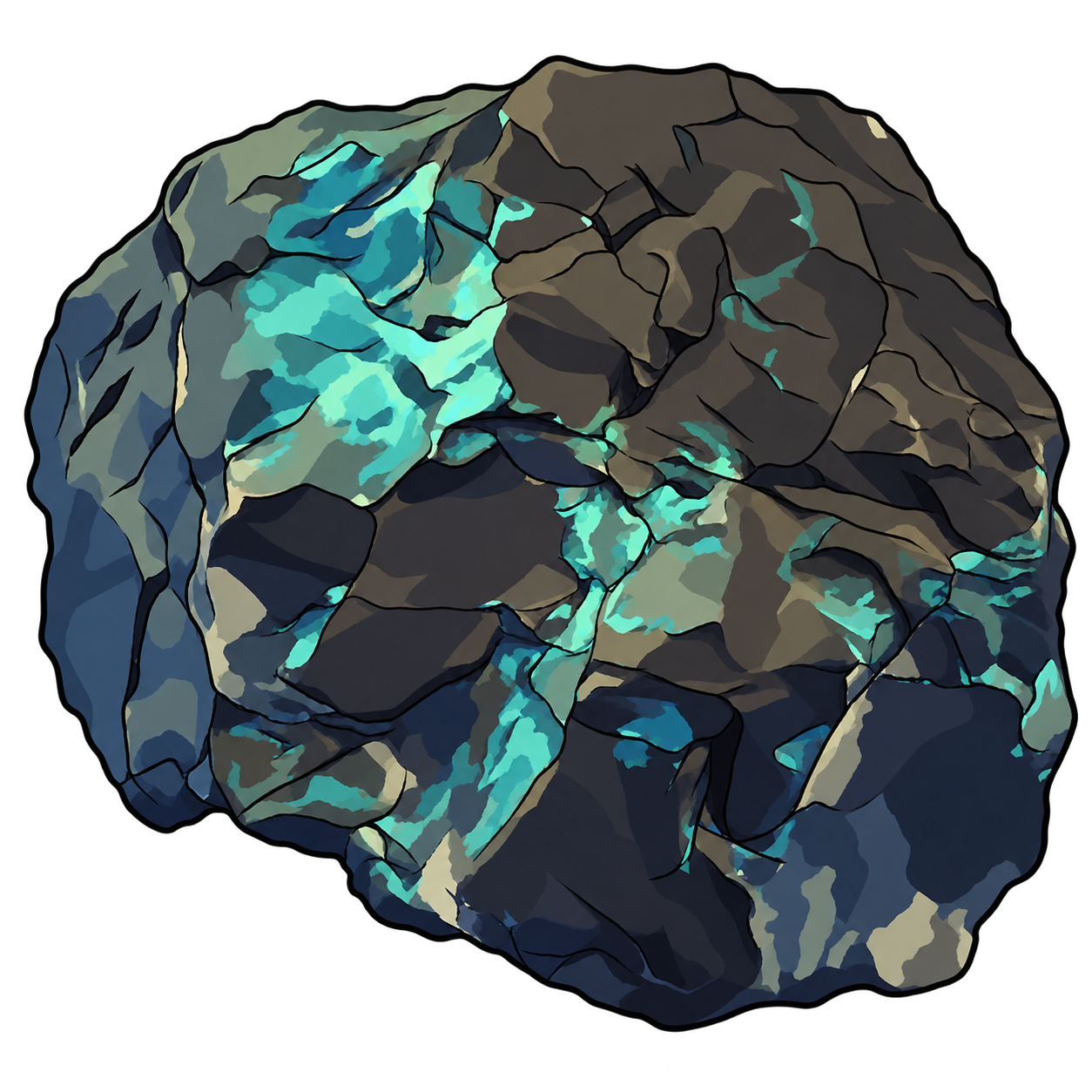
Peacock ore is a name for an appearance, not a single mineral species. Its attraction lies in the blue, green and violet surface colors that interrupt the metallic body of a copper-bearing stone. Beneath that surface there may be bornite, chalcopyrite, or a specimen containing several minerals. Knowing which material is present gives the color a more interesting story than the trade name alone can provide.
The Crystal Council associates chalcopyrite with changing established habits, recognizing opportunities and finding direction. Its chakra interpretation particularly emphasizes the throat, third eye and crown: expression, intuitive reflection and spiritual awareness. These are contemporary practitioner associations, not measured consequences of the copper or sulfur in the stone. [4]
For a collector who uses stones symbolically, the contrast between a dark metallic interior and vivid surface color can offer a focus for reflection on change. That interpretation need not depend on a claim that every rainbow-colored specimen has the same spiritual tradition. A bornite specimen should not automatically acquire a history written for chalcopyrite simply because both were sold as peacock ore. Identification and personal meaning answer different questions.
Bornite is copper iron sulfide, Cu5FeS4. Fresh surfaces are copper-red to brown, and its familiar iridescence develops through tarnishing. The Handbook of Mineralogy describes an orthorhombic structure with pseudocubic forms, a hardness of about 3–3.25 and a density near 5.07 g/cm³. It is brittle, opaque and metallic; many specimens are massive or granular rather than well-shaped crystals. [1]
Chalcopyrite has the different composition CuFeS2. It is tetragonal, usually brass-yellow before tarnishing, and slightly harder at 3.5–4 on the Mohs scale. Its density is approximately 4.1–4.3 g/cm³. Crystals may have tetrahedral-looking forms, although massive material is common. The distinction is not cosmetic: these are different atomic structures and different proportions of copper, iron and sulfur. [2]
The vivid film should therefore be separated conceptually from the bulk mineral. An illustration records the artist's treatment of reflected color; it cannot establish a chemical identification, the thickness of a surface film or whether a seller enhanced that surface.
Bornite occurs in several geological settings, including copper-bearing sedimentary rocks, hydrothermal deposits and mineralized rocks near igneous intrusions. The Handbook records associations with chalcopyrite, pyrite, quartz and other minerals. A mixed specimen is consequently unsurprising and does not need to be forced into one uniform identity. [1]
Chalcopyrite is an important primary copper mineral in veins, stockworks, disseminated deposits and replacement bodies. Here “disseminated” means that mineral grains are distributed through a larger rock rather than concentrated in one spectacular crystal. A small shop specimen represents only a fragment of that geological setting. Its original label, collection history and host rock may reveal more about its origin than the strength of its rainbow colors. [2]
Bornite honors the mineralogist Ignaz Edler von Born. Chalcopyrite's name combines the Greek association with brass and the mineral name pyrite. Peacock ore instead belongs to descriptive trade language: it evokes the colors of a peacock rather than naming a crystal structure. [1,2]
The University of St Andrews collection records bornite under this colorful common name. That museum usage supports the connection between bornite and peacock ore, but it does not make every retail item bearing the name bornite. For a collection label, a useful sequence is the identified mineral, any known treatment, the documented locality, and then the trade name in parentheses. If the species has not been established, retain that uncertainty rather than silently converting a marketing label into an identification. [3]
Both bornite and chalcopyrite can be iridescent. Color alone is inadequate for distinguishing them, especially in an aggregate with weathered surfaces. Visible crystal habit, fresh-surface color and density may assist a mineralogist, but tests that scratch or break a display piece sacrifice part of the object. Request an identification supported by the supplier's records, or professional examination when the distinction matters.
Chemically enhanced material is sold under the same trade name. The Crystal Council's retail account describes acid-treated chalcopyrite. The practical purchasing question is whether enhancement has been disclosed. A colorful treated specimen can still be attractive, but a treatment should not be represented as proof of an untouched natural surface. [4]
Preserve the surface rather than trying to make it brighter. Abrasive polishing can remove exactly the film for which the specimen was selected. As a conservative display practice, use a soft dry brush for loose dust, support fragile edges and keep the stone apart from harder objects. Avoid acids, bleach, salt baths and prolonged soaking; do not attempt to reproduce commercial treatment at home.
A mineral display specimen is not a drinking-water additive. Keep its label with it, including any treatment disclosure. That modest record protects both its scientific meaning and the honesty of any future sale or gift.
handbookofmineralogy.org · Reference for the accompanying text · Reference recorded October 15, 2026
handbookofmineralogy.org · Reference for the accompanying text · Reference recorded October 15, 2026
collections.st-andrews.ac.uk · Reference for the accompanying text · Reference recorded October 15, 2026
thecrystalcouncil.com · Reference for the accompanying text · Reference recorded October 15, 2026