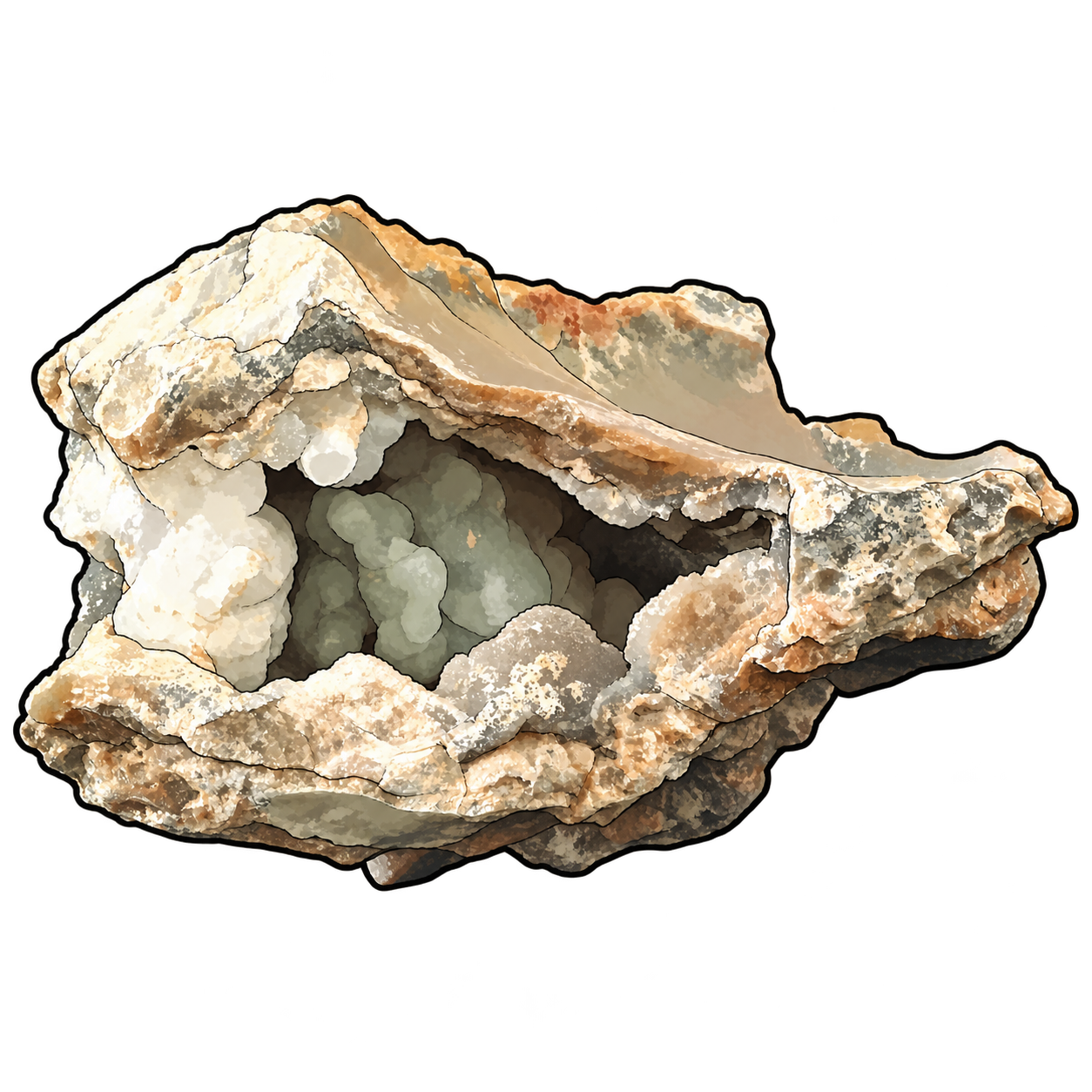
Pale green growth within the spaces of older rock
Prehnite
Calcium aluminium silicate, often pale green and botryoidal.
Calcium-bearing hydroxyl silicate mineral species
Loading this page…
Return homePlease wait while the next page arrives.


Pale green growth within the spaces of older rock
Calcium aluminium silicate, often pale green and botryoidal.
Calcium-bearing hydroxyl silicate mineral species
Prehnite is a distinct mineral, not a pale kind of jade or quartz.
Geology · Human history · Spiritual attributes
Contemporary crystal practice associates prehnite with bringing intention into agreement with feeling. The Crystal Council expresses this through heart and solar-plexus symbolism: what matters inwardly is joined with will and action. These are spiritual correspondences, not established mineral effects. [1]
A rounded specimen can accompany reflection on a practical next step toward something valued. In modern combinations, prehnite with epidote may symbolize intention joined with amplification; that interpretation is separate from identifying the minerals or explaining their geological association. [1]
Prehnite is a distinct mineral, not a pale kind of jade or quartz. Its formula includes calcium, aluminum, silicon, oxygen and hydroxyl. It crystallizes in the orthorhombic system, although individual crystals are often concealed within rounded or fanlike aggregates. A naturally globular specimen is therefore not equivalent to a sphere shaped on a lapidary wheel. [2]
Its Mohs hardness is 6–6½ and its specific gravity is approximately 2.80–2.95. Good cleavage in one direction and brittle behavior are important counterpoints to that moderate hardness: an exposed edge can chip even when the main polished surface resists ordinary wear. Its luster is generally glassy, sometimes faintly pearly on cleavage surfaces. [2]
Translucency is common and can be part of the appeal rather than a defect. Light enters the surface but is scattered enough that objects beyond it are not sharply resolved. Clearer portions can be faceted; cloudier material often works well as beads, cabochons or carvings. Museums Victoria describes both the familiar rounded habits and less common blocky or prismatic crystals. [3]
Prehnite frequently develops after its host rock has formed, when fluids move through fractures and openings. The Handbook of Mineralogy records it in veins and cavities of mafic volcanic rocks and as a product of low-grade metamorphism. Zeolites, calcite and epidote are among its companions. [2]
A cavity specimen can preserve a sequence rather than a single event. An Australian Museum study of material from Prospect, New South Wales, recorded prehnite followed by pectolite and calcite, with apophyllite growing later on pectolite. The importance of that observation is not that every prehnite cavity follows the same order; it is that one mineral's position on another can record successive episodes of growth. [4]
The illustrated cavity makes that distinction visible in a general way: an older-looking outer wall frames a contrasting interior growth. The painting does not establish the minerals in the rim or their exact sequence. A specimen's locality record and examination of its contacts are necessary before assigning such a detailed history.
GIA's examination of four polished specimens from Mali found a wavy aggregate texture, sometimes arranged radially, together with cloudy regions, thin reflective films and partially healed fractures. A yellow specimen also showed weak irregular color zoning. These observations explain why a polished prehnite can look softly illuminated rather than optically empty. They describe those examined samples, not a universal checklist for all prehnite. [5]
An Australian prehnite in the Gübelin collection provides another documented example. GIA measured a specific gravity of 2.91 and refractive indices of 1.618 and 1.638; its principal microscopic feature was gently undulating growth. Such measurements help separate a positive identification from a color-based guess. A pale green appearance alone does not distinguish prehnite from every other translucent ornamental material. [6]
Dark inclusions should likewise be named with care. Epidote is an established associate, but a seller's familiar phrase is not an analytical result for every black or green needle. When the inclusion has not been identified, “dark prismatic inclusions” is more accurate than an unsupported species name.
Museums Victoria records Werner's description of prehnite in 1788 from South African material and its naming for Hendrik von Prehn. That naming history belongs to European mineralogical classification; it should not be stretched into a claim that no one had encountered the stone previously. The museum's Queensland specimen also illustrates how widely the mineral occurs beyond its original named locality. [3]
Prehnite is not limited to untouched mineral clusters. The Australian Museum's ornamental collection includes a small frog carved from Wave Hill material and donated in 2012. The carving exploits the stone's soft green appearance in a different way from a crystal specimen: the artist supplies the external form while the mineral supplies its color and internal texture. [7]
This distinction helps in appreciating a collection. A polished piece reveals cross-sections through an aggregate; an uncut cluster preserves the surface on which growth ended. Neither needs to imitate the other to be compelling. Photographs of both front and edge can show whether a piece's character lies mainly in its surface relief, translucency or included crystals.
Handle cavity specimens by the sound matrix rather than the projecting green lobes. A gentle brush is preferable to scrubbing into a recess, where delicate associated crystals or loose grains may be hidden. Keep polished pieces separated from harder stones so they cannot rub together in storage.
For an intact, untreated polished piece, brief cleaning with mild soapy water and a soft cloth is a conservative approach. Avoid steam, strong chemicals and abrupt temperature changes; do not assume that the host rock, inclusions, repairs and setting tolerate everything the main mineral does. Unknown coatings or fillings are a reason to seek specific advice before soaking. Its structural hydroxyl is not a reason to keep a specimen wet.
thecrystalcouncil.com · Reference for the accompanying text · Reference recorded October 15, 2026
handbookofmineralogy.org · Reference for the accompanying text · Reference recorded October 15, 2026
collections.museumsvictoria.com.au · Reference for the accompanying text · Reference recorded October 15, 2026
media.australian.museum · Reference for the accompanying text · Reference recorded October 15, 2026
gia.edu · Reference for the accompanying text · Reference recorded October 15, 2026
gia.edu · Reference for the accompanying text · Reference recorded October 15, 2026
australian.museum · Reference for the accompanying text · Reference recorded October 15, 2026