Open Frameworks, Fans and Fine Crystal Sprays
Zeolites: Stilbite and Scolecite
A family of hydrated aluminosilicates; species differ.
Hydrated aluminosilicate mineral family
Loading this page…
Return homePlease wait while the next page arrives.


Open Frameworks, Fans and Fine Crystal Sprays
A family of hydrated aluminosilicates; species differ.
Hydrated aluminosilicate mineral family
Zeolites are a family of minerals, not one stone with one formula.
Geology · Human history · Spiritual attributes
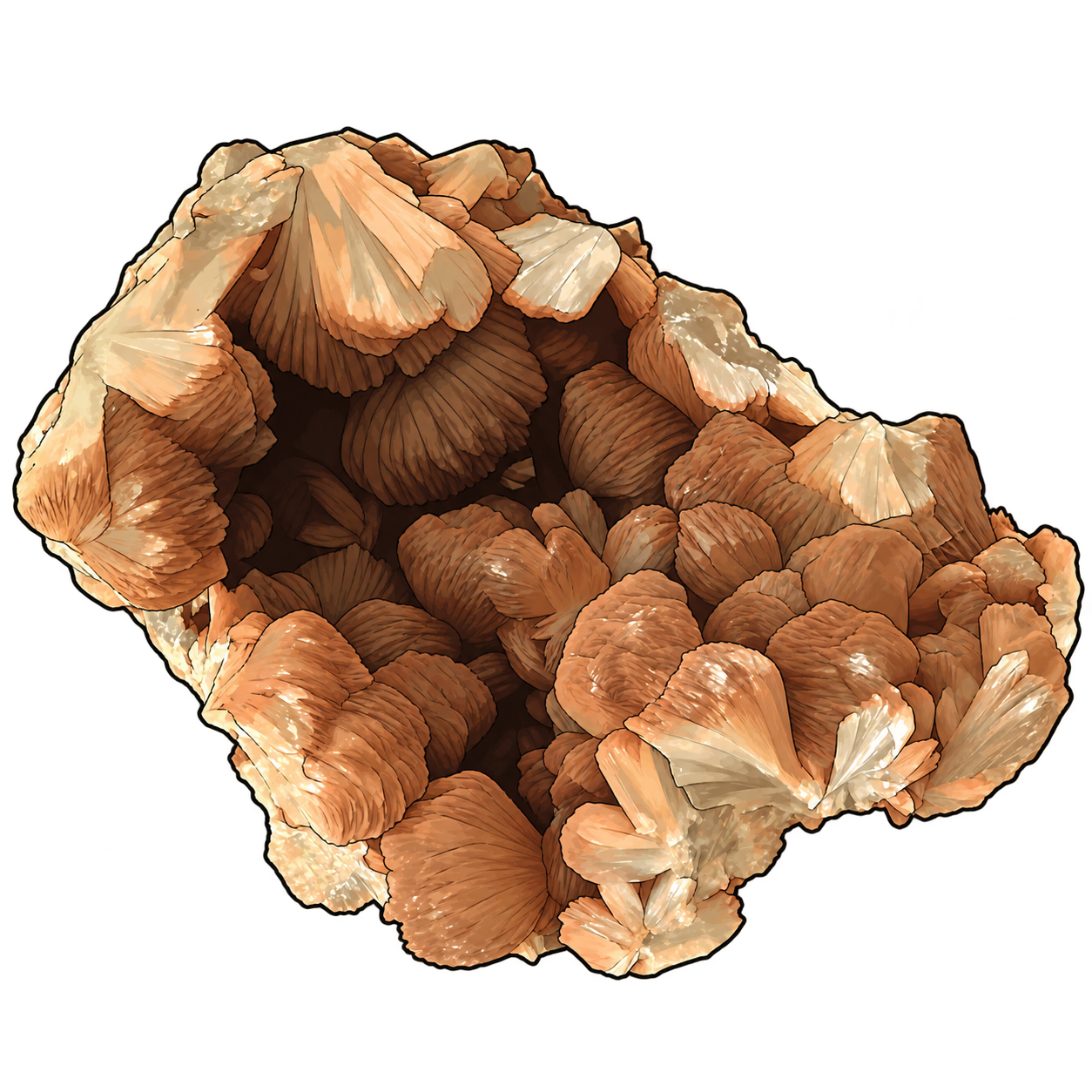
Zeolites are a family of minerals, not one stone with one formula. Their hydrated aluminosilicate frameworks accommodate water and positively charged ions within microscopic spaces. At the scale of a display specimen, that shared structural idea produces remarkably different forms: broad stilbite sheaves, slender scolecite sprays, mesolite tufts and natrolite prisms. A cavity containing several of them is a small mineral assemblage rather than a single crystal type. [1–5]
Spiritual associations are generally attached to individual zeolites rather than uniformly to the whole family. In modern crystal practice, stilbite is associated with compassion and emotional reflection, while scolecite is associated with inner peace and contemplative attention. These interpretations are not equivalent to the measurable ion-exchange or adsorption properties of industrial zeolites. [6, 7]
These are attributed spiritual meanings, not evidence that a specimen treats distress or changes memory. A fragile spray can remain safely on a shelf while accompanying a personal practice; it need not be held against the face or carried loose in a pocket.
Stilbite: Commonly flattened, sheaf-like or fan-shaped aggregates; hardness approximately 3½–4; perfect cleavage and brittle crystals. White, peach and brown tones are familiar. [2]
Scolecite: Calcium-bearing zeolite, CaAl₂Si₃O₁₀·3H₂O; monoclinic; typically slender prisms or radiating sprays; hardness about 5–5½. Individual tips remain fragile despite that scratch hardness. [3]
Mesolite: Contains both sodium and calcium, Na₂Ca₂Al₆Si₉O₃₀·8H₂O; orthorhombic; often hairlike tufts, radiating aggregates or fibrous masses; hardness about 5. [4]
Natrolite: Sodium-rich zeolite, Na₂Al₂Si₃O₁₀·2H₂O; orthorhombic; commonly prismatic or radiating; hardness about 5–5½. [5]
The family therefore has no single crystal system, hardness or decorative habit. A label saying only zeolite may identify a broad relationship while leaving the actual species unresolved. That is preferable to inventing a precise name, but it is not enough to transfer every property of one member to another.
The internal spaces in zeolite frameworks help explain their adsorption, ion-exchange and molecular-sieving behavior. Appropriate zeolite materials can retain substances at internal surfaces, exchange certain ions or select molecules according to their interaction with the structure. These are material-specific physical and chemical processes, not a general ability to remove anything unwanted. [1]
Industry uses both natural and manufactured zeolites. Applications include water treatment, detergents, catalysts and selected horticultural products. Those materials are chosen and processed for a defined purpose. An attractive collector's cluster is neither an approved water filter nor a product intended for consumption; its name alone establishes no such suitability. [1]
Many collector specimens form in cavities within volcanic rocks. Fluid movement after the host has solidified can provide the chemical ingredients for new crystals. Mesolite is documented in cavities of basalt and other volcanic rocks, as well as hydrothermal veins. The contrast between the surrounding dark rock and delicate pale crystals records two different parts of a geological history. [4]
Scolecite occurs notably in basalt cavities but also in other rock settings. Natrolite can form late in cavities or fill seams in rocks including granite and syenite. These differences matter: the convenient picture of a zeolite growing in a lava bubble is useful, but it does not describe every occurrence. [3, 5]
A cavity may hold multiple mineral generations. A crystal growing on another mineral's surface generally came later at that contact, although the complete sequence can be more complicated than one visible overlap. Preserving the matrix and associations allows that relationship to be examined. Separating every crystal from its support can destroy information along with the specimen's stability.
Stilbite's broad, flattened elements differ visibly from the open needles of a fine scolecite spray. Mesolite and natrolite can also form narrow pale crystals, making identification by general silhouette unreliable. The actual crystal geometry, locality, association and—when needed—analysis are more useful than a trade photograph labeled simply white zeolite. [2–5]
Apophyllite often appears in the same collections but is not a zeolite. The A. E. Seaman Mineral Museum explicitly distinguishes it from its frequent companions. A specimen can therefore contain a genuine zeolite together with a clear, pointed mineral that belongs to a different group. The association is interesting precisely because the minerals are not interchangeable. [8]
Maharashtra in India and basalt localities in Iceland are celebrated sources of fine scolecite and associated minerals. Mesolite also occurs in western North America and the Bay of Fundy region; natrolite has noteworthy occurrences in alkaline complexes as well as basalt settings. The familiar pale colors conceal substantial variation in geological context. [3–5]
Keep a locality label with a specimen and record which component each name describes. A label listing three minerals should not imply that each is equally abundant or visible. A small, well-documented crystal can be a more informative addition to a collection than a larger piece with an unsupported species name.
Natrolite's name refers to sodium. Mesolite's name recalls an intermediate composition, reflecting its relationship to sodium-rich natrolite and calcium-bearing scolecite. Scolecite's name alludes to its behavior in an old heating test. These names preserve earlier ways of recognizing materials, while modern analyses provide a much more detailed account of their structures and compositions. [3–5]
A spray's outline is made from many tiny exposed tips. Move it by its matrix or container, not by the crystals, and give it a protected display space. Even when the mineral has moderate hardness, its thin geometry and cleavage make the cluster vulnerable to brushing, snagging or impact. Compact material and open needles should not be handled as though they have the same durability. [3–5]
Avoid vigorous brushing, compressed air directed into fragile sprays, and unverified chemical or ultrasonic cleaning. Identify all minerals present before wet cleaning: a mixed specimen must be treated according to its most vulnerable component. Do not heat a crystal to reproduce a historical test, and do not generate dust by grinding or crushing a collector specimen. Careful preservation reveals more than a destructive demonstration.
usgs.gov · Reference for the accompanying text · Reference recorded October 15, 2026
handbookofmineralogy.org · Reference for the accompanying text · Reference recorded October 15, 2026
handbookofmineralogy.org · Reference for the accompanying text · Reference recorded October 15, 2026
handbookofmineralogy.org · Reference for the accompanying text · Reference recorded October 15, 2026
handbookofmineralogy.org · Reference for the accompanying text · Reference recorded October 15, 2026
thecrystalcouncil.com · Reference for the accompanying text · Reference recorded October 15, 2026
thecrystalcouncil.com · Reference for the accompanying text ·
museum.mtu.edu · Reference for the accompanying text · Reference recorded October 15, 2026