Clear Geometry in Mineral-Lined Cavities
Apophyllite
A group of hydrous silicate minerals.
Hydrous silicate mineral group
Loading this page…
Return homePlease wait while the next page arrives.


Clear Geometry in Mineral-Lined Cavities
A group of hydrous silicate minerals.
Hydrous silicate mineral group
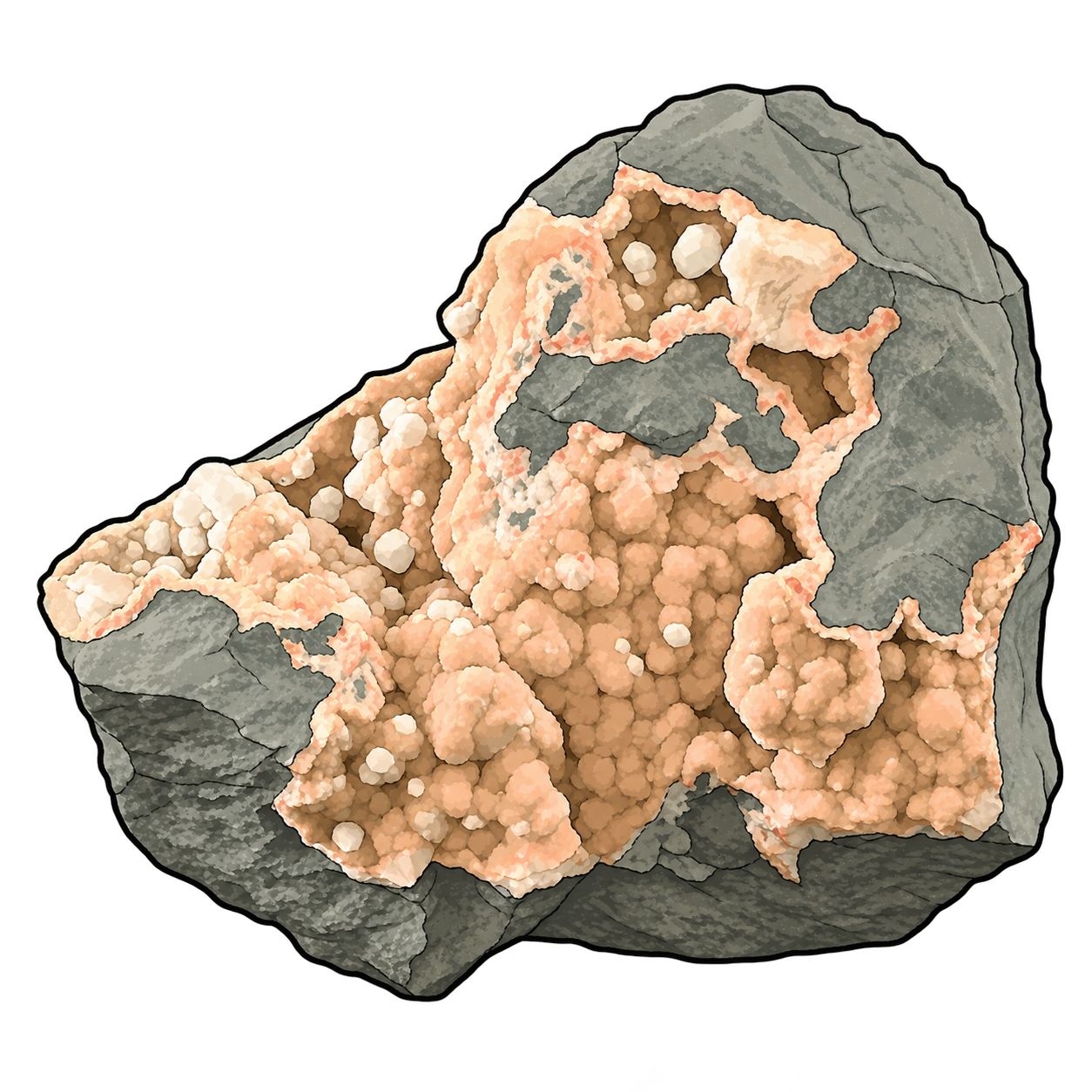
Apophyllite names a group of hydrated silicates whose reflective, blocky or pointed crystals often line mineral cavities.
Geology · Human history · Spiritual attributes
In contemporary crystal practice, apophyllite is associated with meditation, intuitive reflection and spiritual connection. Practitioners commonly connect it with the third-eye and crown chakras; green material is also associated with an attentive relationship to nature. These are spiritual interpretations rather than established effects of the mineral on the brain, sleep or perception. [2]
Some traditions within modern crystal practice connect apophyllite with dream exploration. Those beliefs do not establish that a specimen causes lucid dreams or transfers energy between dimensions. The crystal can hold personal significance without turning a spiritual interpretation into a mineralogical claim.
Group name: Apophyllite Common reference species: Fluorapophyllite-(K) Reference formula: KCa₄Si₈O₂₀F·8H₂O Crystal system of that species: Tetragonal Mohs hardness: About 4½–5 Cleavage: Perfect parallel to the base Tenacity: Brittle Luster: Glassy on crystal faces; pearly on some cleavage surfaces Common habits: Tabular, prismatic or nearly cubic-looking crystals, sometimes with pyramidal terminations [1]
Fluorapophyllite-(K) and hydroxyapophyllite-(K) differ in the fluorine–hydroxyl balance; other members involve additional chemical distinctions. The short group name remains useful where a specimen has not been analyzed. It is more accurate to label such a piece apophyllite than to assign a precise species from green color alone. Formal nomenclature tracks composition, not simply the appearance most familiar in a crystal shop. [1, 3]
The water in the formula is part of the mineral's structure, not a puddle trapped inside a hollow crystal. Heating can remove it and change that structure. Experimental work on the group describes staged dehydration, eventually leading to collapse into an amorphous material. A specimen's response to substantial laboratory heating should not be confused with ordinary room-temperature display, but it does explain why heat testing is destructive. [4]
Four-sided outlines reflect tetragonal symmetry. A reflective flat surface may be a growth face or a cleavage break. [1]
Apophyllite is frequently collected alongside zeolites, but it is not itself a zeolite. Similar growth settings and neighboring crystals have encouraged the loose use of that label in the specimen trade. Shared surroundings do not erase differences in mineral structure. A cluster containing both apophyllite and stilbite is an association of distinct minerals, not a single species with two habits. [5]
FORMATION: A CAVITY AFTER THE LAVA
Many familiar specimens formed when mineral-bearing fluids occupied openings in already solidified volcanic rock. The cavity created space for faces and terminations to develop, while changing fluid conditions could produce successive generations of different minerals. Museum records describe apophyllite in amygdales and secondary veins of altered igneous rocks. Its presence records later mineral growth, not necessarily crystallization directly from the original lava. [3]
The Welsh record broadens this picture. Museum specimens include blocky crystals on pectolite and occurrences in altered gabbro or microgabbro. These are less familiar than the large Indian cavity clusters, but they show why one attractive commercial form cannot represent the group's entire geological range. Preserved museum specimens also allow identifications to be checked by methods such as X-ray diffraction. [3]
India and Iceland are among the documented sources. [1]
In Michigan's Lake Superior copper district, apophyllite-series minerals are recorded among the late minerals lining cavities and fissures. Museum examples include plates, pyramidal forms and crystals coating native copper. This association is especially revealing: the attractive crystals belong to a sequence of mineral growth that can be studied, not merely an ornamental arrangement assembled for display. [5]
Some transparent apophyllite is faceted for collectors. GIA's Gübelin collection includes a documented 7.48-carat example. A cut gem demonstrates that transparency can be sufficient for faceting; it does not make the material as resistant to scratching or cleavage as more durable everyday jewelry stones. [6]
Inspect a cluster from more than its best display angle. Check whether points are intact, whether broad shiny surfaces are natural faces or breaks, and whether the matrix supports the crystals securely. Ask about repaired attachments and any surface treatment. A repair may be acceptable when disclosed, but it changes what a collector is evaluating.
Keep the original label even if it uses an older name. It preserves the history of the specimen and can be supplemented with a current identification rather than discarded. For a specimen sold under a species-level name, ask whether that name is based on analysis or convention. A precise-looking label is not itself evidence of precision.
Gentle dry dusting is preferable for a fragile mixed-mineral specimen. Before wet cleaning, determine the needs of every associated mineral and any repair or mounting material. The finest specimen may be a small, undamaged group whose faces remain intact rather than a large cluster subjected to aggressive cleaning.
handbookofmineralogy.org · Reference for the accompanying text · Reference recorded October 15, 2026
thecrystalcouncil.com · Reference for the accompanying text · Reference recorded October 15, 2026
museum.wales · Reference for the accompanying text · Reference recorded October 15, 2026
cambridge.org · Reference for the accompanying text · Reference recorded October 15, 2026
museum.mtu.edu · Reference for the accompanying text · Reference recorded October 15, 2026
gia.edu · Reference for the accompanying text · Reference recorded October 15, 2026