Interlocking Minerals, Enduring Craft
Jade
Jadeite jade and nephrite / a material umbrella
Tough gem aggregates: jadeite jade, nephrite and relevant omphacite-rich material
Loading this page…
Return homePlease wait while the next page arrives.


Interlocking Minerals, Enduring Craft
Jadeite jade and nephrite / a material umbrella
Tough gem aggregates: jadeite jade, nephrite and relevant omphacite-rich material
Jade is valued not only for color but for the dense mineral fabric that allows it to become a fine-edged carving, a smoothly rounded bangle or a luminous cabochon.
Geology · Human history · Spiritual attributes
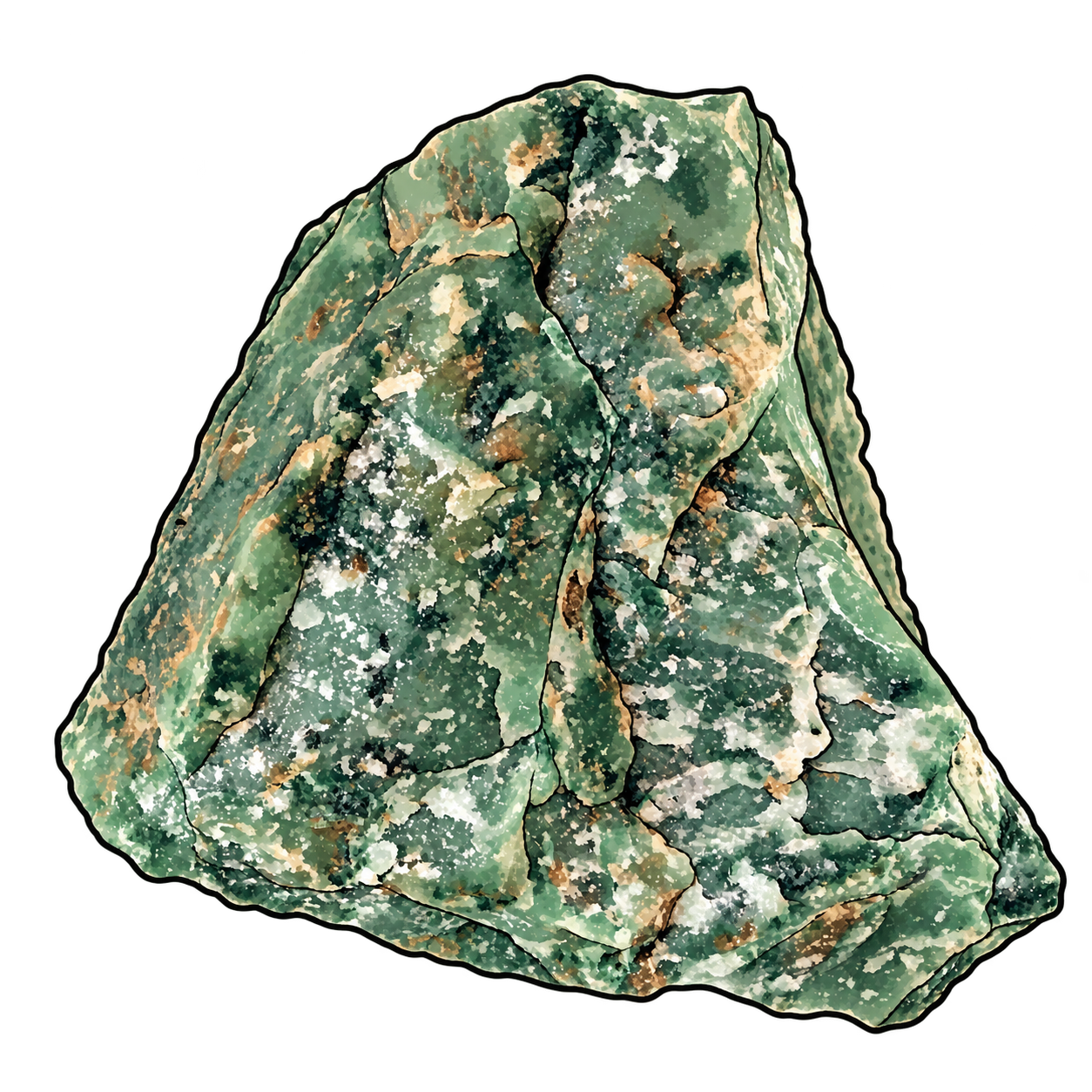
Compact interlocking mineral aggregates, principally jadeite jade or nephrite [1][3][4][5][6][7]
Green, white, lavender, gray, brown, yellow or other colors, depending on material [1][3][4][5][6][7]
Harmony · Love · Prosperity · Patience · Connection with Nature [2]
Jade is valued not only for color but for the dense mineral fabric that allows it to become a fine-edged carving, a smoothly rounded bangle or a luminous cabochon. The name principally encompasses jadeite jade and nephrite, with some green omphacite also recognized in gemological usage. These materials are related by appearance and use, not by one chemical formula. [1]
Contemporary crystal practice commonly links green jade with the heart, harmony and flourishing. The Crystal Council associates it with affection, abundance, patience and a connection with nature. These present-day correspondences are one strand of jade's meaning, not a summary of every culture that has valued it. [2]
Jade can be personally meaningful without being credited with physical healing powers. Chinese ethical traditions, Māori relationships with pounamu and modern crystal-shop associations deserve their own context; they are not interchangeable lists of effects.
Jadeite mineral: Sodium aluminum pyroxene, ideally NaAlSi₂O₆ Jadeite crystal system: Monoclinic Jadeite jade Mohs hardness: Approximately 6.5–7 Nephrite: Compact amphibole aggregate in the tremolite–actinolite compositional range Representative amphibole formula: Ca₂(Mg,Fe)₅Si₈O₂₂(OH)₂ Nephrite Mohs hardness: Approximately 6–6.5 Defining practical quality: Exceptional toughness in suitable compact material [3–5]
Hardness describes resistance to scratching. Toughness concerns resistance to breaking. Jade's interlocking texture helps prevent fractures from moving easily through an entire object; a carving can therefore be tough even though harder materials can scratch it. Thin projections, old repairs and pre-existing fractures remain vulnerable. A familiar name does not make every jade object equally durable. [1, 5]
Jadeite is an individual mineral; jadeite jade is the compact material fashioned into objects. The mineral's handbook entry records good cleavage in crystals, yet describes massive material as very tough. The aggregate texture matters. The handbook also records measured densities of roughly 3.24–3.43, reflecting compositional variation rather than a single exact value for every piece. [3]
Nephrite is not simply a softer grade of jadeite. Its tightly intergrown amphiboles belong to a different mineral family. Tremolite and actinolite participate in a compositional series in which iron substitutes for magnesium. Their mineral structure, and the way small crystals interlock, must be distinguished from the pyroxene grains of jadeite jade. [1, 4]
Jadeite jade includes lavender, white, yellow, orange and black as well as green. Nephrite also has a broad palette, often with more subdued tones. Some green omphacite closely resembles jadeite and requires advanced testing for distinction. A green appearance alone therefore answers neither the mineral-identification question nor the treatment question. [1]
Jadeite occurs in high-pressure metamorphic environments. The Handbook of Mineralogy associates it with glaucophane-bearing rocks and eclogite and records occurrences in Myanmar, Japan, Guatemala and California, among other regions. A specimen's geological setting explains why jadeite belongs to a different story from a quartz crystal growing in an open cavity. [3]
The amphibole minerals associated with nephrite form in appropriate calcium–magnesium-rich metamorphic environments. Tremolite can develop through reactions in siliceous carbonate rocks and in metamorphic rocks derived from magnesium-rich or ultramafic material. Not every tremolite-bearing rock has the compact fabric or quality needed to be called nephrite jade. [4]
CHINESE JADE: OBJECTS AND ETHICAL MEANINGS
The Metropolitan Museum's nephrite bi, object 17.118.43, dates to the mid-third millennium BCE and is attributed to the Liangzhu culture. Its carefully worked annular form demonstrates an investment of skill and labor. The museum identifies ritual use and social status as possibilities, rather than claiming that the precise meaning of this particular disk is known. [6]
Later Chinese writing used jade's perceived qualities as a language of character. In the Crow Museum's presentation of the Book of Rites, smoothness and luster evoke benevolence, compact strength suggests intelligence, and beauty that does not hide flaws becomes an image of loyalty. These are ethical comparisons: the observer is invited to cultivate a quality, not simply expect the stone to confer it. [7]
Such examples are more informative than a general claim that “ancient people believed in jade.” They identify an object, a text or a tradition and leave room for differences across centuries and communities.
Te Rūnanga o Ngāi Tahu describes pounamu as a taonga of deep cultural, spiritual and ancestral importance. Its significance involves relationships with place and people, not merely a preferred shade of green. Ngāi Tahu's authentication system uses a mark and traceability code to connect an object with the stone's origin and whakapapa. [8]
Pounamu is also broader than a strict jade-mineral label. Te Papa identifies tangiwai as bowenite rock, compositionally different from the more common nephrite. Cultural naming and mineralogical classification answer different questions; respecting one does not require erasing the other. [9]
TREATMENT: WHAT A, B AND C MEAN
These designations concern jadeite enhancement, not a descending scale of craftsmanship or beauty. A-jade permits ordinary surface waxing; B-jade has undergone bleaching and impregnation; C-jade has been dyed. B+C combines those processes. The letter does not authenticate an object's age or identify its maker. [10]
Impregnation is not limited to polymer resin. A published laboratory case documented a bangle deeply impregnated with wax, supported by infrared analysis and microscopic evidence. That is different from routine superficial waxing during polishing. A claim of “wax only” is therefore incomplete unless it distinguishes the process and extent. [11]
For valuable pieces, obtain an independent identification report and retain it with the object. An ultraviolet reaction, tapping sound or online photograph is not a substitute for a proper treatment determination.
Assess color distribution, texture, translucency and workmanship separately. The carving may deliberately use contrasting patches; a uniform commercial color is not the only attractive choice. Look for cleanly resolved details, comfortable proportions and a finish that suits the object. Inspect thin areas and joins without forcing or tapping them. GIA identifies texture, transparency, color and cut as distinct quality considerations. [10]
Use lukewarm soapy water and a soft cloth for routine care, then rinse and dry. Heat and warm acids can cause damage. Although untreated jade can tolerate cleaning methods unsuitable for many gems, treatment histories are often uncertain, so avoid steam and ultrasonic cleaning unless a qualified professional has confirmed suitability. [5]
Store pieces separately to prevent abrasion. Do not repolish an old carving merely to remove every sign of age: inscriptions, surface wear and associated records may be part of its historical value. For an antique, repaired or culturally significant object, seek conservation advice before altering the surface.
gia.edu · Reference for the accompanying text · Reference recorded October 15, 2026
thecrystalcouncil.com · Reference for the accompanying text · Reference recorded October 15, 2026
handbookofmineralogy.org · Reference for the accompanying text · Reference recorded October 15, 2026
handbookofmineralogy.org · Reference for the accompanying text · Reference recorded October 15, 2026
gia.edu · Reference for the accompanying text · Reference recorded October 15, 2026
metmuseum.org · Reference for the accompanying text · Reference recorded October 15, 2026
crowmuseum.org · Reference for the accompanying text · Reference recorded October 15, 2026
ngaitahu.iwi.nz · Reference for the accompanying text · Reference recorded October 15, 2026
collections.tepapa.govt.nz · Reference for the accompanying text · Reference recorded October 15, 2026
gia.edu · Reference for the accompanying text · Reference recorded October 15, 2026
gia.edu · Reference for the accompanying text · Reference recorded October 15, 2026