Blue Copper Carbonate
Azurite
Blue copper carbonate hydroxide.
Mineral species; ornamental specimens may include other minerals
Loading this page…
Return homePlease wait while the next page arrives.


Blue Copper Carbonate
Blue copper carbonate hydroxide.
Mineral species; ornamental specimens may include other minerals
Azurite ranges from a pale powder-blue crust to intensely blue crystals that can seem almost black until their faces catch the light.
Geology · Human history · Spiritual attributes
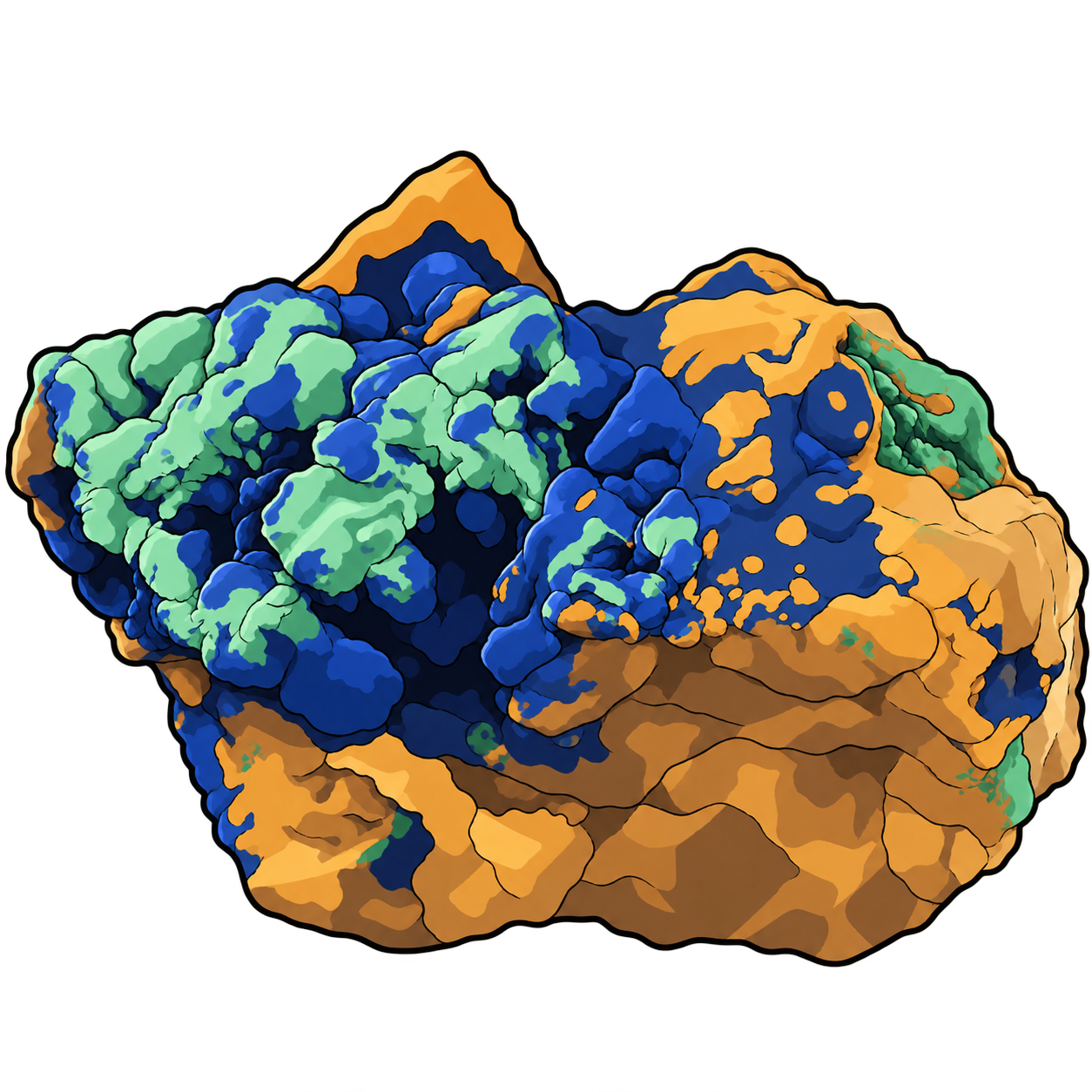
Azurite ranges from a pale powder-blue crust to intensely blue crystals that can seem almost black until their faces catch the light. A specimen may preserve individual blades, a sparkling coating or rounded masses. Green malachite often accompanies it, but the two colors represent different minerals, not two shades of one species. [1, 2]
Azurite's contemporary crystal associations concentrate on perception. The Crystal Council links it with the third eye and crown chakras, treating it as a companion for meditation and attention to the inner life. The following are attributed beliefs rather than laboratory-established effects. [3]
A display specimen can provide that visual focus without being repeatedly handled. There is no need to sacrifice delicate crystals to a ritual: keeping a fragile cluster on its stand preserves its natural surfaces.
Composition: Cu₃(CO₃)₂(OH)₂ Crystal system: Monoclinic Mohs hardness: 3.5–4 Specific gravity: Approximately 3.77 Streak: Pale blue Luster: Glassy to strongly brilliant Tenacity: Brittle Cleavage: Perfect but interrupted in one direction; additional weaker directions [1]
Azurite forms tabular or prismatic crystals, rosettes, radiating aggregates and druses—coverings of tiny crystals. Grain size and illumination influence its apparent blue. [1]
Scratch resistance does not predict the strength of a projecting point. Support a specimen from its base rather than lifting it by a crystal tip.
A streak test exposes the color of powdered material. It can help distinguish minerals in an educational setting, but it removes material. A polished stone or well-formed crystal should not be sacrificed merely to confirm a blue streak. Professional identification can choose methods appropriate to the object's value and condition.
Azurite forms in oxidized copper deposits, often in carbonate-bearing rocks, where dissolved copper precipitates as a secondary mineral. [1]
Changing conditions can favor replacement of azurite by malachite. Preservation of the earlier mineral's external shape produces a pseudomorph; adjacent green and blue alone do not prove that sequence. [2]
Azurite was an important mineral pigment, but grinding it was not simply a matter of turning a blue crystal into a uniformly blue powder. Particle size, pigment mixtures and the paint layers beneath it affected the final appearance. The National Gallery's technical study of Northern European painting documents two grades of azurite in Saint Peter's robe in the Master of the Saint Bartholomew Altarpiece's Saints Peter and Dorothy. It also records varied blues produced with azurite, white and red pigments. [4]
That technical evidence makes the history more informative than a general claim that the stone was “used by ancient people.” The surviving paint preserves decisions about preparation and layering. For a collector, those decisions offer another way to appreciate the mineral: its color is not independent of its physical form.
The painting itself, dated by the National Gallery to about 1505–1510, contrasts cloth, polished stone, flowers and the saints' attributes. Its painted textures demonstrate how mineral ingredients became part of an artist's much larger visual construction. [5]
Decide whether the attraction is crystal architecture, a natural nodule, or a cut blue-and-green aggregate. These are different collecting categories. Fine undamaged terminations may matter most in one, while color distribution or the relationship of azurite to its matrix may matter more in another.
Inspect a crystal specimen from several directions. Ask whether it has repairs, consolidants or attached fragments, and whether the label records a mine rather than only a country. A strong color does not authenticate a locality. For a polished object, request the material identification and treatment history; the label “azurmalachite” should describe azurite with malachite, not imply a new mineral species. [2]
Lighting also deserves attention. A dark crystal photographed with concentrated light may look different in an ordinary room. Compare daylight-balanced and diffuse images when possible, and use dimensions rather than a close-up alone to judge scale. An inexpensive small specimen can display excellent crystal detail without the mass of a larger carving.
Azurite is a relatively soft, brittle copper carbonate. Avoid acid cleaning, abrasive rubbing and heat. Keep specimens away from prolonged intense illumination and changing storage conditions; choose preservation rather than trying to intensify their color with oil or another surface product. [1, 2]
If dirt is embedded in a fragile matrix, consult a mineral conservator rather than soaking the whole object. Keep labels with their specimens and store pieces separately so that harder minerals cannot rub against them. A sound container and stable support often contribute more to long-term preservation than repeated cleaning.
handbookofmineralogy.org · Reference for the accompanying text · Reference recorded October 15, 2026
geology.com · Reference for the accompanying text · Reference recorded October 15, 2026
thecrystalcouncil.com · Reference for the accompanying text · Reference recorded October 15, 2026
nationalgallery.org.uk · Reference for the accompanying text · Reference recorded October 15, 2026
nationalgallery.org.uk · Reference for the accompanying text · Reference recorded October 15, 2026