Green Copper Carbonate
Malachite
Copper carbonate hydroxide.
Mineral species; ornamental specimens may include other minerals
Loading this page…
Return homePlease wait while the next page arrives.


Green Copper Carbonate
Copper carbonate hydroxide.
Mineral species; ornamental specimens may include other minerals
Malachite is a copper mineral whose green color is part of its chemistry, not an occasional variation.
Geology · Human history · Spiritual attributes
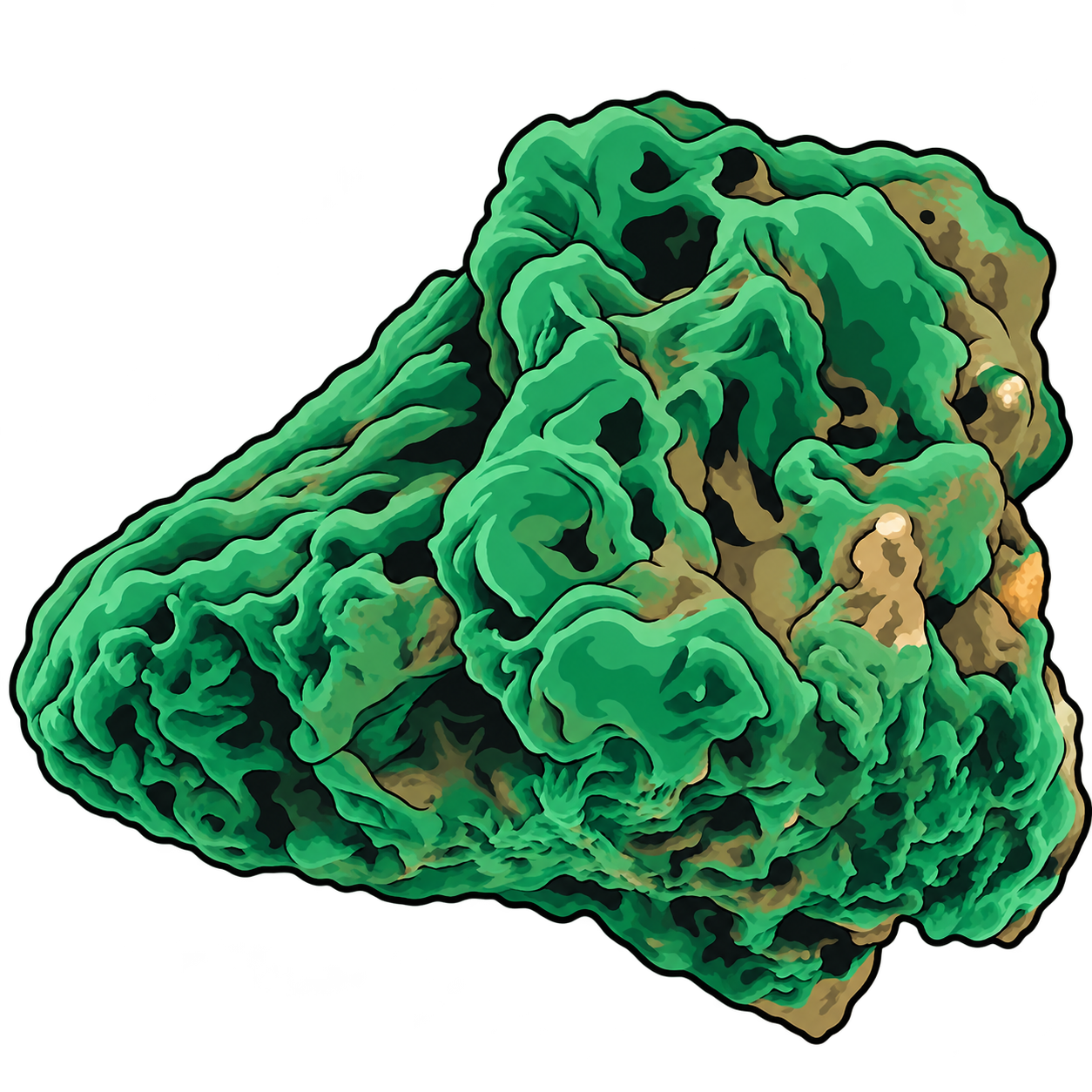
Malachite is a copper mineral whose green color is part of its chemistry, not an occasional variation. Its familiar stripes belong to masses of tiny crystals; an uncut specimen may instead present rounded lobes, silky fibers or delicate needles. It is collected both for those natural structures and for the striking patterns revealed by cutting and polishing. [1, 2]
In contemporary crystal practice, malachite is associated with active personal change rather than passive reassurance. The Crystal Council connects it with the heart and solar plexus and describes its protective meaning in terms of emotional boundaries and confidence. These are spiritual interpretations, distinct from its measured mineral properties. [3]
A polished piece can serve as a visual focus during reflection or meditation. Its symbolic use does not require grinding it, immersing it in drinking water or exposing it to aggressive cleansing methods.
Composition: Cu₂(CO₃)(OH)₂ Crystal system: Monoclinic Mohs hardness: 3.5–4 Specific gravity: About 4 in compact material Streak: Pale green Cleavage: Perfect in one direction; fair in another Fracture: Uneven to somewhat shell-like Transparency: Translucent to opaque [1]
“Botryoidal” describes a surface of rounded, grape-like growths. Malachite also forms stalactitic shapes and aggregates with radiating fibers inside. A silky sheen can therefore be a natural consequence of fine crystal texture; a dull surface is not automatically unfinished polish. Well-developed individual crystals are less familiar than masses, but malachite remains crystalline even when its constituent crystals cannot be separated by eye. [1]
Density and scratch resistance are different properties: a heavy carving can still be easily scratched. Neither property alone predicts whether a thin edge will survive a fall.
Cutting rounded growth exposes bands and eye-like patterns. Slice orientation changes the design, but a visual resemblance to agate does not make malachite a quartz variety. [2]
Malachite forms as copper deposits weather and copper-bearing water deposits secondary minerals in fractures, cavities and porous rock. It commonly accompanies azurite, chrysocolla and cuprite. [1]
A blue-and-green specimen may contain several minerals. Its description should account for the mixed material rather than assigning every visible area the properties of malachite.
The Metropolitan Museum of Art holds malachite recovered from a smelter's crucible in a foundation deposit at Hatshepsut's temple at Deir el-Bahri. The object, 25.3.95b, is dated to approximately 1473–1458 BCE and was excavated in the temple forecourt. This is a specific archaeological context linking malachite, copper working and a royal building project. It does not establish that all Egyptian malachite objects carried one spiritual meaning. [4]
Malachite is cut into beads, cabochons, inlay and small sculpture. The cutter's decisions affect how its pattern is read: concentric growth may become a set of eyes on one surface and long undulating stripes on another. Wax may be used to improve the appearance of small voids, so treatment information is useful even when the material itself is natural. [2]
An imitation is not the same as a treated natural stone. GIA documents glass made to resemble malachite by using fused colored layers. Such an object can reproduce green banding without having malachite's chemistry or physical behavior. A convincing photograph is consequently insufficient identification. [5]
For an important purchase, request the material identification, dimensions and clear views of the back, edges and any joins. Ask whether the object is a single piece, a construction of natural pieces, or an imitation; whether it has fillings or coatings; and whether a stated mine or locality is documented. Those questions establish what is being offered more effectively than deciding authenticity from the regularity of the stripes alone.
Inspect rough specimens for loose fibers, fragile projections and repairs. With a carving, look for cracks at thin sections and contact points. Choose the form for its intended use: a protected pendant or cabinet specimen faces different wear from a ring or an object repeatedly handled on a desk. Do not scratch or apply acid to a finished item as a home authenticity test.
Keep malachite away from heat, acids and abrasive cleaning. Its relatively low hardness makes rubbing against harder stones undesirable, and chemical cleaning can affect the mineral itself rather than merely remove dirt. [2]
GIA excludes malachite from routine ultrasonic cleaning. [6]
For ordinary display dust, begin with the least intervention: a soft dry cloth on a sound polished surface, or advice from a mineral conservator for delicate crystalline material. Do not force a brush into fibers or cavities. Keep pieces in padded separate compartments, support heavy objects from below and avoid lifting specimens by small projecting growths. If cleaning more than surface dust is necessary, ask the supplier or a qualified jeweler about the entire object, including matrix, adhesives and treatments. The appropriate method for a solid polished cabochon need not suit a fragile natural cluster.
handbookofmineralogy.org · Reference for the accompanying text · Reference recorded October 15, 2026
geology.com · Reference for the accompanying text · Reference recorded October 15, 2026
thecrystalcouncil.com · Reference for the accompanying text · Reference recorded October 15, 2026
metmuseum.org · Reference for the accompanying text · Reference recorded October 15, 2026
gia.edu · Reference for the accompanying text · Reference recorded October 15, 2026
gia.edu · Reference for the accompanying text · Reference recorded October 15, 2026