Layered Chalcedony for Seals, Cameos and Contrasting Color
Onyx and Sardonyx
Parallel-banded chalcedony; sardonyx includes sard-colored bands.
Patterned or colored microcrystalline silica aggregate
Loading this page…
Return homePlease wait while the next page arrives.


Layered Chalcedony for Seals, Cameos and Contrasting Color
Parallel-banded chalcedony; sardonyx includes sard-colored bands.
Patterned or colored microcrystalline silica aggregate
Onyx and sardonyx turn mineral layering into a design material.
Geology · Human history · Spiritual attributes
Onyx and sardonyx turn mineral layering into a design material. Onyx traditionally has relatively straight, contrasting bands, particularly black and white; sardonyx combines pale layers with reddish brown, orange or brown sard. Both belong to chalcedony, the fine-grained quartz family. In modern commerce, “black onyx” also commonly means uniformly black, treated chalcedony rather than a visibly banded stone. [1, 2]
Contemporary black-onyx practice emphasizes protection, concentration and willpower. The Crystal Council connects these themes with grounding and personal resolve. Sardonyx has a related but distinct symbolic vocabulary: GIA records modern associations with courage, communication and stable relationships. These meanings describe traditions of use, not demonstrated effects of mineral chemistry. [2, 3]
The two materials need not be assigned identical meanings simply because they share a mineral family. A solid black bead and a banded sardonyx carving offer different visual starting points for personal symbolism.
Principal chemistry: Silicon dioxide, SiO₂ Structure: Fine crystalline aggregate, not a single large quartz crystal Mohs hardness: Approximately 6½–7 Reported specific gravity for onyx: About 2.55–2.70 Reported refractive index: Approximately 1.530–1.543 Pattern: Relatively straight, contrasting layers in traditional onyx Commercial variation: Uniformly black chalcedony is also sold as onyx [1]
Hardness describes resistance to scratching; it does not make an engraved surface immune to damage. A sharp blow can chip an edge, and a finely carved projection is more vulnerable than the surrounding body. With an old jewel, the setting, previous repairs and carved details matter as much as the mineral name.
Color alone cannot establish identity or treatment. A black surface does not distinguish chalcedony from glass or another dark material, and a photograph cannot establish whether the color is natural. Gemdat treats dyed color as the normal expectation for commercial black chalcedony. An untreated-color claim therefore needs supporting information rather than an assumption based on appearance. [1]
A cameo is carved in relief, while an intaglio is cut below the surface. Chalcedony can serve either purpose, but layered material offers a particular advantage for cameos: the carver can leave a pale figure above a darker ground. The image is constructed through the stone's depth, not merely drawn on its surface. [4]
This makes the rough's internal arrangement important. A striking pattern on one cut face does not guarantee a suitable layer at the depth needed for a portrait. Thin layers, changes in their direction and flaws can constrain the composition. A finished carving should therefore be appreciated as a negotiation between the material and the intended image, not simply as an illustration transferred to a gem.
The Metropolitan Museum's sardonyx portrait of Augustus, dated approximately 41–54 CE, shows how that technique could carry political meaning. The emperor appears with divine attributes, including an aegis. The museum interprets the portrait within the imperial presentation of Augustus as more than an ordinary ruler. Its significance lies in the combination of material, carving and imagery—not in evidence that sardonyx itself conferred authority. [5]
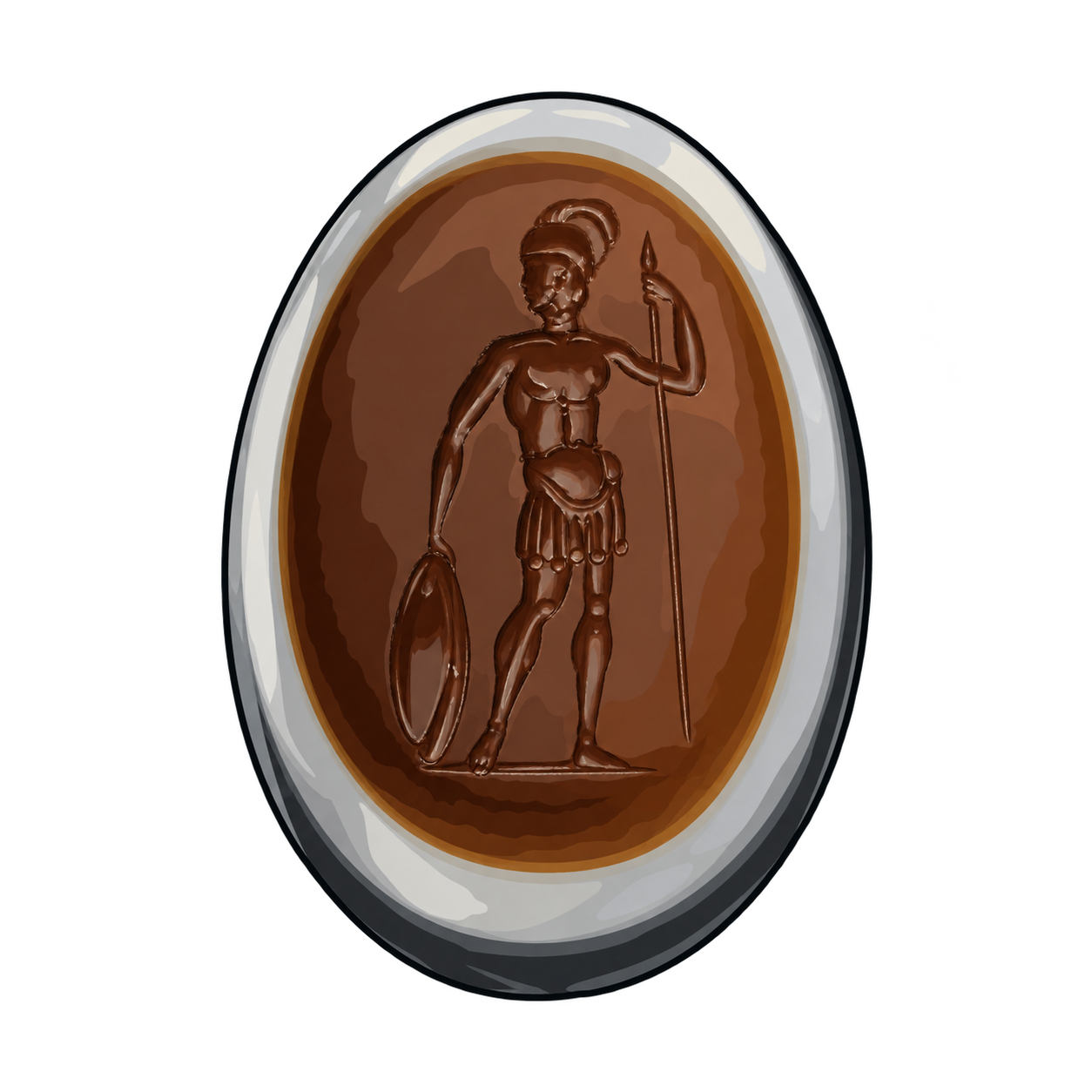
The Roman ring stone used as the illustration's reference is only 1.7 centimeters long. The Metropolitan Museum identifies its figure as Ares, or Mars, equipped with spear and shield, and dates the object broadly from the first century BCE to the third century CE. That catalogue supports the material and identification; it does not identify the owner or prove how the owner understood the image. [6]
An engraved gem could communicate identity, allegiance, taste or religious meaning. It is tempting to turn every martial image into a documented protective amulet, but the object and the general tradition are different kinds of evidence. The carved figure is observable; an individual's intention may no longer be recoverable.
Sardonyx also belongs to the August birthstone tradition. That association offers a contemporary reason to choose it while leaving its longer history of craftsmanship intact. [2]
The most useful sales description states what the material is, whether its color has been treated, and whether it is a single piece or an assembled object. “Natural stone” does not answer all three questions. A stone can be naturally formed and subsequently colored, while a historic mounting may include replacement parts.
For sound sardonyx jewelry, GIA recommends gentle cleaning with warm soapy water and a soft brush; high heat can affect treated color. Ultrasonic and steam cleaning require caution. An antique or repaired carving should be assessed for its construction before immersion or mechanical cleaning. [2]
Preserve the patina and detail of old work rather than polishing it indiscriminately. For a new carving, inspect how cleanly the design follows the layers and whether chips or repairs interrupt the image. These details explain more about the object than a dramatic trade name does.
gemdat.org · Reference for the accompanying text · Reference recorded October 15, 2026
gia.edu · Reference for the accompanying text · Reference recorded October 15, 2026
thecrystalcouncil.com · Reference for the accompanying text · Reference recorded October 15, 2026
gia.edu · Reference for the accompanying text · Reference recorded October 15, 2026
metmuseum.org · Reference for the accompanying text · Reference recorded October 15, 2026
metmuseum.org · Reference for the accompanying text · Reference recorded October 15, 2026