Bands, Cavities and the Architecture of Silica
Agate
Patterned, commonly banded chalcedony, a fine-grained silica material.
Patterned or colored microcrystalline silica aggregate
Loading this page…
Return homePlease wait while the next page arrives.


Bands, Cavities and the Architecture of Silica
Patterned, commonly banded chalcedony, a fine-grained silica material.
Patterned or colored microcrystalline silica aggregate
Agate is a patterned variety of chalcedony, not a separate mineral species.
Geology · Human history · Spiritual attributes
Modern crystal traditions use agate as a symbol of balance, household protection and material well-being. Sandra Kynes includes it in contemporary crystal arrangements associated with comfort and prosperity; Raven Digitalis describes agate in a household-protection practice. These accounts document present-day spiritual uses, not experimentally established effects or a single tradition shared by every culture. [3, 4]
The bands offer a useful visual focus for contemplation: attention can follow a line, return to a center or move gradually across contrasting layers. That is an invitation to a reflective practice, not a claim that the stone directs events or substitutes for practical decisions.
Principal chemistry: Silicon dioxide, SiO₂ Material structure: Very fine crystalline aggregate Main mineral: Quartz; agate can contain additional silica phases and inclusions Hardness: Approximately 6½–7 on the Mohs scale Typical chalcedony refractive index: About 1.53–1.54 Typical specific gravity: Around 2.6 Luster: Waxy on many natural surfaces, glassier when polished Transparency: Commonly translucent in thin sections, with opaque bands or inclusions [1, 5]
Chalcedony's crystals are too small to resolve with the unaided eye. Coarser crystals can occupy the center of an agate, making both textures visible together. [1, 2]
Specific gravity is a ratio, not the stone's weight or size. It becomes less straightforward to interpret if a specimen includes an open cavity, substantial host rock or a mounted backing. A measurement should describe the material actually tested; it should not be treated as a universal certificate of locality.
Hardness describes resistance to scratching, not immunity to breakage. A narrow polished rim and a thick rounded cabochon may be made from similar material but tolerate handling very differently. Inspect the object as well as its mineral name: open fractures, unsupported projections and old repairs matter when choosing a setting or stand.
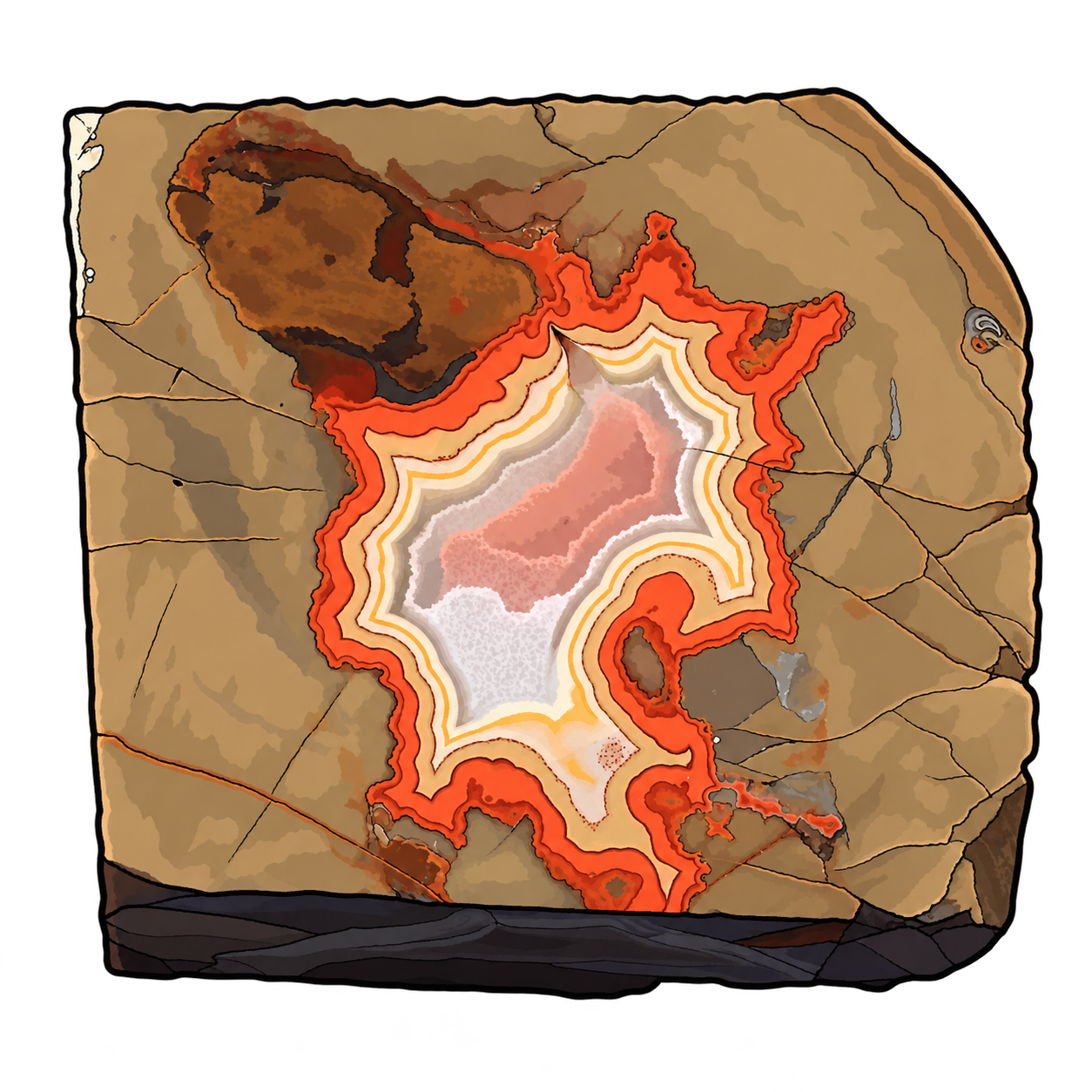
Many agates develop inside cavities where silica-bearing fluids deposit material along the walls. Volcanic gas bubbles provide one familiar setting. The Natural History Museum's Jubilee agate, from southern Brazil, records several stages: fine banding, growth of larger quartz crystals, renewed banding and a final crystal-lined opening. That example illustrates why a single nodule need not represent one uninterrupted style of growth. [2]
The spaces and their fillings have different histories. Knowing the age of a volcanic host does not, by itself, date every later silica layer. Likewise, a remaining central cavity is not evidence that a finished specimen is defective; it can be part of the natural growth sequence.
The finest banding also requires more than a simple picture of colored water arriving in successive floods. Heaney and Davis examined iris agate and found alternating fine, defect-rich chalcedony and coarser, lower-defect quartz. They proposed self-organized crystallization cycles as an explanation for the repeating texture. This research concerns a particular kind of microscopic banding, not a universal clock that can count years from visible stripes. [5]
Ordinary banding is visible in reflected light, but translucency can reveal additional structure when a thin piece is illuminated from behind. Compare both views without assuming one is the stone's only correct appearance. A slice displayed against a window may look very different on a dark shelf.
Iris agate and fire agate are not interchangeable names. Iris agate produces rainbow effects in transmitted light; fire agate displays iridescent color in reflected light. The lighting needed to see an effect is therefore part of understanding the specimen, not merely a photographic preference. Other names describe shape or pattern rather than a distinct mineral species. [6]
An agate's apparent composition also depends on the cut. Two slices through the same nodule can show different centers, outlines and relationships between bands. A collector choosing a complete nodule may value its exterior and geological context; a cutter choosing a cabochon may prioritize a small, balanced area. Neither approach needs to disguise the rest of the stone.
Agate has long supported both small ornaments and ambitious carved objects. Its layered appearance can be emphasized by shaping the stone rather than applying decoration over it. A British Museum covered cup incorporates an agate bowl dated around 1480, with later alterations. The object's gray, lilac, white and reddish veins were deliberately used in its design; the later mounting belongs to a separate stage of its history. [7]
Idar-Oberstein became a major center for working agate and related stones. GIA traces local cutting to the fifteenth century and describes the later importance of imported Brazilian material. Workshops, water-powered machinery and international trade shaped the town's agate industry. [6]
Some agate is dyed. A treated piece can still be genuine chalcedony: material identity and natural color are different questions. Ask whether the color is natural, enhanced or unknown, and keep that information with the specimen. Bright color alone is not a reliable laboratory test. [8]
Different dyes have different stability. Solvents and prolonged sunlight can affect some treated colors, while fractures may complicate cleaning and assessment. Do not use alcohol, acetone or destructive scraping to test a purchase at home. Suitable gemological examination is the better route when natural color affects value. [8]
For online purchases, request a view of the reverse and an ordinary-light image with dimensions. Confirm whether a slice has a separate backing, surface coating or repair. A description such as “natural agate” should not be assumed to answer all three questions of material, treatment and origin.
Look for a pattern that remains attractive under the lighting in which the piece will actually be used. On a pendant, examine the drilled opening or setting; on a slice, check the rim and support points. On a specimen with a crystalline cavity, consider how exposed crystal tips can be protected during dusting and transport.
Keep labels, locality records and treatment disclosures together. These details allow a collection to preserve more than appearance: they distinguish a documented specimen from a decorative object whose history has been lost.
australian.museum · Reference for the accompanying text · Reference recorded October 15, 2026
nhm.ac.uk · Reference for the accompanying text · Reference recorded October 15, 2026
llewellyn.com · Reference for the accompanying text · Reference recorded October 15, 2026
llewellyn.com · Reference for the accompanying text · Reference recorded October 15, 2026
pubmed.ncbi.nlm.nih.gov · Reference for the accompanying text · Reference recorded October 15, 2026
gia.edu · Reference for the accompanying text · Reference recorded October 15, 2026
wb.britishmuseum.org · Reference for the accompanying text · Reference recorded October 15, 2026
gia.edu · Reference for the accompanying text · Reference recorded October 15, 2026