Warm-Colored Chalcedony, Carved and Worn Across Centuries
Carnelian
Orange to reddish chalcedony.
Patterned or colored microcrystalline silica aggregate
Loading this page…
Return homePlease wait while the next page arrives.


Warm-Colored Chalcedony, Carved and Worn Across Centuries
Orange to reddish chalcedony.
Patterned or colored microcrystalline silica aggregate
Carnelian is the orange to reddish-brown member of the chalcedony family.
Geology · Human history · Spiritual attributes
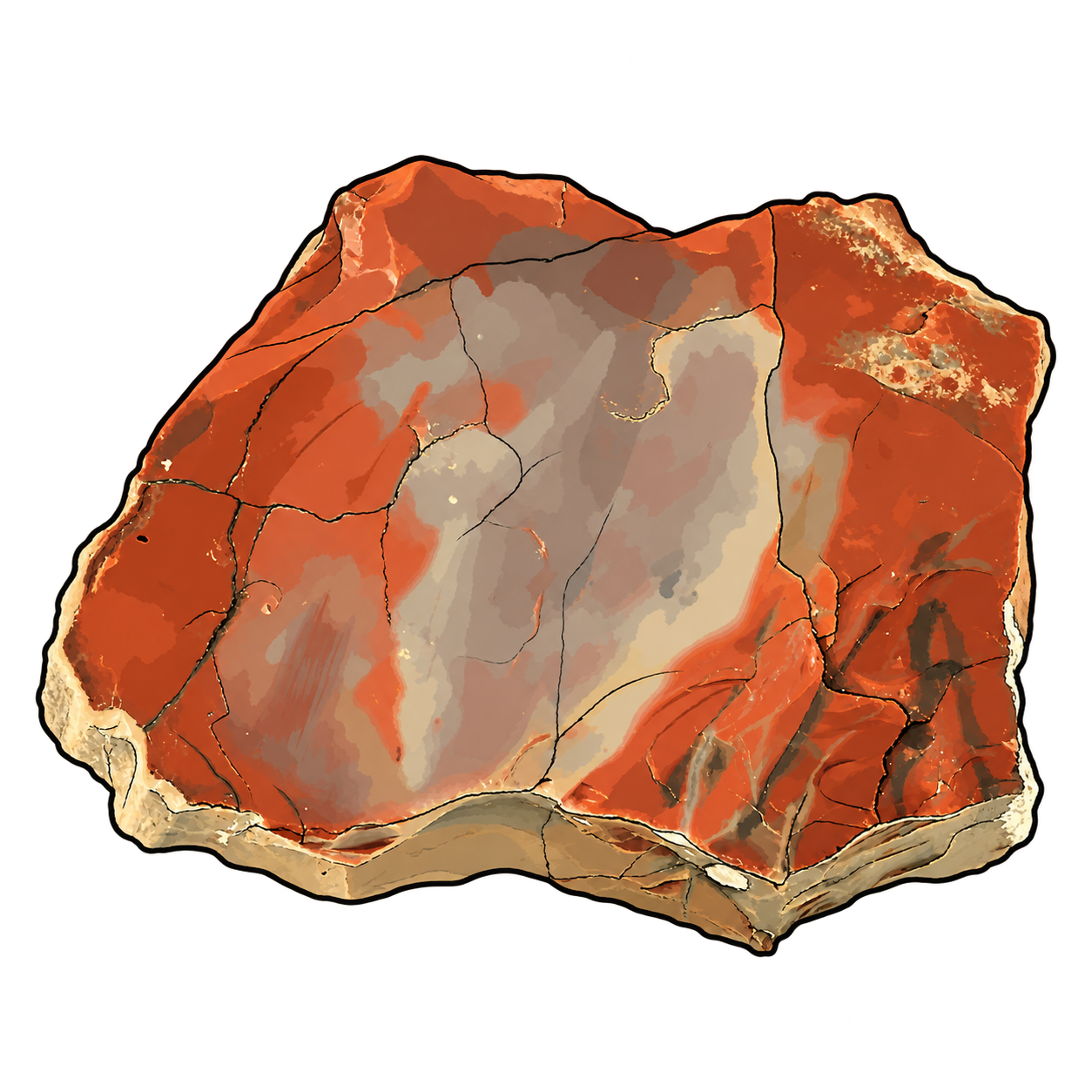
Carnelian is the orange to reddish-brown member of the chalcedony family. Its color comes from finely dispersed iron-bearing material within silica rather than from a separate red mineral species called carnelian. Thin edges can glow in transmitted light; thicker areas may look nearly opaque. A single piece can move from pale cream through amber-orange to deep rust. [1]
In contemporary crystal practice, carnelian is associated with initiative and creative expression. The Crystal Council connects it with courage, confidence, motivation and passion, often through root-, sacral- and solar-plexus-chakra symbolism. These are spiritual interpretations, not measured effects of the mineral. [2]
A piece placed beside a sketchbook or workbench can serve as a personal cue to begin. Its meaning need not depend on a promised result: the practice can be as simple as choosing one concrete action whenever the stone catches the eye.
Principal chemistry: Silicon dioxide, SiO₂ Texture: Extremely fine fibrous to granular aggregate Mohs hardness: Approximately 6½–7 Specific gravity: Typically 2.58–2.64 Refractive index: Approximately 1.535–1.539 Cleavage: None apparent in the aggregate Fracture: Uneven Luster: Commonly waxy to resinous Transparency: Semitransparent to opaque, depending on the piece and its thickness [1]
These ranges describe gem material, not a certificate for every orange stone. Inclusions, fractures and an attached matrix can affect an actual specimen's measurements. The fine aggregate texture also matters: carnelian does not present the large, transparent crystal faces associated with rock crystal.
Hardness measures resistance to scratching, not immunity to damage. A narrow bead wall or a thin carved edge can still break. When evaluating an object, consider the shape and condition of the whole piece rather than treating its mineral hardness as a guarantee.
Iron-bearing inclusions are responsible for the characteristic warm coloration. Their distribution can produce cloudy zones and a darker exterior around a pale center. Heating can strengthen carnelian-like colors in suitable chalcedony; therefore, an attractive red-orange appearance does not by itself establish an untreated history. [1]
Gemological literature documents thermal alteration as a longstanding treatment of chalcedony. A GIA discussion of heat-induced changes in inclusions specifically notes the development of reddish carnelian and brownish sard colors in lighter material. This is a treatment possibility, not a reason to assume that every specimen has been heated. [3]
Ask a seller separately about material identity, heating and added color. “Natural stone” can describe the origin of the material while leaving its later treatment unspecified. Equally, visible bands or a cloudy interior are observations, not a conclusive home test for treatment. A useful description states what is known and leaves an undocumented history undocumented.
First examine the stone in ordinary reflected light. Then, if it is translucent, look through a thin edge with a gentle light behind it. The two views answer different questions: one shows the surface and normal wearing appearance, while the other reveals color distribution and internal fractures.
A thick red bead and a thin orange slice may look very different even when their material is closely related. Photographs taken with intense backlighting can exaggerate an internal glow that is barely visible in normal use. For a purchase, an unlit view and a side view are often more informative than several dramatic photographs of the same face.
For carvings and engraved gems, inspect the recesses as well as the polished high points. Abrasion may soften fine lettering, while chips at a hole or rim can matter more to practical durability than a small irregularity in color. Preserve inscriptions and old surfaces rather than polishing an object solely to make it look new.
A Roman-era gold ring in the Swedish History Museum combines carnelian with two garnets. Its Greek inscription expresses a wish for Eunesios to be happy. Found in Södermanland in 1936, the ring demonstrates the movement of objects across considerable distances, but its route to Sweden and the identity of its wearer remain uncertain. The museum interprets a possible amuletic use rather than claiming to know precisely what power its owner attributed to the stone. [4]
A nineteenth-century Iranian wrestler's armband in the British Museum offers a different, specifically documented setting. Its leather band holds fifteen carnelian and chalcedony amulets inscribed with Qur'anic verses. The museum relates the bazuband tradition to the story of Rustam and Suhrab in the Shahnama. The surviving armband is a nineteenth-century object associated with that tradition, not an artifact belonging to the epic's characters. [5]
These examples reveal more than a generalized claim that carnelian was “sacred to the ancients.” Material, inscription, setting and cultural context worked together. They also show why a modern list of crystal correspondences should not be projected unchanged onto every earlier society that valued the stone.
Choose a piece for its appearance in the conditions where it will actually be used. Even color can suit beads or a simple cabochon; a pale center or contrasting margin may be more interesting in a slice or carving. Neither preference establishes authenticity or quality by itself.
For jewelry, inspect drill holes, settings and edges. A sound, well-finished piece is usually a better practical choice than one whose strongest selling point is a dramatic color name. Keep any treatment disclosure and seller's identification with the purchase record.
Begin routine care with a soft cloth and avoid unnecessary heat, aggressive chemicals or abrasive polishing. For mounted, repaired or historically significant pieces, cleaning must also respect adhesives, metalwork and the object's existing surface. Do not scratch, burn or chemically test a valued object at home. Consult a qualified jeweler, gemologist or conservator when identification or cleaning requires more than gentle surface care.
gemdat.org · Reference for the accompanying text · Reference recorded October 15, 2026
thecrystalcouncil.com · Reference for the accompanying text · Reference recorded October 15, 2026
gia.edu · Reference for the accompanying text · Reference recorded October 15, 2026
historiska.se · Reference for the accompanying text · Reference recorded October 15, 2026
islamicworld.britishmuseum.org · Reference for the accompanying text · Reference recorded October 15, 2026