The Fine Structure Behind a Family of Gemstones
Chalcedony
Microcrystalline/fibrous silica aggregate; includes many named gem varieties.
Patterned or colored microcrystalline silica aggregate
Loading this page…
Return homePlease wait while the next page arrives.


The Fine Structure Behind a Family of Gemstones
Microcrystalline/fibrous silica aggregate; includes many named gem varieties.
Patterned or colored microcrystalline silica aggregate
Chalcedony connects stones that can look entirely unlike one another: pale blue cabochons, orange carnelian, banded agate and green chrysoprase.
Geology · Human history · Spiritual attributes
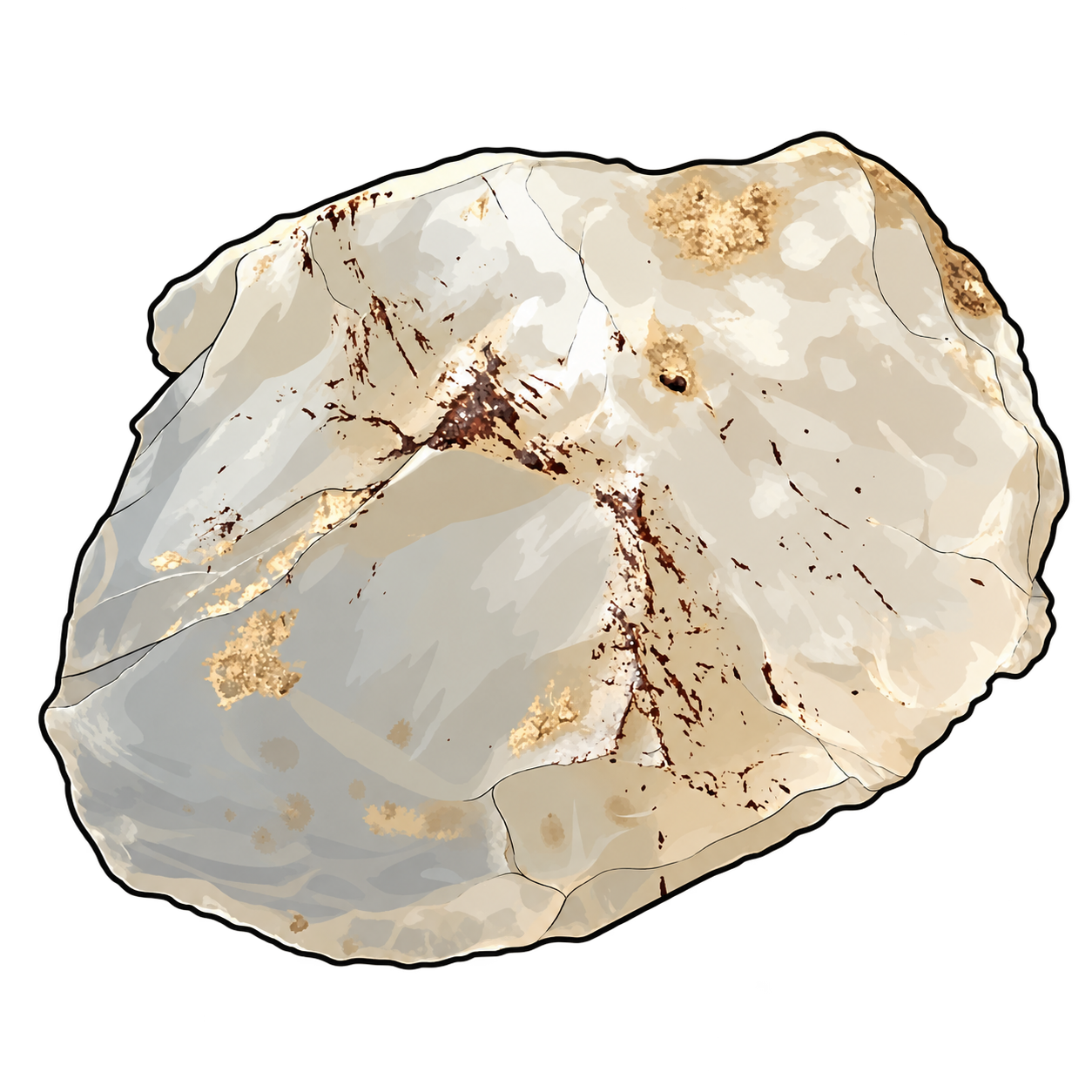
Chalcedony connects stones that can look entirely unlike one another: pale blue cabochons, orange carnelian, banded agate and green chrysoprase. Their names emphasize color or pattern, while chalcedony describes their fine-grained silica foundation. In narrower jewelry usage, the unqualified name commonly means white, gray or blue material without a more familiar variety name. [1, 2]
Chalcedony's spiritual meanings are clearest when the variety is identified. Modern blue-chalcedony practice emphasizes calm expression and thoughtful communication. The Crystal Council associates it with the heart, throat and third eye, connecting the recognition of a feeling with the ability to express it. These are contemporary spiritual correspondences rather than properties established by mineral analysis. [3]
These associations do not replace the distinct histories of carnelian, onyx or other members of the family. A shared silica foundation does not mean that every culture or practitioner has assigned all its varieties the same significance.
Principal chemistry: Silicon dioxide, SiO₂ Structure: Fine crystalline aggregate, often combining quartz and moganite Mohs hardness: Approximately 6½–7 Typical specific gravity: Around 2.6; reported ranges vary with material Typical refractive index: Approximately 1.53–1.54 Cleavage: None apparent in the aggregate Fracture: Uneven to shell-like Luster: Often waxy Transparency: Semitransparent to opaque [1]
The word cryptocrystalline indicates that the constituent crystals are too small to be distinguished with the unaided eye. Fibrous chalcedony has an organized texture at a much smaller scale than the crystals visible in a quartz cluster. A smooth-looking surface is therefore not evidence that the material lacks crystalline structure.
A 2024 study compared agate, chrysoprase and the blue-green variety marketed as aquaprase. Raman spectroscopy detected both quartz and moganite in the studied samples. These minerals share silica chemistry but arrange their atoms differently. The findings explain why “tiny quartz crystals” is useful introductory language without being a complete description of every piece. [4]
The same study found differences in microstructure and trace chemistry among the varieties. Its measurements apply to the investigated material, not to a fixed recipe for every chalcedony deposit. Identification requires attention to texture, inclusions and composition together. [4]
Chalcedony commonly develops as crusts, veins or cavity fillings through relatively low-temperature deposition of silica. Volcanic rocks, tuffs and breccias can provide spaces for this growth, although the material occurs in more than one geological setting. An outer rind, rounded growth surface or remnant cavity can preserve information that is removed when a specimen is cut. [1]
This makes rough and polished pieces complementary rather than competing forms of the same object. A cabochon emphasizes translucency and continuous color. A rough specimen may better display its relationship to the host rock or the shape of the space in which silica accumulated.
Do not infer a complete formation history from a rounded outline alone. Similar-looking surfaces can arise in materials with different internal textures, and a weathered fragment no longer shows every relationship it had in the original deposit.
Carnelian emphasizes warm orange-red color; chrysoprase is the familiar nickel-associated green variety; agate usually emphasizes banding. These are descriptive and historical categories within a broader material family, not a list of unrelated mineral species. The boundaries of commercial terminology can be less exact than the names suggest. [1]
A good label therefore works at two levels: it states the material and describes the particular appearance. “Blue chalcedony, translucent cabochon” communicates more than a promotional name alone. Where origin or treatment is known, those details can be added without pretending that color proves either one.
The popular name “grape agate” illustrates the need for care. A 2018 investigation of Manakarra material from Sulawesi described radiating quartz microcrystals coarser than ordinary cryptocrystalline chalcedony. Its clustered spheres explain the grape comparison, but the attractive name does not establish agate banding or chalcedony's characteristic texture. [5]
An eighteenth-century Chinese cup and saucer in the Metropolitan Museum of Art show chalcedony transformed into a small hardstone vessel. The cup stands only 3.5 centimeters high and has dragon-shaped handles. Its scale and projecting details illustrate how a familiar gem material can become a complex sculptural object rather than simply a polished stone. [6]
For any carving, the arrangement of color and translucency becomes part of the design. A pale area may define a figure; a darker zone may act as its background. Removing material changes both form and the path of light through the object, so a finished carving should be judged as a composition rather than by uniform color alone.
This distinction also guides collecting. A fine mineral specimen, an attractive cabochon and an accomplished carving answer different questions. The first may preserve geological relationships, the second emphasize a favorable section, and the third demonstrate how a maker used the material's possibilities and limitations.
Some chalcedony is dyed. Color concentrated in fractures or between grains may prompt further examination, but a simple visual rule cannot establish the treatment history of every stone. Strong color is neither proof of deception nor proof of rarity. Obtain a clear description and seek laboratory identification when the value or significance warrants it. [1]
Construction matters as well as mineral identity. A thin handle, a repaired rim and a solid bead require different handling even if all are made from chalcedony. Support carvings by their main body, not a projecting detail, and store polished pieces so that harder objects cannot rub against them.
Begin with a soft cloth rather than aggressive cleaning. For an old carving, composite, mounted gem or repaired object, obtain advice appropriate to the entire object before soaking, heating or using an ultrasonic machine. Preserve labels, invoices and treatment information alongside the piece: they supply a history that its appearance alone cannot recover.
gemdat.org · Reference for the accompanying text · Reference recorded October 15, 2026
minerals.net · Reference for the accompanying text · Reference recorded October 15, 2026
thecrystalcouncil.com · Reference for the accompanying text · Reference recorded October 15, 2026
doi.org · Reference for the accompanying text · Reference recorded October 15, 2026
gem-a.com · Reference for the accompanying text · Reference recorded October 15, 2026
metmuseum.org · Reference for the accompanying text · Reference recorded October 15, 2026