Orbicular Chalcedony from Madagascar
Ocean Jasper
A lapidary trade name associated with orbicular silica-rich material from Madagascar.
Orbicular chalcedony-rich decorative rock described by a trade name
Loading this page…
Return homePlease wait while the next page arrives.


Orbicular Chalcedony from Madagascar
A lapidary trade name associated with orbicular silica-rich material from Madagascar.
Orbicular chalcedony-rich decorative rock described by a trade name
Ocean Jasper is a trade name for patterned, silica-rich material from northwestern Madagascar.
Geology · Human history · Spiritual attributes
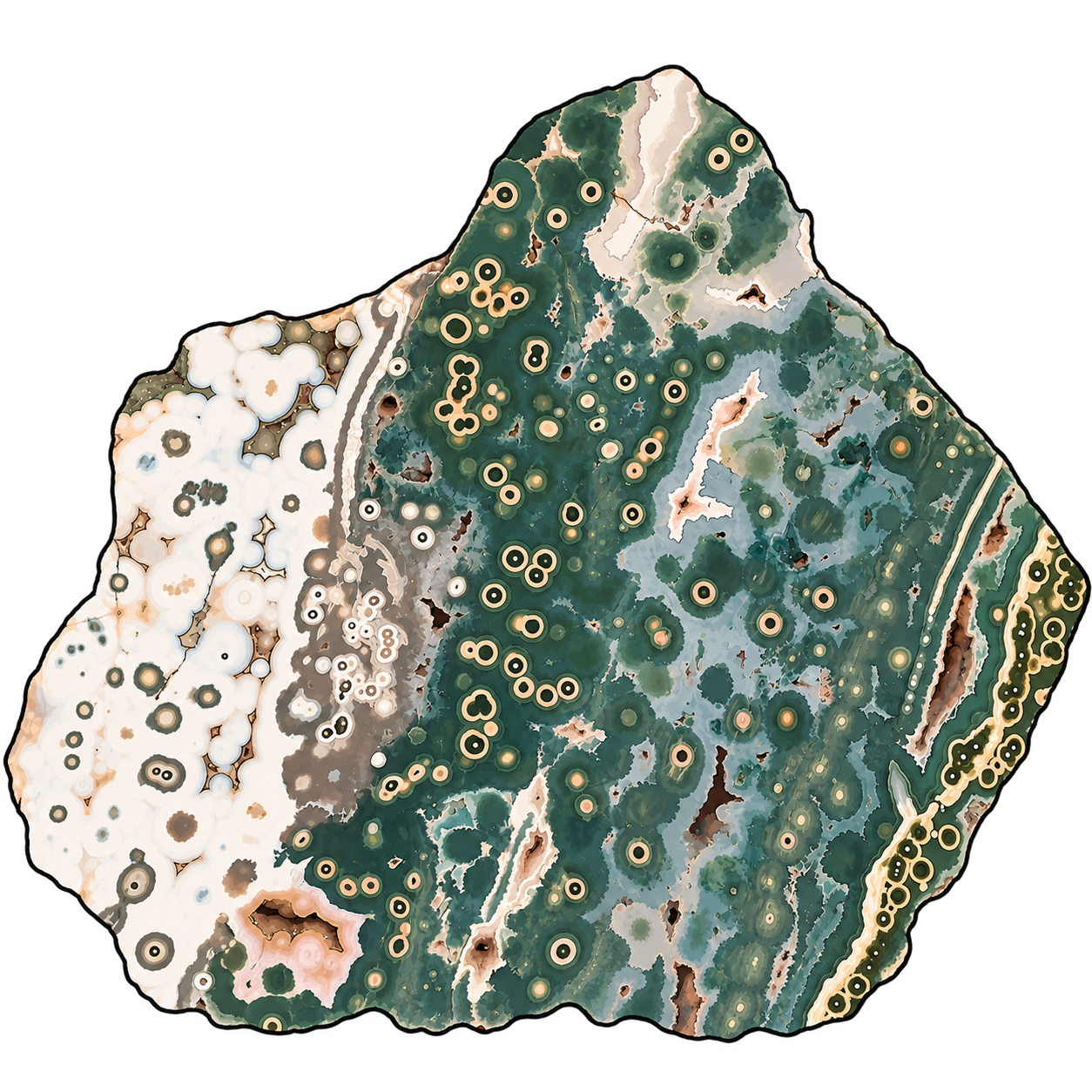
Ocean Jasper is a trade name for patterned, silica-rich material from northwestern Madagascar. Its characteristic circles are sections through rounded mineral growths: some appear as isolated eyes, others as nested rings or crowded, interlocking forms. Chalcedony and quartz can occur alongside open crystal-lined cavities, translucent bands and opaque colored areas within the same piece. [1, 2]
Contemporary Ocean Jasper practice uses ocean imagery to express flexibility and emotional openness. The Crystal Council connects it with the solar plexus, heart and throat: symbolically bringing intention, feeling and expression together. These are modern spiritual associations, not a geological explanation of the stone or a treatment for emotional illness. [3]
Its patterns offer a natural focus for contemplation: attention can move from one ring to another without requiring a single center. The meaning remains personal rather than a measurable property of the silica.
Principal material: Chalcedony and quartz, chiefly SiO₂ Structure: Fine crystalline aggregate, locally with larger quartz crystals Characteristic texture: Spherulitic or orbicular growth Transparency: Variable, from opaque areas to translucent zones Surface features: Polished bands, rounded growths and sometimes drusy cavities [1, 2]
“Spherulitic” describes growth arranged around a center. It is a textural term, not the name of a separate mineral. A polished circle is a two-dimensional section through that three-dimensional structure; cutting away from its center produces a smaller circle or partial arc. Where neighboring growths meet, their outlines can become irregular rather than perfectly round. [2]
A small 2020 characterization study by Susanne Lomatch examined seven old-stock specimens using electron microscopy with elemental analysis and, for selected samples, powder X-ray diffraction. Several tested areas were dominated by quartz/chalcedony, with minor elements in some colored portions. The author also identified questions requiring further high-resolution work. Those results support a silica-rich interpretation of the tested pieces, not a single exact recipe or complete formation history for everything sold under the name. [4]
Hardness or density values quoted for pure quartz should not be treated as measurements of every part of a cavity-rich, mixed-texture specimen. Thin walls, fractures and fragile crystal points can govern an object's durability even when its main mineral is hard.
In a 2016 GIA report, Elise Skalwold examined a 50.95-carat orbicular chalcedony cabochon cut by Paul Stalker. Its appearance suggested eggs in a pond, giving the piece its name, “Pond Life.” The rounded structures were mineral: iron-bearing inclusions surrounded by concentric growth of fibrous chalcedony. [1]
The report also illustrates the importance of illumination. Transmitted light and contrast filters exposed growth details that were less obvious in ordinary viewing. Such images are useful records of internal structure, but their intensified appearance should not be mistaken for the everyday color of a hand-held stone. [1]
The rounded structures are mineral growths, not fossils. Their resemblance to eggs or cells is a visual analogy.
GIA's Spring 2000 Tucson report documents Madagascar orbicular jasper being offered in hundreds of polished examples. The observers described a wide color range and rounded features approximately one millimeter to one centimeter across. Some pieces also showed quartz crystals between the orbicules. The report establishes a dated trade appearance; its mining details were explicitly supplied by the dealer rather than independently established by the laboratory. [5]
The mine operator Enter the Earth distinguishes coastal Marovato from inland Kabamby and records several later veins. Its account documents extraction beyond the often-repeated 2006 exhaustion date. Numbered-vein descriptions are supplier provenance claims, not mineral classifications. [2]
Kabamby and similarly spelled Kambaba designate different decorative materials. The coastal association behind “Ocean Jasper” does not mean that every piece was recovered underwater. [2]
Look at the whole object, including the back and edges. A face crowded with small rings offers a different composition from one broad orb in a quiet field. Neither is automatically superior. Translucency, contrast, the placement of cavities and the quality of polish all contribute to the result.
Ask separately about repairs, filling and provenance. A numbered-vein claim cannot be established simply by matching colors to an online photograph. For a setting, check that cavities or thin areas will not lie where pressure is concentrated. In a display slab, they may be features worth preserving rather than defects to conceal.
The material offers patterns at several scales: broad color fields across a slab, circles within those fields, and fine growth textures within the circles.
gia.edu · Reference for the accompanying text · Reference recorded October 15, 2026
entertheearth.com · Reference for the accompanying text · Reference recorded October 15, 2026
thecrystalcouncil.com · Reference for the accompanying text · Reference recorded October 15, 2026
mindat.org · Reference for the accompanying text · Reference recorded October 15, 2026
gia.edu · Reference for the accompanying text · Reference recorded October 15, 2026