Opaque Silica in Color, Pattern and Geological Context
Jasper
Opaque, impure, fine-grained silica-rich material; retail use of the name is broader.
Opaque fine-grained silica material; broader trade labels may describe other rocks
Loading this page…
Return homePlease wait while the next page arrives.


Opaque Silica in Color, Pattern and Geological Context
Opaque, impure, fine-grained silica-rich material; retail use of the name is broader.
Opaque fine-grained silica material; broader trade labels may describe other rocks
Jasper is a broad name for opaque, fine-grained silica-rich material selected for its color and pattern.
Geology · Human history · Spiritual attributes
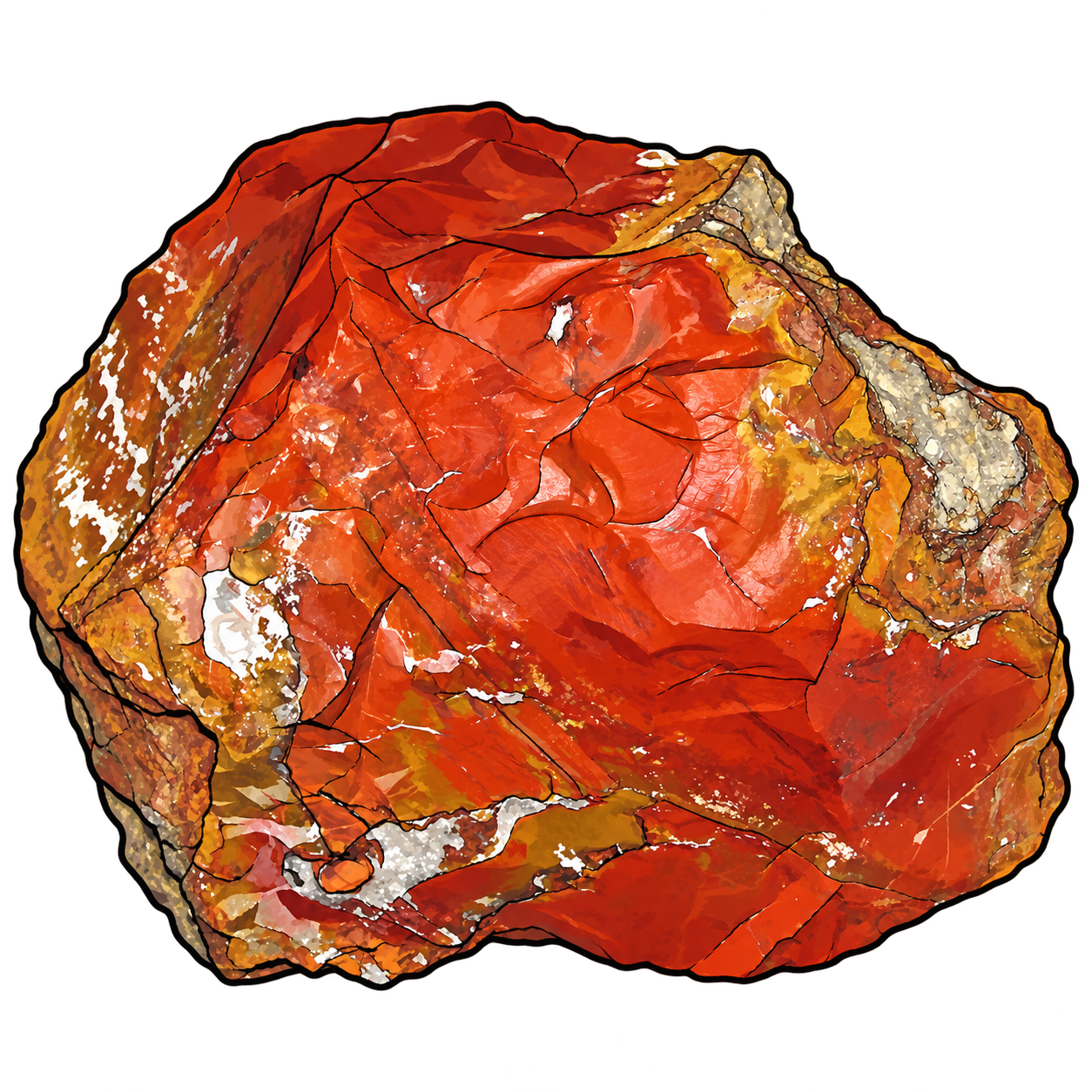
Jasper is a broad name for opaque, fine-grained silica-rich material selected for its color and pattern. Red is familiar, but yellow, brown, green and mixed-color examples are also common. Mineral inclusions contribute much of that variety. The term belongs both to mineral collecting and to the lapidary trade; it is not a guarantee that every attractively patterned rock carrying a jasper name has the same composition. [1, 2]
The associations listed here concern red jasper, the familiar red member of a much broader category. In the Crystal Council's contemporary account, it represents grounding, purposeful effort and personal growth, with root- and sacral-chakra symbolism. Those associations should not automatically be extended to every material marketed as jasper. [3]
These are meanings people attach to the stone. They are not measured mineral properties or evidence of medical benefit.
Principal constituent: Silica, chiefly quartz, SiO₂ Texture: Fine crystalline aggregate with included material Mohs hardness: Typically about 6½–7 Reported specific gravity: Approximately 2.58–2.91 Refractive index: Around 1.54 Cleavage: None apparent Fracture: Conchoidal to splintery Transparency: Opaque [1]
The figures describe conventional silica-rich jasper, not every trade-named decorative rock. Gemdat notes that its granular texture has led some researchers to distinguish it from chalcedony in a narrower sense. This is a classification difference within fine-grained quartz materials, not evidence that jasper is one chemically uniform crystal species. [1]
A stone's behavior also depends on its texture and accompanying minerals. Fractures, porous zones and softer seams can interrupt an otherwise hard surface. A nominal hardness value is useful, but it cannot predict the quality of every slab or guarantee that a carved object will resist impact.
Formation cannot be inferred from the name alone. Mississippi's geological survey describes pelletal jaspers produced by silica replacement of iron-rich carbonate mudstones from shallow marine environments. It also distinguishes jaspers associated with banded iron formations. Both occur among gravels used historically for lapidary work, yet their textures and working properties differ. [4]
A separate research example comes from the Ordovician Løkken rocks of Norway. Grenne and Slack interpreted extensive hematitic jasper beds as the descendants of silica–iron gels deposited from submarine hydrothermal plumes. Their geochemical work links iron-rich particles from vent fluids with silica-rich seawater and subsequent settling. This explains those studied beds; it is not a universal origin story for a polished jasper sold without provenance. [5]
Similar red surfaces can preserve different histories of replacement, precipitation and later alteration. Included minerals and the surrounding host rock help distinguish those histories.
“Picture” and “landscape” describe a visual resemblance. They do not mean that the stone contains a fossilized scene. “Brecciated” describes angular fragments within a surrounding material; it identifies a texture, not the cause or date of breakage. A red jasper can therefore also be brecciated or landscape-patterned without becoming a different mineral species.
Look for relationships within the pattern. Does a pale seam cross several colored areas? Do fragment boundaries continue to the edge? Is a band visible on more than one face? Such observations can reveal a sequence of changes, although a reliable geological interpretation may require a thin section or analysis.
The cut adds another layer of selection. A slab and a small cabochon from the same rough can show very different compositions. The cutter chooses which colors remain, where the edge falls and which features dominate. The resulting image is partly a property of the rock and partly a consequence of orientation and design.
Vapriikki's Mineral Museum identifies leopard-skin “jasper” as rhyolite and Kambaba material as a volcanic rock with several mineral constituents. Their established names can remain useful labels, provided their geology is explained rather than replaced by the word jasper. [2]
Color enhancement adds another distinction. Gemdat records blue-dyed jasper sold as an imitation of lapis lazuli. The underlying stone may be natural while its marketed color is not. A useful description therefore separates material identity, treatment and origin instead of compressing all three into “genuine.” [1]
The Metropolitan Museum preserves a green-jasper scarab, object 19.3.103, excavated at Thebes in 1918–1919. It measures only 1.9 centimeters in length. The catalogue assigns it to the Middle Kingdom–Second Intermediate Period and gives an approximate date of 2030–1550 BCE. [6]
Its compact form shows how fine-grained stone could hold detailed carving on the scale of a seal or amulet. The excavation record connects the object with a particular place; it does not identify the personal beliefs of whoever wore or used it.
Keep a locality label, supplier information and any treatment disclosure with the specimen. For an old carving, preserve records of repairs and previous ownership. For an unprovenanced decorative stone, a modest description—color, pattern and confirmed composition—is more useful than a confident but unsupported mine name.
gemdat.org · Reference for the accompanying text · Reference recorded October 15, 2026
vapriikki.fi · Reference for the accompanying text · Reference recorded October 15, 2026
thecrystalcouncil.com · Reference for the accompanying text · Reference recorded October 15, 2026
mdeq.ms.gov · Reference for the accompanying text · Reference recorded October 15, 2026
usgs.gov · Reference for the accompanying text · Reference recorded October 15, 2026
metmuseum.org · Reference for the accompanying text · Reference recorded October 15, 2026