Western Australia's Radiolarian Stone in Red, Ochre and Cream
Mookaite
Silicified radiolarian sedimentary material from Western Australia.
Siliceous radiolarian-derived sedimentary rock and lapidary material
Loading this page…
Return homePlease wait while the next page arrives.


Western Australia's Radiolarian Stone in Red, Ochre and Cream
Silicified radiolarian sedimentary material from Western Australia.
Siliceous radiolarian-derived sedimentary rock and lapidary material
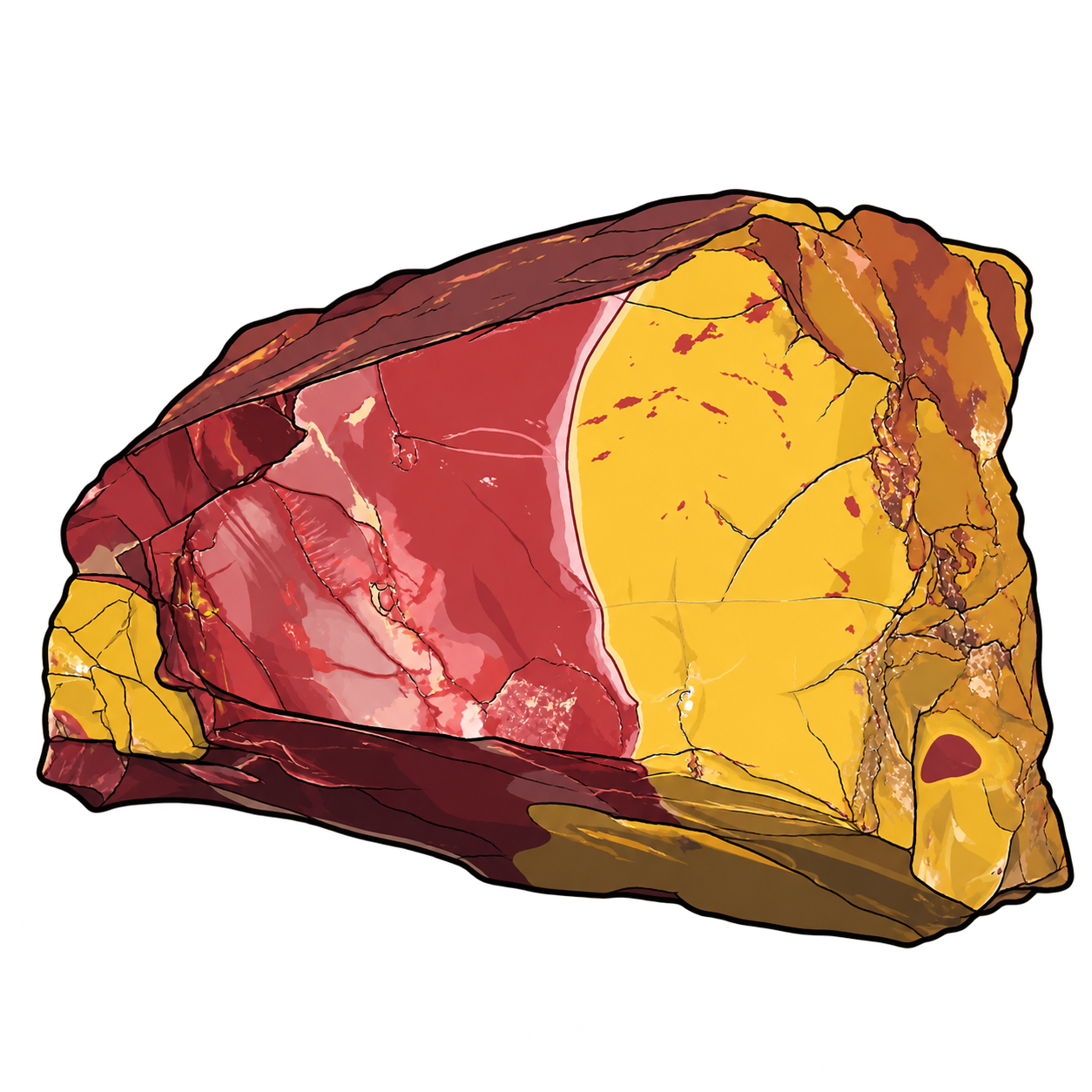
Mookaite is a decorative rock from Western Australia, valued for broad fields of mustard yellow, cream, red and wine-purple.
Geology · Human history · Spiritual attributes
Presence · Nature Connection · Determination · Appreciation · Grounding [3]
Mookaite is a decorative rock from Western Australia, valued for broad fields of mustard yellow, cream, red and wine-purple. Its familiar “mookaite jasper” name describes its place in the lapidary trade, but its geological identity is more specific: silicified material associated with the Windalia Radiolarite, a Lower Cretaceous sedimentary formation. The informal name comes from Mooka Station. [1, 2]
Modern mookaite practice emphasizes attention to the present and a renewed appreciation of the natural world. The Crystal Council links its strong colors with noticing everyday beauty, while solar-plexus symbolism supplies themes of will and determination. These are contemporary interpretations, not documented Aboriginal teachings or medical effects. [3]
Rock classification: Silicified radiolarite or porcellanite Principal material: Very fine silica; opaline to chalcedonic silicification Mohs hardness: Reported approximately 6–7 Transparency: Opaque to translucent Luster: Glassy in some areas, matte in others Coloring constituents: Iron oxide and hydroxide granules Crystal form: Massive rock rather than a single terminated crystal [2]
Calling mookaite simply SiO₂ omits the distinction between a silica-rich rock and a pure mineral. Likewise, assigning it quartz's crystal system would describe one possible constituent rather than the whole object. Its ornamental name does not specify an exact proportion of silica phases or a single refractive index.
The reported hardness is a range, not a promise that every seam and weathered margin behaves identically. The condition of a particular piece matters when it is cut or mounted. Broad, sound areas may polish beautifully while fractures or crumbly edges require a different treatment by the lapidary.
Radiolarians are single-celled marine organisms with intricate silica skeletons. The Smithsonian illustrates their microscopic architecture as an example of the structural variety of ocean plankton. These are not miniature corals, and the broad red or yellow areas in a polished mookaite are not individual radiolarian bodies. [4]
The connection operates at the scale of sediment. Siliceous skeletal material contributed to the formation later altered into the decorative rock. The Geological Survey of Western Australia's 1992 Kennedy Range report describes mookaite as opalized radiolarite. A later survey account discusses secondary opaline silicification within the Windalia Radiolarite and records the locally named material's white, yellow, red, purple and brown colors. [1, 5]
This sequence separates the age of the original sediment from later changes to its silica and coloration. “Cretaceous” identifies the formation's geological setting; it does not mean that every visible band was laid down unchanged in the sea or that the present polished surface preserves a simple annual record.
The Western Australian survey records Liesegang banding in the silicified material. Such bands belong to a pattern of later mineral organization, rather than necessarily marking original sediment layers. The broad color fields and curved boundaries can therefore cut across the visual expectations created by the word “sedimentary.” [5]
For a viewer, the distinction is useful even without a laboratory. A stripe can be described accurately as a stripe without being called a growth ring, shoreline or fossil. A geological interpretation adds a different claim, one that needs support from the rock's context and internal structure.
The orientation of the cut determines which colors share a face. One small bead may contain mostly cream; a neighboring cabochon may capture a sharp yellow-red division. A slab can preserve transitions that a smaller object necessarily leaves out. This is why a varied collection need not represent several mineral species.
The 1992 survey distinguishes mookaite from another local lapidary material, peanut wood. The latter is silicified wood with borings filled by pale radiolarite. The two can share warm colors and a silica-rich finish while preserving different original materials: marine sediment in one case, wood and its borings in the other. [1]
That difference is more informative than grouping both under a broad jasper label. Similar polish and color can make stones attractive companions in a display without making their origins interchangeable.
Inspect the surface, edges and back for fractures or unstable areas, not just the most colorful face. A smooth polish and a dramatic color boundary are separate qualities; either can be appealing without establishing rarity or a precise source within the formation.
Retain the supplier's locality information and any record of treatment or repair. Historical geological maps explain the origin of the name and material; they do not provide present-day collecting permission. Mookaite's strongest story needs no embellishment: microscopic marine life contributed to a rock whose later alteration and cutting reveal a striking modern ornamental palette.
library.dbca.wa.gov.au · Reference for the accompanying text · Reference recorded October 15, 2026
mindat.org · Reference for the accompanying text · Reference recorded October 15, 2026
thecrystalcouncil.com · Reference for the accompanying text · Reference recorded October 15, 2026
ocean.si.edu · Reference for the accompanying text · Reference recorded October 15, 2026
library.dbca.wa.gov.au · Reference for the accompanying text · Reference recorded October 15, 2026