Earthly Glass from an Extraordinary Impact
Moldavite and Tektites
Natural impact-generated glasses derived from terrestrial material.
Natural terrestrial impact glass
Loading this page…
Return homePlease wait while the next page arrives.


Earthly Glass from an Extraordinary Impact
Natural impact-generated glasses derived from terrestrial material.
Natural terrestrial impact glass
Moldavite is associated with a collision from space, but its glass is transformed terrestrial material—not a green fragment of the incoming meteorite.
Geology · Human history · Spiritual attributes
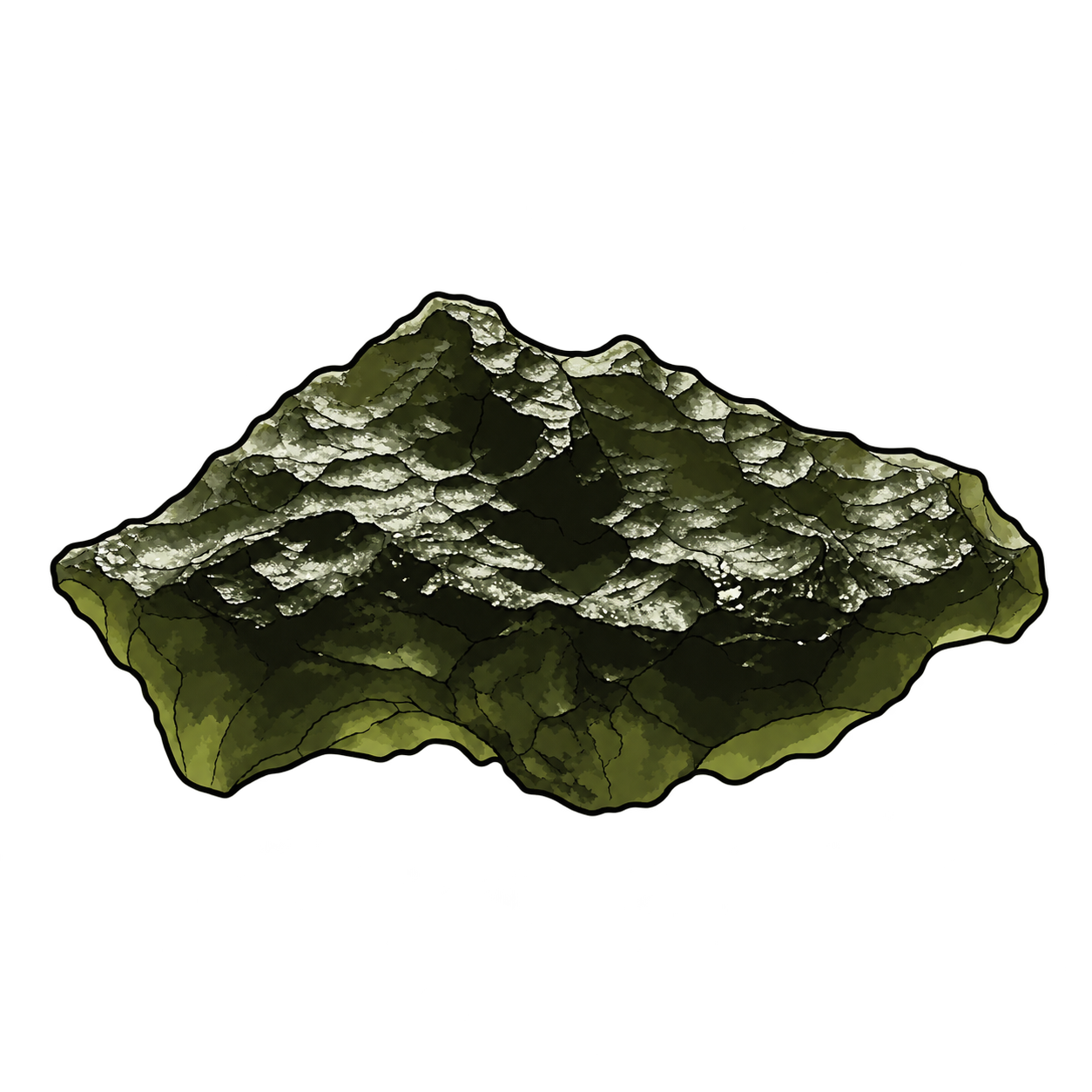
Moldavite is associated with a collision from space, but its glass is transformed terrestrial material—not a green fragment of the incoming meteorite. Its olive color and sculptured surface belong to a particular Central European impact-glass story. Other tektites record other places and events; the category is wider than this one green variety. [1, 2]
Moldavite has a prominent place in contemporary crystal practice as a symbol of transformation. The Crystal Council associates it with change, meditation, visionary insight and heart-centered openness. These meanings draw emotional power from its dramatic origin, but they remain spiritual interpretations rather than measurable properties of impact glass. [6]
Accounts of a “moldavite flush” describe subjective sensations within this community. Such feelings are not an authenticity test, and not feeling them does not establish that a specimen is false. The glass does not need to be credited with causing a disruptive life event for someone to value it as an emblem of change.
Tektites form when impact processes melt terrestrial material and the resulting melt cools into glass. Many were transported away from the impact site and are found across regions called strewn fields. Natural glass is not necessarily volcanic: its origin must be established from geological and analytical evidence, not simply from a shiny fracture. [1]
This separates a tektite from a meteorite and from obsidian. A meteorite is surviving extraterrestrial material; obsidian is volcanic glass. Moldavite belongs with impact glasses whose geological identity includes their connection to a particular event. The categories describe origin, not a hierarchy of beauty or importance. [1, 2]
Moldavite is chiefly silicate glass with variable composition, not a crystalline mineral having one fixed chemical formula. GIA's published comparison gives a refractive-index range around 1.48–1.51 and density commonly around 2.35, with measured variation. Green to brownish tones and internal flow texture are characteristic, but none of these observations alone authenticates a piece. [3]
The glass can contain threadlike lechatelierite, silica glass produced at high temperature. These inclusions and gas bubbles are useful microscopic clues. They should be assessed as part of a collection of evidence, not converted into a rule that any bubble-bearing green glass must be natural moldavite. [3]
Rough relief and thin projections also matter practically. A strong-looking color does not make a delicate edge resistant to chipping. A setting should support the individual shape rather than clamp a fragile ridge merely because the stone is described as a gemstone.
Moldavites are linked to the Ries impact in southern Germany, roughly fifteen million years ago. Their Central European distribution includes well-known South Bohemian occurrences in the Czech Republic. The crater and the collecting locality are therefore not the same place: material was displaced during the event and subsequently experienced its own geological history. [2, 4]
A locality label is valuable because it connects a hand specimen to that history. It is not equivalent to a certificate merely stating “natural.” Preserve information about where a specimen was recovered and from whom it was obtained, especially when a seller uses a highly specific locality name.
Pratesi and colleagues examined six South Bohemian moldavites using optical microscopy and X-ray microtomography. Their samples included two splashforms and four layered Muong Nong-type examples. Pore sizes, numbers and distributions varied markedly, including variation within individual samples. [4]
The relationships between some elongated bubbles and flow bands indicated more than one deformation stage. In particular, certain pores developed after the flow texture they displaced. An apparently empty space could therefore help reconstruct the sequence of events in cooling glass. This is a stronger geological use of bubbles than simply counting them as a buyer's pass-or-fail test. [4]
The study also illustrates why a single dramatic photograph cannot represent every moldavite. A nearly compact green fragment and a darker, more porous layered example may record different internal textures without requiring one to be an imitation.
Natural weathering can produce pits and grooves after tektites have returned to the ground. Their present surface is not necessarily a perfectly preserved outline from the instant of formation. [1]
Manufacturers can imitate an etched appearance. In 2021, GIA examined a 46.13-carat yellowish-green rough piece with suspiciously regular surface features. Microscopy raised questions; infrared spectroscopy confirmed artificial glass. The surface was a clue that prompted investigation, not the final identification by itself. [2]
For a collector, this favors a documented source and, where warranted, a qualified gemological examination. Images, a seller's assurances about powerful sensations, and an elaborate story cannot substitute for evidence. Do not reproduce acid-etching or heating experiments as home tests: damaging a surface would destroy information while adding no reliable provenance.
Moldavite and its imitations both have a history in Czech jewelry. Hyršl's investigation of five nineteenth-century jewelry sets in Prague found genuine moldavite in only one set; the other four contained imitation glass. The result shows why age and appearance are not proof of material identity, even for an attractive historic jewel. [3]
Moldavite is not a synonym for every tektite. The Australian Museum describes dark australites and other forms distributed across different strewn fields. Some preserve aerodynamic shapes; others are layered or have been altered and redistributed after deposition. [1]
A GIA study of a Vietnamese tektite with a large fluid inclusion offers another caution about easy categories. Its researchers examined the unusual inclusion and compared the piece with other local samples. Rare internal features are questions for investigation, not reasons to invent a new cosmic origin from appearance alone. [5]
Support rough pieces beneath their broad surfaces rather than gripping a thin point. Store them separately from harder stones and protect exposed edges from impacts. Use a soft brush for loose dust without forcing bristles into fragile projections; seek specimen-specific advice before removing an attached coating or residue.
For jewelry, inspect the setting as well as the glass. Avoid abrasive polishing, sudden heating and unverified chemical cleaning. A natural surface is part of a specimen's appeal and evidence. Preserve it, together with the locality label, rather than attempting to make every piece smoother or brighter.
australian.museum · Reference for the accompanying text · Reference recorded October 15, 2026
gia.edu · Reference for the accompanying text · Reference recorded October 15, 2026
my.gia.edu · Reference for the accompanying text · Reference recorded October 15, 2026
pmc.ncbi.nlm.nih.gov · Reference for the accompanying text · Reference recorded October 15, 2026
gia.edu · Reference for the accompanying text · Reference recorded October 15, 2026
thecrystalcouncil.com · Reference for the accompanying text · Reference recorded October 15, 2026