Mineral Landscapes in Fine-Grained Silica
Moss and Tree Agate
Chalcedony with mineral inclusions resembling moss or branches.
Patterned or colored microcrystalline silica aggregate
Loading this page…
Return homePlease wait while the next page arrives.


Mineral Landscapes in Fine-Grained Silica
Chalcedony with mineral inclusions resembling moss or branches.
Patterned or colored microcrystalline silica aggregate
Moss agate contains inclusions that resemble branching plants, tangled foliage or small landscapes.
Geology · Human history · Spiritual attributes
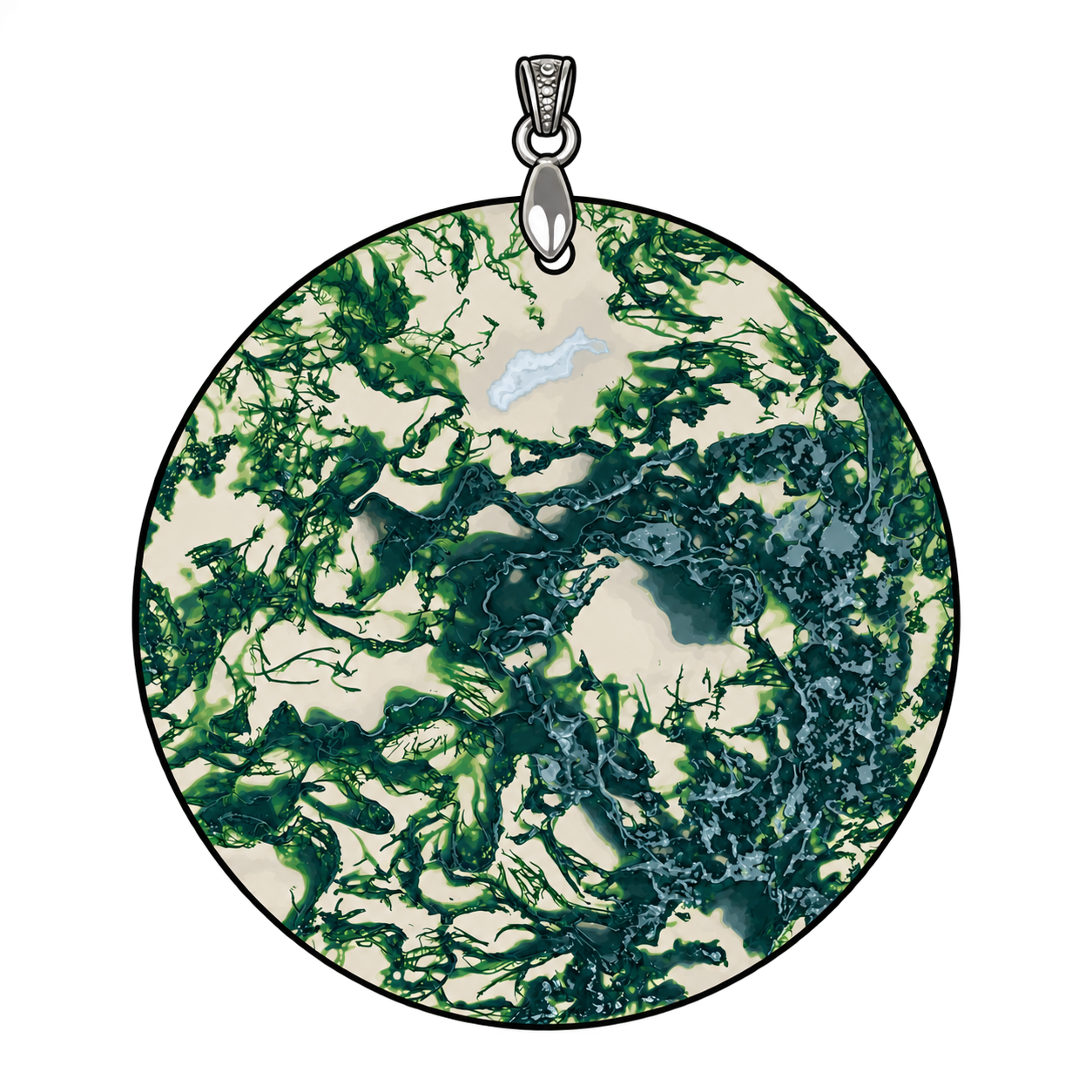
Moss agate contains inclusions that resemble branching plants, tangled foliage or small landscapes. The host is chalcedony, and the visible forms commonly include green minerals rather than recognizable pieces of moss. Tree agate is a related trade name generally applied to green-marked material with a more opaque, whitish background. These visual names overlap; neither identifies a separate mineral species or a single inclusion chemistry. [1, 2, 8]
Contemporary crystal practice connects moss agate with feeling rooted in the natural world. The Crystal Council emphasizes personal authenticity, protection and renewed enjoyment of ordinary surroundings. These associations belong to spiritual practice, not to laboratory descriptions of the inclusions. [3]
The resemblance to vegetation makes these meanings easy to understand visually, but it does not establish what the inclusions are. A nature-focused meditation can use the stone as a point of attention without requiring a claim that it contains an actual miniature forest.
Host composition: Predominantly silicon dioxide, SiO₂ Material type: Microcrystalline silica aggregate Hardness: Typically 6½–7 Specific gravity: Commonly about 2.58–2.64 Refractive index: Approximately 1.530–1.540 Cleavage: None apparent in the chalcedony aggregate Transparency: Translucent to opaque, depending on host and inclusions Inclusion colors: Commonly green, also brown, red or nearly black [1]
Gemological references describe amphibole and chlorite-group inclusions; mineral databases also record iron- and manganese-oxide dendrites. Research on particular deposits has identified other phases, including celadonite. A green branch cannot therefore be assigned one mineral name merely because it looks like another specimen's branch. [1, 2, 4]
The chemical formula SiO₂ describes the principal host, not the entire composite. Likewise, a standard chalcedony property range does not specify the density or toughness of every inclusion-rich piece. Distinguishing host from inclusion is more informative than presenting the whole object as chemically uniform.
The usual trade distinction concerns the background. In translucent moss agate, inclusions can appear suspended at several depths. Tree agate's whiter, more opaque field gives green markings a stronger surface-like contrast. Intermediate pieces resist a rigid division, so the most useful sales description states both translucency and pattern rather than relying on the name alone. [8]
“Dendritic” means branching in form. It is a description, not proof of a tree, fossil or particular mineral. Many examples sold as moss agate lack the continuous banding that defines agate more narrowly. The long-established trade usage does not make them false stones; it means the label is broader than a strict textural classification. [1, 2]
Moss-bearing silica occurs in cavities and fractures, including those within volcanic rocks. Mineral precipitation, alteration and the later enclosure of earlier structures can all contribute to the final texture. The pattern records a sequence of events, but a polished face rarely reveals that sequence completely. [4]
A 2025 study of Japanese moss agates from Bodai and Imakane adds an important qualification to the familiar statement that all such patterns are purely inorganic. Researchers found carbonaceous remnants associated with celadonite-rich filaments. Microscopic relationships and carbon-isotope measurements supported biological precursors for much of the material examined, with mineral replacement preserving their forms. [4]
That result does not establish that every moss agate contains fossils, nor that the precursors were literal moss plants. It concerns particular samples and an interpretation supported by several analytical methods. The practical distinction is between resemblance, present mineral composition and original structure: those are related questions, but not identical ones.
Begin by identifying what can actually be seen. Are the markings thin and branching, cloud-like, densely tangled or arranged along a plane? Does a clear region separate them, or does the host remain milky throughout? Those observations are more dependable than immediately naming the inclusion mineral.
Look from both sides of a loose or suitably mounted piece. A pattern close to the front can appear sharply defined, while deeper material may be softened by light scattering through the host. A dark backing changes the visual effect again. Photographs should identify unusual backlighting or backing rather than implying that every view looks the same.
Cutting can select an especially evocative portion of rough. A branch-like feature placed near an edge may suggest a tree beside an open field; a dense inclusion mass may be better suited to a small cabochon. These are lapidary choices that work with the material, not evidence of a geological image intended to depict a landscape.
A Roman moss-agate ring stone in the Metropolitan Museum of Art is engraved with a man riding a tortoise. The museum dates it broadly from the first century BCE to the third century CE and records a length of 1.8 centimeters. It demonstrates historical use of the patterned material in miniature carving without establishing the wearer's spiritual beliefs. [5]
Patterned agates also appear in Scottish jewelry. National Museums Scotland records a silver brooch with moss agates surrounding a central cairngorm quartz. Here, mineral pattern, setting and contrast between stones form a deliberate composition. The object is evidence of a particular design tradition, not a reason to assign all modern moss agates the same cultural meaning. [6]
Clarity is not the sole measure of appeal. A transparent window can make fine inclusions striking, while an opaque pale background can suit a bold, graphic design. Evaluate how the pattern works at the object's actual size; a greatly enlarged photograph can make subtle details seem more prominent than they are in hand.
Ask whether color has been enhanced and whether the piece has a backing, filling or repair. Chalcedony is among the materials that can be dyed. Genuine mineral inclusions do not, by themselves, establish that every aspect of a finished object's color is untreated. [7]
For jewelry, inspect the drilled hole, edge and setting. For a specimen, retain any locality record and avoid polishing away informative surfaces solely to obtain a brighter image. A collection can value both an attractive ornament and a rough geological specimen without judging them by the same criteria.
Use mild, conservative cleaning suited to the piece's treatment history and setting. Avoid attempting to bleach the pale background or dissolve a suspected dye. Solvents can alter treatments and mounting materials; such experiments can damage an object without resolving its identity. [7]
Protect thin edges, carved details and open fractures from impact. Store pieces separately so their hard silica surfaces do not scratch softer jewelry. An exposed, crumbly inclusion needs different handling from material securely enclosed beneath a polished surface. If a specimen has loose material, leave it undisturbed until its condition is assessed.
Record observations without overstating them: “green branching inclusions in translucent chalcedony” is often more accurate than an unsupported mineral or fossil identification. Good descriptions leave room for later analysis while preserving what makes the individual piece distinctive.
gemdat.org · Reference for the accompanying text · Reference recorded October 15, 2026
mindat.org · Reference for the accompanying text · Reference recorded October 15, 2026
thecrystalcouncil.com · Reference for the accompanying text · Reference recorded October 15, 2026
nature.com · Reference for the accompanying text · Reference recorded October 15, 2026
metmuseum.org · Reference for the accompanying text · Reference recorded October 15, 2026
nms.ac.uk · Reference for the accompanying text ·
gia.edu · Reference for the accompanying text · Reference recorded October 15, 2026
mindat.org · Reference for the accompanying text · Reference recorded October 15, 2026