Branching Mineral Patterns in Chalcedony
Dendritic Agate
Chalcedony with branching mineral inclusions.
Patterned or colored microcrystalline silica aggregate
Loading this page…
Return homePlease wait while the next page arrives.


Branching Mineral Patterns in Chalcedony
Chalcedony with branching mineral inclusions.
Patterned or colored microcrystalline silica aggregate
Dendritic agate contains dark, branching inclusions that can resemble ferns, roots or distant trees.
Geology · Human history · Spiritual attributes
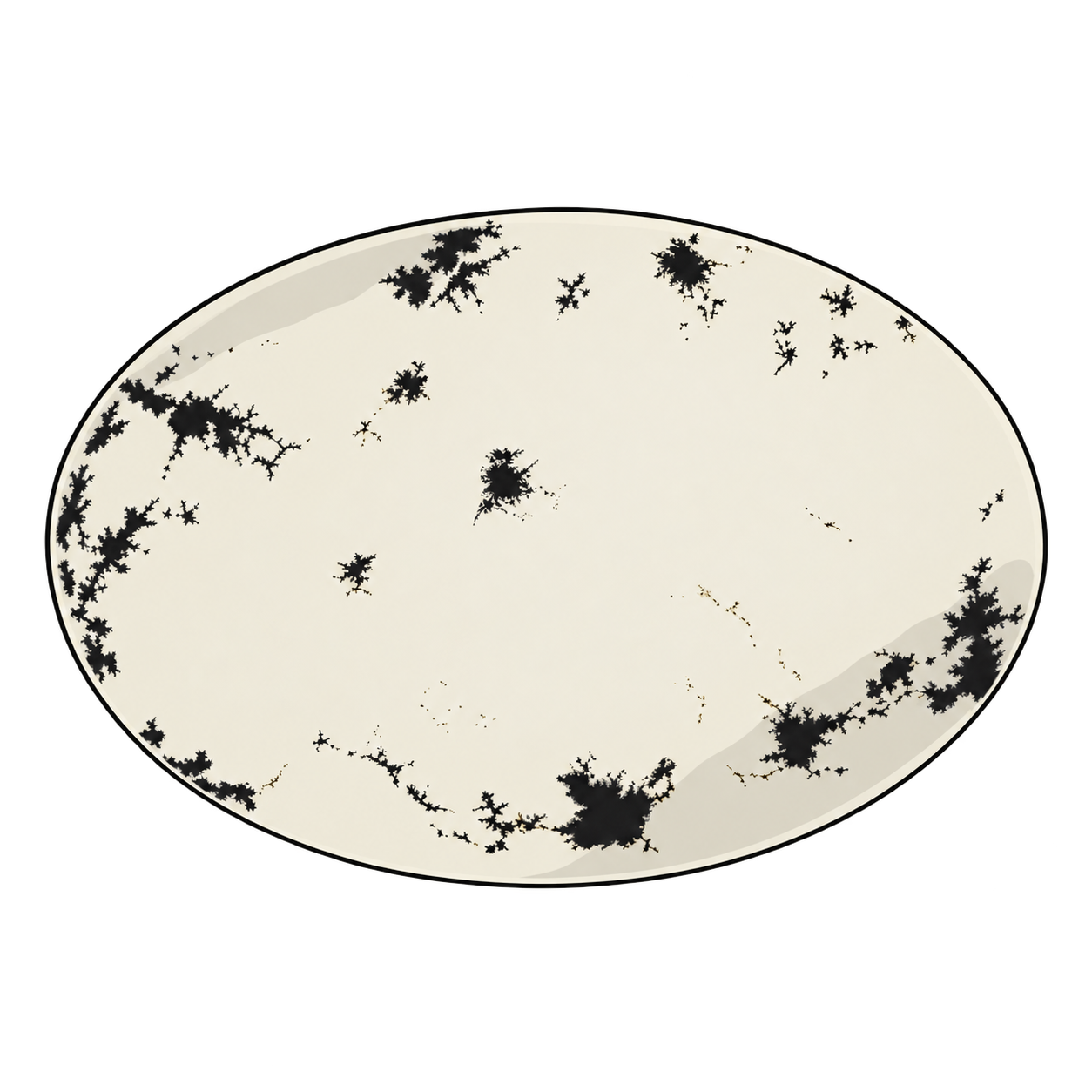
Dendritic agate contains dark, branching inclusions that can resemble ferns, roots or distant trees. The name describes their form rather than their species: iron- and manganese-bearing minerals can produce brown or black patterns within a pale silica host. The host is chalcedony, and a specimen need not show the concentric bands familiar from many other agates. [1]
Modern crystal practice reads dendritic agate's branching forms as images of connection and personal growth. The Crystal Council associates it with grounding, nature and the freedom to be oneself, using both heart- and root-chakra correspondences. These meanings are symbolic interpretations, distinct from the chemistry responsible for the patterns. [2]
A contemplative practice can begin with close observation rather than a prescribed image. Follow one branch to its smallest visible divisions, then look at the entire stone. The imagined landscape may change as it is turned; the mineral pattern remains the same.
Principal host chemistry: Silicon dioxide, SiO₂ Host texture: Microcrystalline chalcedony Hardness: Approximately 6½–7 Typical refractive index: About 1.53–1.54 Specific gravity: Usually near 2.6, varying with inclusions and composition Cleavage: None apparent in the aggregate Fracture: Uneven to shell-like Appearance: Pale or colorless host with contrasting brown-black branches [1, 3]
The property ranges describe the chalcedony host. They are not measurements of the individual dark inclusions, nor are they proof of where a stone was collected. Gemological assessment combines observations rather than identifying a specimen from a single matching number.
Chalcedony can include both quartz and moganite, two silica minerals with different structures. Its extremely fine texture accounts for a continuous-looking surface rather than the visible crystal faces of a quartz cluster. The aggregate can take a smooth polish while preserving inclusions as a separate visual component. [3]
Hardness and pattern should be evaluated separately. A thin cabochon can chip despite its resistance to scratching, and an attractive inclusion can lie beside a fracture. Neither the dark color nor the delicate appearance of a branch establishes whether it is a structural weakness.
“Dendrite” derives from the resemblance to a tree. It is a morphological term: the branching habit alone does not identify one universal mineral or demonstrate that a plant was preserved. In a documented Indian cabochon, GIA described fern-like manganese- and/or iron-oxide inclusions between agate layers. That observation supports a mineral explanation for the example without assigning every black branch the same composition. [1, 4]
The distinction between pattern and composition is useful beyond this stone. A convincing miniature landscape can be described accurately as dark branching inclusions in a pale host. Calling it a fossil, a specific oxide species or a named geographic scene requires additional evidence.
The cutter selects one section of a three-dimensional material. Inclusions may become clearer or less legible as material is removed, and a cabochon's curved surface changes their apparent depth. A composition that suggests an isolated tree in one orientation can become a root system or coastline when turned.
That selection creates an artistic relationship without making the pattern artificial. Look for enough open space to distinguish the branches, but judge the whole composition rather than imposing one ideal. Some collectors prefer fine isolated markings; others value dense, intricate patterns.
Lighting also matters. Reflected light emphasizes contrast against the host, while transmitted light can reveal depth in a thin, translucent piece. Ask for both an ordinary view and a photograph of the edge. Enlarged or strongly backlit photographs may show details that are much less prominent at normal viewing distance.
A 2008 GIA report describes dendritic agates from central India, including material recovered near the Narmada River and from other deposits in Madhya Pradesh. Its account distinguishes more transparent waterworn material from more translucent production elsewhere. These are reported observations about particular sources, not a rule that identifies every stone by clarity. [4]
Commercial production has also included assembled and inlaid pieces. In 2011, GIA described doublets made by bonding a clear quartz cap to a thin layer of dendritic agate. Other examples placed agate discs within contrasting stones or incorporated them into ornate pendants. A composite can be an intentional lapidary design rather than a deceptive object, provided its construction is disclosed. [5]
The distinction becomes important when purchasing a seemingly thick gem. Its visible depth may include a separate cap rather than a single piece of patterned material. Ask whether the object is solid, capped, backed or inlaid, and inspect its side before assuming that its face tells the whole story.
Moss agate overlaps with dendritic agate, especially where green inclusions become branching or fern-like. These labels emphasize different visual features within a related material family. They are not necessarily mutually exclusive classifications. [1]
Branching patterns can also occur in other hosts, including opal: Mindat records a polished Austrian example with dark dendrites in white opal. Consequently, identifying the branches does not finish the identification of the stone. A poetic or spiritual trade name is not a substitute for identifying its host. [6]
If a seller uses an unfamiliar variety name, ask for the underlying material and any treatments. A clear description should distinguish a natural inclusion pattern from added color, surface decoration or an assembled construction. Photographs can help identify questions, but cannot settle every treatment or mineral identification.
Consider orientation before mounting a stone. A setting can conceal the beginning of a branch, cover an important translucent margin or impose a visual horizon that the loose stone did not have. Preview the design with the actual cabochon rather than relying only on a generic setting photograph.
For display, a neutral background lets the inclusion pattern remain the focus. Avoid adhesives directly on a collectible stone when a suitable stand can support it instead. Keep labels and any construction disclosure together, particularly for doublets and inlays.
Preserve the edges and surface rather than trying to prove identity with scratches or chemicals. The most useful collector record includes dimensions, translucency, the observed pattern, known construction and documented locality. It separates what is visible, what is reported and what has actually been tested.
gemdat.org · Reference for the accompanying text · Reference recorded October 15, 2026
thecrystalcouncil.com · Reference for the accompanying text · Reference recorded October 15, 2026
gemdat.org · Reference for the accompanying text · Reference recorded October 15, 2026
gia.edu · Reference for the accompanying text · Reference recorded October 15, 2026
gia.edu · Reference for the accompanying text · Reference recorded October 15, 2026
mindat.org · Reference for the accompanying text · Reference recorded October 15, 2026