Nickel's Green Signature in Chalcedony
Chrysoprase
Nickel-colored green chalcedony.
Patterned or colored microcrystalline silica aggregate
Loading this page…
Return homePlease wait while the next page arrives.


Nickel's Green Signature in Chalcedony
Nickel-colored green chalcedony.
Patterned or colored microcrystalline silica aggregate
Chrysoprase is green chalcedony whose color is associated with nickel-bearing material dispersed through its fine silica structure.
Geology · Human history · Spiritual attributes
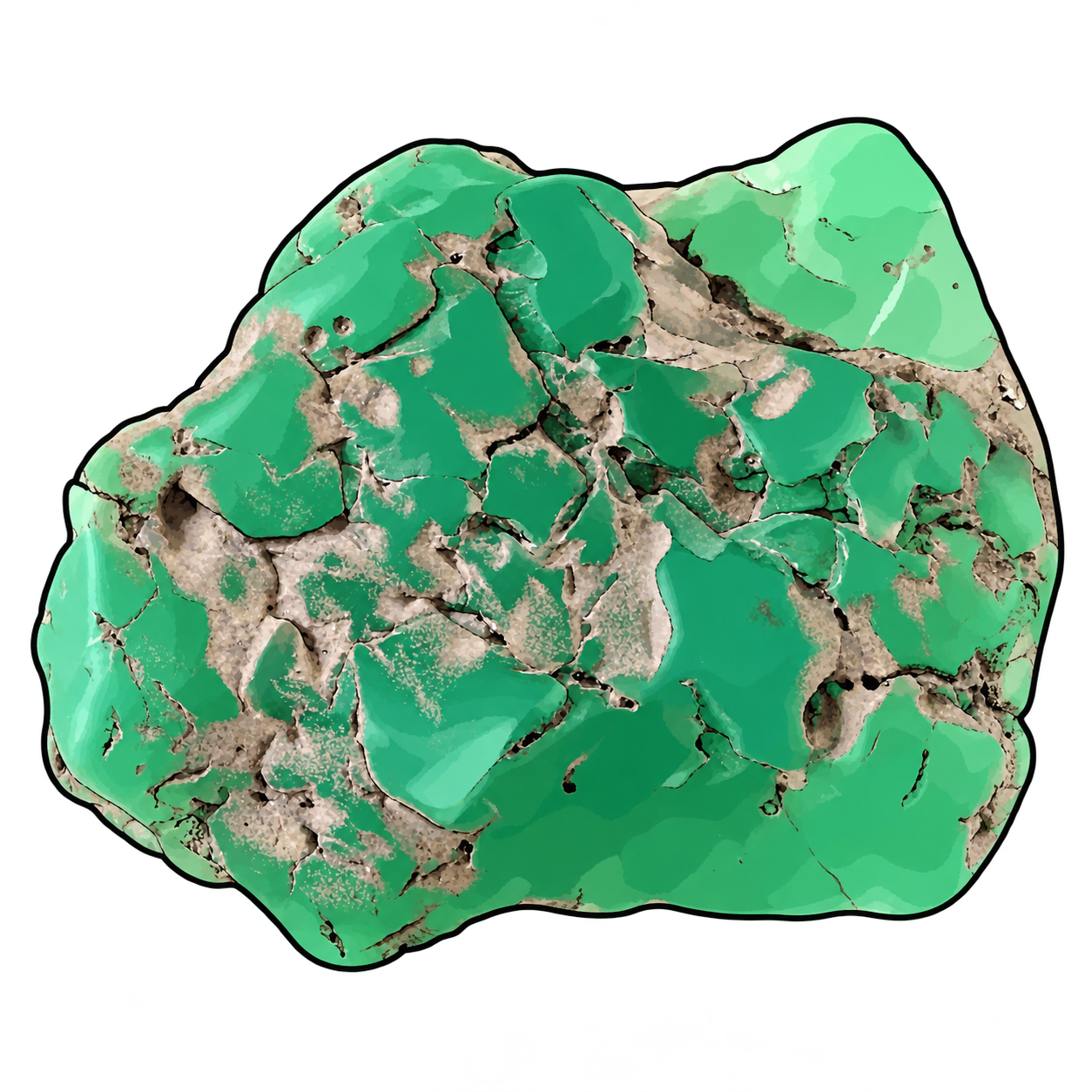
Chrysoprase is green chalcedony whose color is associated with nickel-bearing material dispersed through its fine silica structure. It can range from softly cloudy apple green to a stronger, more saturated color. Its appearance is quite different from a transparent emerald crystal: light passes through an aggregate of minute constituents rather than a single large crystal. [1, 2]
Modern crystal practice associates chrysoprase with compassion and purposeful action. The Crystal Council interprets it through the heart and solar plexus, joining emotional openness with the will to act on what matters. Its outdoor meditation tradition also emphasizes connection with nature. These meanings belong to spiritual practice, not to demonstrated effects of nickel or silica on the body. [3]
The green color can become a personal symbol of flourishing without requiring a claim that the stone creates it. A useful reflective question is what deserves more attention, followed by one practical way of giving it that attention.
Principal host chemistry: Silicon dioxide, SiO₂ Texture: Microcrystalline aggregate Mohs hardness: Approximately 6½–7 Typical specific gravity: Near 2.6 Typical refractive index: About 1.53–1.54 Cleavage: None apparent in the aggregate Tenacity: Brittle Transparency: Translucent to opaque Coloring constituents: Nickel-bearing microscopic material within the silica [1]
A GIA investigation published in 2026 measured refractive indices of 1.53–1.54 and specific gravities of 2.59–2.65 in supplied Western Australian cabochons. The material also showed the aggregate optical response expected of chalcedony. These measured values help illustrate the broader ranges; they do not make every green cabochon with a similar reading chrysoprase. [4]
The stone's fine structure can hide considerable complexity. A smooth, evenly colored face may still contain minute whitish clumps, fluid inclusions and colored particles. These are features for microscopic examination, not imperfections that can be interpreted reliably from a heavily enlarged sales photograph alone. [4]
Nickel is the key, but saying “nickel in quartz” leaves out where it resides. Jiang and Guo's 2021 study examined Australian chrysoprase using spectroscopy and electron microscopy. In their selected material, nickel-rich layered silicate inclusions identified as pimelite supplied the color. The authors distinguished this from nickel simply substituting throughout the silica crystal structure. Their result is sample-specific, not a claim that every deposit contains an identical coloring constituent. [2]
Other research has identified different nickel-bearing silicates. Monico and colleagues' 2024 comparison of chalcedony varieties detected willemseite in the chrysoprase they studied. Together, these findings support a more precise description: microscopic nickel-bearing constituents color the aggregate, and identifying the particular carrier requires analysis. [5]
In the 2026 GIA study, absorption in the violet and red portions of the spectrum left more green-blue light to be transmitted. Chemical analysis detected nickel. The miner reported an origin near Yerilla in Western Australia; the laboratory measurements did not independently establish that locality. [4]
Chrysoprase is closely associated with the alteration of nickel-bearing rocks. A GIA study of Haneti, Tanzania, documented chrysoprase and green prase opal in altered serpentinite. Both materials can be green and nickel-bearing, yet one is chalcedony and the other common opal. A shared geological setting does not erase that distinction. [6]
Weathering can redistribute constituents rather than merely destroying a rock. Veins and irregular concentrations of silica can develop within an altered host, leaving green material beside pale or earthy matrix. This relationship explains why a rough specimen may look much more heterogeneous than the carefully selected center of a cabochon.
For collectors, retaining matrix can be valuable. It preserves part of the geological relationship and creates a different visual composition from an evenly green gem. Record a documented mine or district when available, but do not assign a locality from color alone.
The name “Australian jade” has been applied commercially to chrysoprase, but it is not a mineralogical identification as jade. A buyer should ask for the actual material name rather than treating a geographic nickname as equivalence.
Green prase opal is a particularly instructive comparison because it can occur alongside chrysoprase. In the Haneti study, the two materials differed substantially in refractive index and specific gravity: the opal was lower in both. The measurements, not the shared green appearance, established the distinction. [6]
Dyed chalcedony can also resemble chrysoprase. A genuine silica host does not by itself establish naturally acquired green color. Reliable descriptions should address treatment separately from mineral identity, particularly when a piece is sold at a premium for its color. [1]
Vapriikki's Mineral Museum recounts a story attributed to the thirteenth-century scholar Albertus Magnus in which Alexander the Great wore a chrysoprase amulet for luck in battle. This is a medieval account about an ancient ruler, not direct evidence that a surviving stone belonged to Alexander. Its value is as a record of the meaning later writers attached to the gem. [7]
Avoid prolonged strong sunlight and excessive heat: color instability has been reported for chrysoprase. Do not attempt to restore a fading stone by experimenting with soaking or heating, particularly if it is mounted, repaired or treated. Obtain advice for the particular object instead. [1]
Use gentle handling and a soft cloth for routine care. A cabochon may resist ordinary scratching yet still chip at an edge, and exposed matrix may behave differently from its green portions. Store pieces separately from harder gems and support a matrix specimen securely rather than gripping a narrow projection.
For a fair visual comparison, use the same background and illumination. Examine both the polished face and a side view. Thickness can deepen the apparent green, while a thin edge can look much lighter; neither observation alone determines quality, origin or treatment.
gemdat.org · Reference for the accompanying text · Reference recorded October 15, 2026
nature.com · Reference for the accompanying text · Reference recorded October 15, 2026
thecrystalcouncil.com · Reference for the accompanying text · Reference recorded October 15, 2026
gia.edu · Reference for the accompanying text · Reference recorded October 15, 2026
doi.org · Reference for the accompanying text · Reference recorded October 15, 2026
gia.edu · Reference for the accompanying text ·
vapriikki.fi · Reference for the accompanying text · Reference recorded October 15, 2026