Goshenite, heliodor and the mineral behind a spectrum of gems
Other Beryl Varieties
Beryl family material outside the dedicated aquamarine, emerald and morganite pages.
Beryllium aluminum silicate mineral species and its color varieties
Loading this page…
Return homePlease wait while the next page arrives.


Goshenite, heliodor and the mineral behind a spectrum of gems
Beryl family material outside the dedicated aquamarine, emerald and morganite pages.
Beryllium aluminum silicate mineral species and its color varieties
Beryl is the mineral species; emerald, aquamarine, morganite, heliodor and goshenite are names used for particular appearances within it.
Geology · Human history · Spiritual attributes
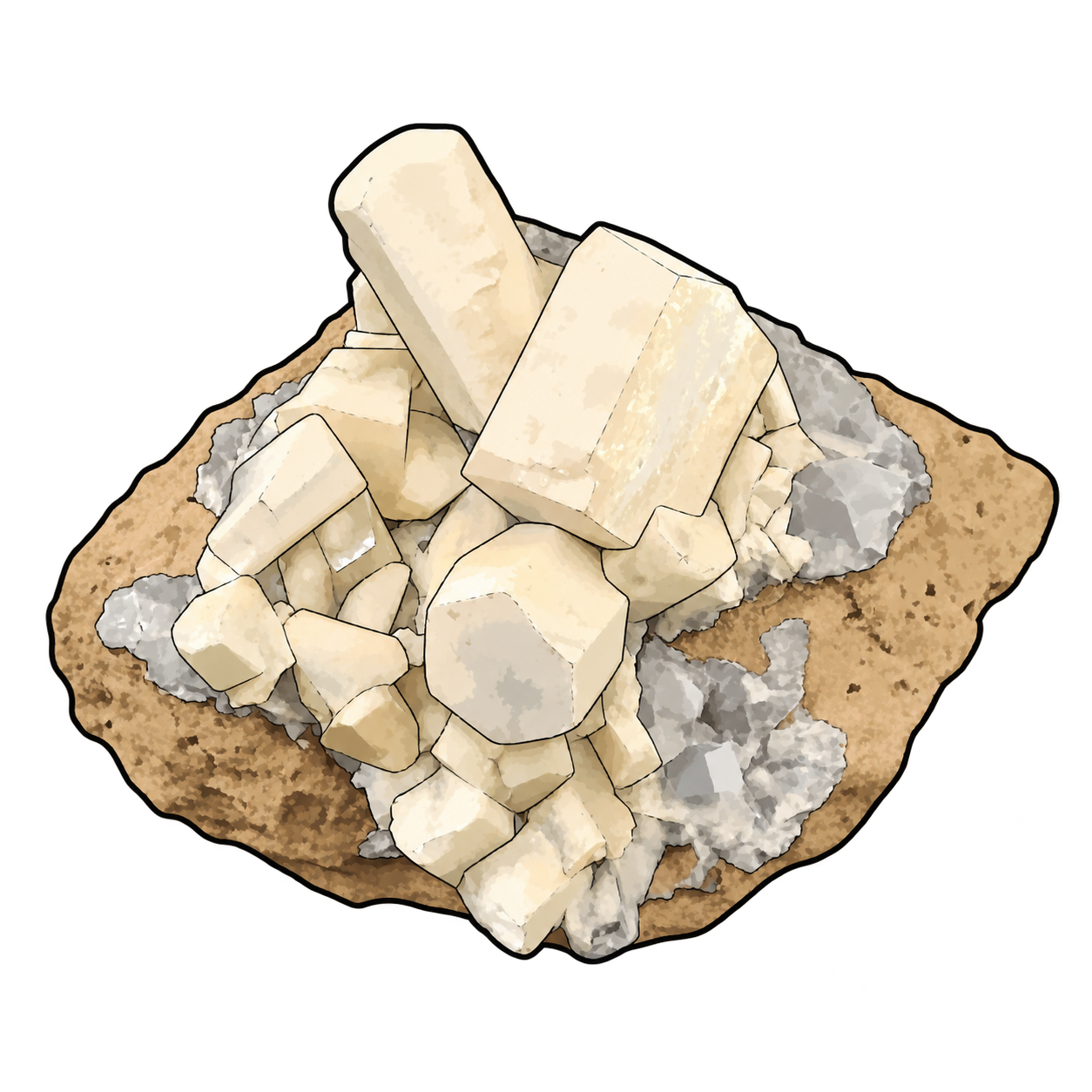
Goshenite and heliodor share a mineral identity but carry different symbolic personalities in contemporary crystal practice. The Crystal Council associates colourless goshenite with the crown and third-eye chakras, and golden heliodor with the solar plexus. These are spiritual correspondences rather than measurable effects of beryl. [1,2]
Transparency and golden colour give these associations their visual character. A clear crystal can suggest openness to observation, while a yellow one evokes sunlight and initiative. Each can have a place in personal reflection without requiring the two varieties to share one symbolic role.
Beryl is the mineral species; emerald, aquamarine, morganite, heliodor and goshenite are names used for particular appearances within it. GIA's collection overview attributes emerald's green to chromium or vanadium, aquamarine's blue and heliodor's yellow to iron, and morganite's pink to manganese. Chemically pure beryl is colorless. The small amounts of other constituents that influence color do not turn each variety into an unrelated mineral. [3]
Goshenite is colorless beryl, while heliodor is generally used for yellow to greenish-yellow material, with golden beryl also common in the gem trade. A pale green beryl need not qualify as emerald. The point is not to force every intermediate shade into an impressive commercial name, but to describe what the specimen actually is. Color zoning can also occur within one crystal: Geoscience Australia records clear beryl with emerald-colored bands from Torrington, New South Wales. One crystal can therefore document changing growth conditions rather than fit a perfectly uniform color label. [4]
Beryl crystallizes in the hexagonal system. Long six-sided prisms are familiar, but flattened crystals and more complicated terminations also occur. Its luster is usually glassy; specimens range from transparent gem material to cloudy, translucent crystals. The National Museum of Natural History in Sofia gives a hardness of 7.5–8, imperfect basal cleavage and brittle behavior, with conchoidal to uneven fracture. Hardness describes resistance to scratching, not immunity to a dropped specimen or a blow against a crystal edge. [5]
The same mineral name does not imply one exact optical reading for every sample. Chemical variation produces a range of refractive indices and densities; gem identification uses a combination of observations rather than matching color alone. Beryl is optically uniaxial, and colored varieties may show different hues or strengths of color along different viewing directions. These directional effects matter when a cutter decides how to orient a transparent crystal. [5]
Not every attractive beryl is faceting material. Growth interruptions, cracks, inclusions and irregular terminations can make a specimen more informative as a natural crystal than as a source of clean gems. Some cabochon-cut beryls display a moving band of light or a star when internal features are suitably arranged. GIA documents these phenomena within the species; they should not be inferred simply from an illustrated bright line or a seller's poetic description. [3]
Many familiar beryl varieties occur in granitic pegmatites, where concentrated late-stage constituents can support large crystals. Emerald also forms in settings involving metamorphic or sedimentary rocks. Thus “beryl” does not identify one universal geological environment. The useful questions are which variety, which locality and which host assemblage accompany a particular specimen. [6]
Utah's red beryl provides an especially instructive contrast. Research on the Ruby-Violet deposit in the Wah Wah Mountains describes crystals in fractures within rhyolite and a formation model involving beryllium-bearing fluids and reactions with heated groundwater and host rock. It is not simply a pink pegmatite beryl given a stronger name. The older term bixbite invites confusion with bixbyite, a different oxide mineral, while “red emerald” obscures the green meaning of emerald. Red beryl is the clearer designation. [6]
Beryl has an industrial history as a source of beryllium as well as a decorative one. Geoscience Australia records beryl extraction from the Broken Hill region and notes the metal's use in specialized electrical, aerospace and nuclear applications. Large yellow crystals from the Triple Chance mine were not necessarily gem quality. This distinction is important: a mineral can be economically significant without yielding transparent stones, and a spectacular crystal's scientific value need not depend on whether it can be cut. [4]
Goshenite's understated appearance can make its form, inclusions and growth surfaces the main subjects of appreciation. Heliodor shifts attention toward the interaction of warm color and crystal geometry. Neither needs the borrowed prestige of another variety to be interesting. Together they show how the same structural family can produce markedly different visual experiences.
Handle exposed crystal tips and matrix-mounted specimens gently. Store pieces separately from harder gems and metal tools, and do not perform destructive scratch tests on an attractive face. For an intact, untreated-looking display specimen, start with a soft brush; do not assume that an unknown matrix, coating or fracture filling will tolerate immersion merely because the central crystal is beryl. If treatment history is uncertain, obtain material-specific cleaning advice before using heat, chemicals or an ultrasonic cleaner.
Keep the variety name, locality and treatment information distinct in a collection record. A color label is not proof of mine origin; a convincing crystal outline is not proof that a gem is untreated. Clear descriptions make comparisons possible without turning uncertainty into an embellished story.
thecrystalcouncil.com · Reference for the accompanying text · Reference recorded October 15, 2026
thecrystalcouncil.com · Reference for the accompanying text · Reference recorded October 15, 2026
gia.edu · Reference for the accompanying text · Reference recorded October 15, 2026
ga.gov.au · Reference for the accompanying text · Reference recorded October 15, 2026
nmnhs.com · Reference for the accompanying text · Reference recorded October 15, 2026
nhmu.utah.edu · Reference for the accompanying text · Reference recorded October 15, 2026