The Sea-Blue Variety of Beryl
Aquamarine
Blue to blue-green beryl.
Colored beryl gem variety
Loading this page…
Return homePlease wait while the next page arrives.


The Sea-Blue Variety of Beryl
Blue to blue-green beryl.
Colored beryl gem variety
Aquamarine ranges from delicate greenish blue to a more concentrated blue.
Geology · Human history · Spiritual attributes
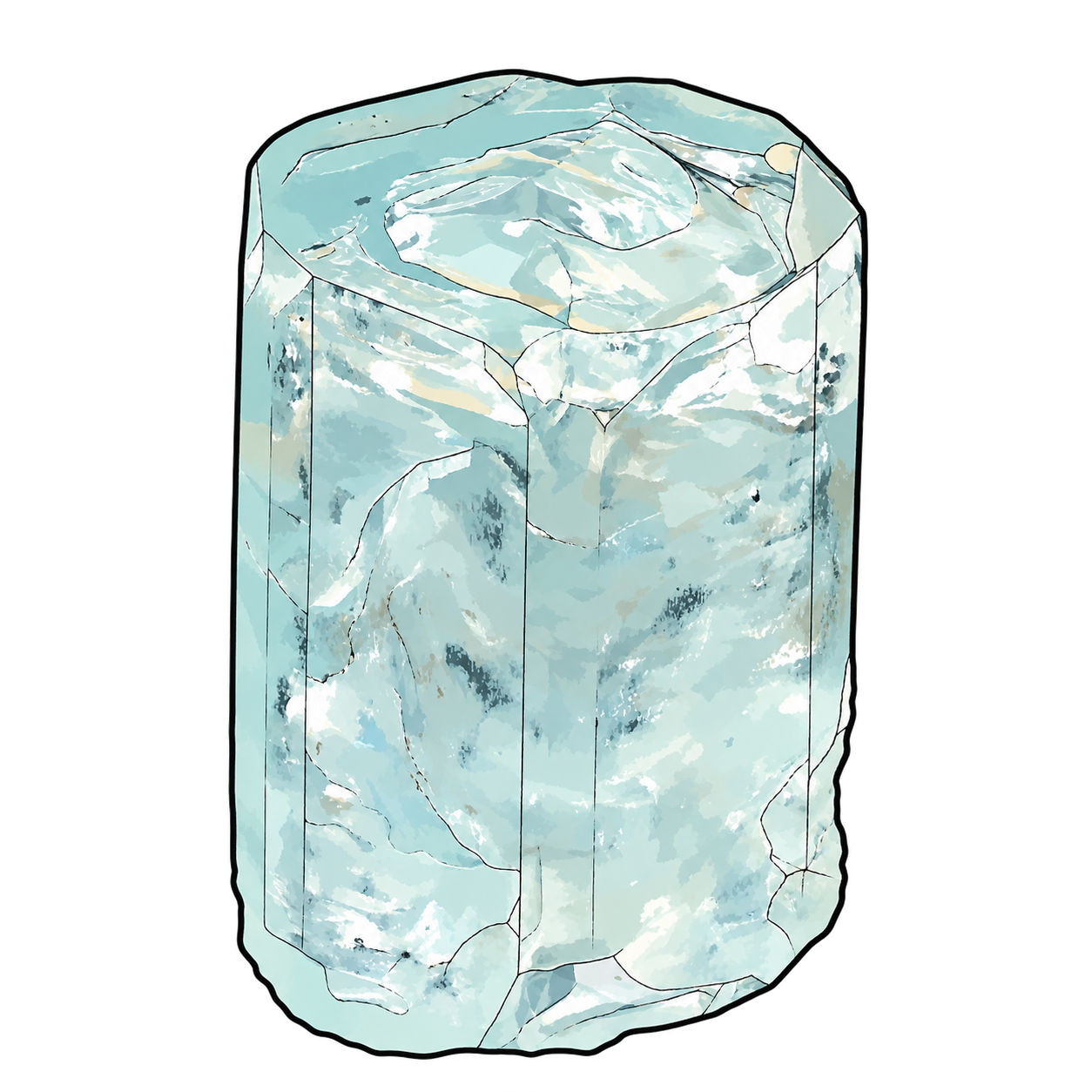
Aquamarine ranges from delicate greenish blue to a more concentrated blue. Large, well-formed crystals and transparent faceted gems show different aspects of the same mineral: the former preserve natural growth, while the latter reveal decisions about orientation, proportion and light. Aquamarine is a variety of beryl, sharing its basic composition with emerald and morganite. [1]
Contemporary crystal practice often gives aquamarine a role in communication. The Crystal Council describes a symbolic connection between heart and throat: sincerity provides the message, while clear expression gives it a voice. Water imagery supports associations with composure and a less reactive approach to disagreement. [2]
Keeping a stone beside written notes can give a communication practice a tangible focus. It is the person's preparation and action, rather than a demonstrated physical effect of beryl, that carries the conversation forward. These spiritual associations do not establish treatment for anxiety or other health conditions.
Chemical formula: Be₃Al₂Si₆O₁₈ Crystal system: Hexagonal Mohs hardness: 7.5–8 Luster: Vitreous Typical specific gravity: Approximately 2.72 Representative refractive index: 1.577–1.583 Birefringence: Approximately 0.005–0.009 Cleavage: Imperfect in the basal direction; fracture may be conchoidal to uneven [3, 4]
Beryl commonly grows as six-sided prisms, although proportions and terminations vary. A crystal can be transparent in one region and cloudy or fractured in another. Attached quartz, feldspar or mica may record its growth environment, while a polished point records later workmanship. Neither form is inherently more authentic as an object; their descriptions should simply distinguish natural faces from manufactured ones. [3]
The Handbook of Mineralogy gives a wider range of density and optical constants for beryl as a whole than the representative aquamarine figures above. Alkali content and other compositional differences contribute to that variation. Measurements are identification evidence, not a reason to assume that every beryl variety behaves identically. [3, 4]
Aquamarine's blue is associated with iron. Spectroscopic work distinguishes this mechanism from the radiation-related blue of Maxixe beryl. Aquamarine also absorbs light differently in different crystal directions: the stronger blue is generally seen across the long crystal axis rather than looking directly down it. This directional color difference, called pleochroism, helps explain why orientation matters when a cutter selects the table of a gem. [5]
Heat treatment is commonly used to reduce a greenish component and produce a bluer appearance. A treated stone may still be a naturally grown aquamarine; “natural” and “untreated” answer different questions. GIA notes that collectors also value large, clean natural crystals, whose appeal need not depend on matching the preferred color of a faceted jewel. [1]
Most fine faceted aquamarines have few eye-visible inclusions. Material with more internal detail can be attractive as cabochons, carvings or beads. In some stones, parallel tubes produce a cat's-eye effect when the material is cut and oriented appropriately. The effect is a relationship between internal structure, cutting and illumination, not a feature of all blue beryl. [6]
Granites and granite pegmatites are important beryl-bearing environments. Associated minerals can include feldspar, quartz, muscovite and tourmaline. An intact matrix specimen may show how these minerals grew together, whereas a loose polished stone preserves less geological context. [3]
Aquamarine sources include Brazil's Minas Gerais region, Pakistan's mountain workings and several African countries. Brazil supplies material from both primary and weathered deposits. [7]
The Smithsonian's Dom Pedro aquamarine, cataloged as NMNH G10690, weighs 10,363 carats and originated in Minas Gerais. Bernd Munsteiner fashioned it into an obelisk with recessed, lozenge-shaped cuts on the back. Those cuts redirect light through the body, creating the impression of illumination within the blue stone. [8]
The sculpture demonstrates why cutting is more than the removal of rough material. A surface hidden behind the frontal view can shape the entire visual experience. When examining a smaller aquamarine, look for the same relationship between depth, light return and apparent color; a large carat weight by itself does not guarantee a lively appearance.
Named from Latin for sea water, aquamarine is a March birthstone. Sailors' stories attributed protection at sea to it—a cultural belief, not a mineral property. [7]
The maritime image remains particularly apt for its pale, transparent color, but contemporary communication symbolism belongs to a different setting. A voyage amulet and a stone kept for reflection can share watery imagery without being evidence of an unchanged practice across every era or culture.
Blue color alone is insufficient identification. Adamo and colleagues compared aquamarine, Maxixe-type beryl and hydrothermal synthetic blue beryl using microscopy, chemistry and spectroscopy. Their study found that combined evidence could separate materials that appear similar at first glance. Ordinary aquamarine's stable color should not be assumed for every blue beryl. [5, 9]
When choosing a gem, compare it at normal viewing distance and under more than one light. Pale material may be appealing precisely for its delicacy; stronger color is not the only legitimate preference. Check the actual dimensions, cut symmetry and whether the center appears bright or washed out. An elaborate color name should not replace a clear description of treatment and origin evidence.
Aquamarine's hardness makes it useful for jewelry, but protect it from sharp blows and abrasion by harder stones. GIA recommends avoiding heat exposure. Lukewarm soapy water and a soft brush are a conservative cleaning choice, followed by rinsing and careful drying. Liquid inclusions, fractures or rare fracture fillings can make steam and ultrasonic cleaning unsuitable even when an intact stone might tolerate them. [10]
Support large crystals securely and avoid lifting a matrix specimen by its projecting prism. For pieces with fragile associated minerals or repairs, select a cleaning method for the whole object rather than only the beryl. A well-preserved surface and accurate history are more valuable than a forced appearance of flawless transparency.
gia.edu · Reference for the accompanying text · Reference recorded October 15, 2026
thecrystalcouncil.com · Reference for the accompanying text · Reference recorded October 15, 2026
handbookofmineralogy.org · Reference for the accompanying text · Reference recorded October 15, 2026
gia.edu · Reference for the accompanying text · Reference recorded October 15, 2026
gia.edu · Reference for the accompanying text · Reference recorded October 15, 2026
gia.edu · Reference for the accompanying text · Reference recorded October 15, 2026
gia.edu · Reference for the accompanying text · Reference recorded October 15, 2026
naturalhistory.si.edu · Reference for the accompanying text · Reference recorded October 15, 2026
gia.edu · Reference for the accompanying text · Reference recorded October 15, 2026
gia.edu · Reference for the accompanying text · Reference recorded October 15, 2026