Ancient marine structures preserved in stone
Fossil Coral
Fossil coral material, sometimes replaced by silica.
Biological fossil material with variable mineral preservation
Loading this page…
Return homePlease wait while the next page arrives.


Ancient marine structures preserved in stone
Fossil coral material, sometimes replaced by silica.
Biological fossil material with variable mineral preservation
Fossil coral brings the architecture of ancient animals into view.
Geology · Human history · Spiritual attributes
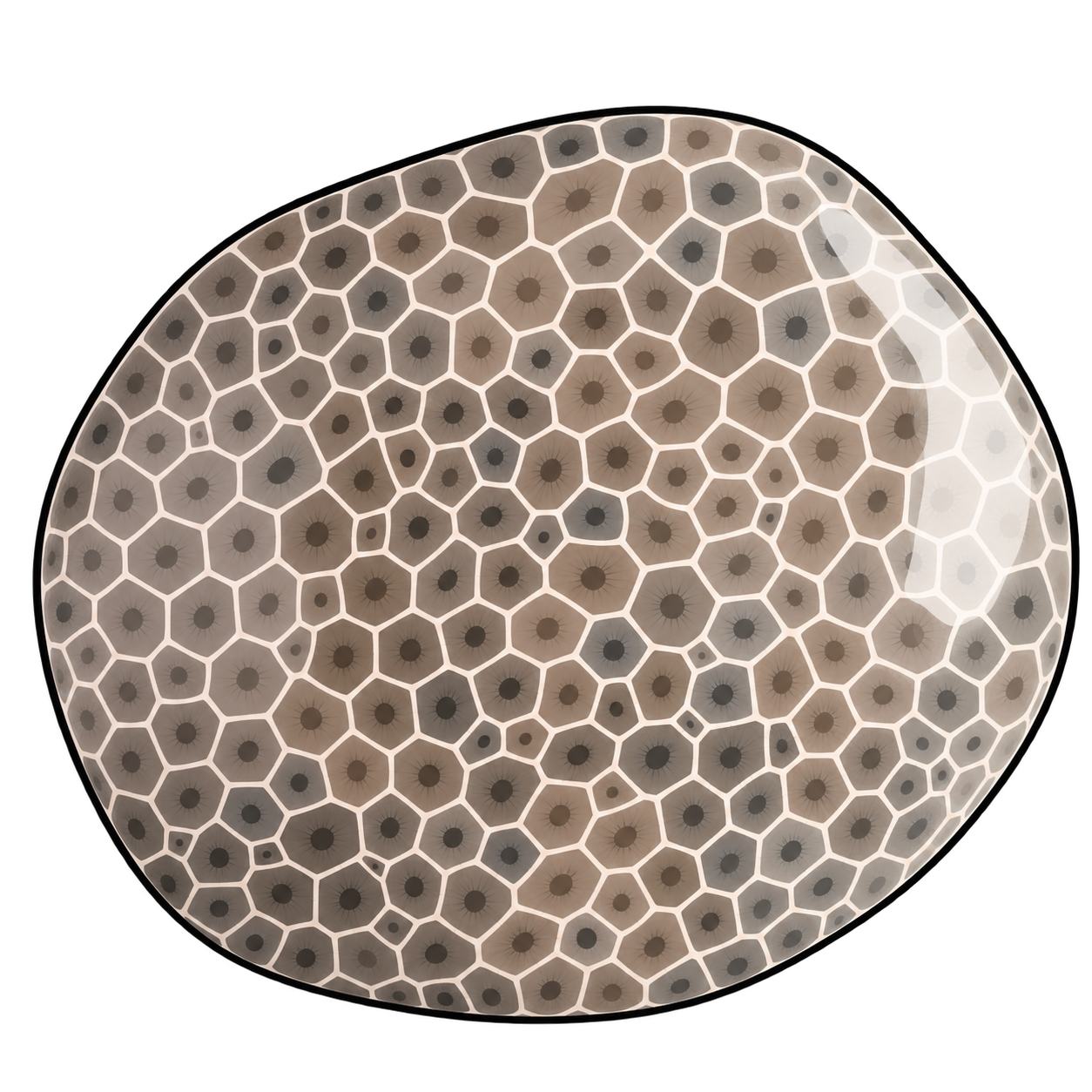
Fossil coral brings the architecture of ancient animals into view. Repeating cups, honeycomb-like outlines or radiating partitions may preserve the arrangement of a colony long after the animals themselves disappeared. Some pieces remain carbonate-rich fossils; others have been partly or extensively replaced by silica. The shared name describes their biological origin, not one uniform mineral composition.
In her contemporary crystal writing, Anna Stark associates fossil coral with stability, resilience and gradual transformation. She connects it with Earth and Water symbolism and with the root and sacral chakras. Her emphasis is on steady growth rather than sudden change. [4]
The repeated pattern of a former colony lends itself to reflection on continuity and interconnection. Those are interpretations of the fossil's appearance and history, not evidence that mineralized coral transmits ancestral knowledge. Nor do they establish an ancient universal tradition: a modern practitioner's account should be presented as such. The specimen can hold personal meaning without its beliefs being confused with paleontology.
Corals are animals. In colonial forms, many individual polyps build adjacent skeletal structures, producing the repeated patterns visible in some fossils. Other corals were solitary. Michigan's geological guidance distinguishes extinct rugose and tabulate corals from modern scleractinian forms and identifies several common fossil examples, including Hexagonaria, Favosites and Syringopora. [2]
This diversity matters when identifying a specimen. A honeycomb pattern is not automatically a Petoskey stone, and a circular pattern does not establish a particular genus. The shape of individual skeletal units, their internal partitions and the relation between neighboring units provide more useful evidence than a decorative resemblance alone.
“Fossil coral” and “agatized coral” are not interchangeable labels. The latter specifies a kind of silicification. Florida's geological survey describes agatized coral as silica replacing original coral material, while the broader fossil category includes other preservation states. A carbonate-rich specimen should not be assigned the durability of quartz simply because another fossil coral is agatized. [3]
Mineral composition affects polishing, response to cleaning agents and resistance to wear. It also affects what the fossil tells us: replacement can preserve an external pattern while changing the original material. The living coral's identity and the present mineral filling are different aspects of the same object.
FORMATION: REPLACEMENT AND OPEN CAVITIES The Florida Museum describes agatized coral in which groundwater dissolved part of the original calcium-carbonate skeleton while silica was deposited. Some examples became hollow, geode-like forms lined with rounded agate surfaces. The result need not be a solid replica of every original skeletal detail. [1]
One museum specimen is identified as Siderastrea from the Early Oligocene, approximately 34–28 million years ago. That age belongs to the documented fossil, not every item sold as fossil coral. The museum's example also belongs to a collection donated by Gene Hamm and his family after decades of collecting. Such records make it possible to discuss a real specimen rather than inventing one generalized origin for the entire trade category. [1]
Michigan's Petoskey stones are associated with Hexagonaria, a colonial rugose coral from Devonian rocks. Their familiar polygonal outlines and radiating internal features differ from the hollow agatized examples described in Florida. Both belong within fossil coral, but they should not be collapsed into the same material, age or locality. [2]
Fossil coral sits at the intersection of natural-history collecting and lapidary art. Cutting and polishing can reveal structure that is difficult to see on a weathered surface, but preparation also removes material. A specimen selected for scientific study may be best preserved differently from a common piece selected for a cabochon.
Keep the acquisition locality and any identification with the fossil. A name such as “coral agate” should be accompanied by enough detail to distinguish a geological identification from a seller's description. Fossil coral is also distinct from newly harvested living reef coral; a fossil label should not be used to obscure the origin of modern coral material.
When composition and repairs are unknown, begin with a soft dry brush or cloth. Avoid acid cleaning and abrasive scrubbing: a carbonate component or delicate fossil surface may be damaged even if neighboring silica looks robust. Support fractured or hollow pieces, and do not assume that a polished specimen can tolerate every jewelry-cleaning method.
Its most valuable pattern is not merely ornamental. It is a record of how living animals built structure, followed by the geological changes that allowed part of that structure to survive.
floridamuseum.ufl.edu · Reference for the accompanying text · Reference recorded October 15, 2026
michigan.gov · Reference for the accompanying text · Reference recorded October 15, 2026
floridadep.gov · Reference for the accompanying text · Reference recorded October 15, 2026
annastark.com.au · Reference for the accompanying text · Reference recorded October 15, 2026