Silicon Carbide, Natural Rarity and a Grown Gem's Fire
Moissanite
Silicon carbide (SiC); rare natural mineral, with laboratory-created material supplying the gem trade.
Silicon carbide mineral; retail gems ordinarily laboratory-created
Loading this page…
Return homePlease wait while the next page arrives.


Silicon Carbide, Natural Rarity and a Grown Gem's Fire
Silicon carbide (SiC); rare natural mineral, with laboratory-created material supplying the gem trade.
Silicon carbide mineral; retail gems ordinarily laboratory-created
Moissanite brings together two different stories: rare natural silicon carbide and deliberately grown crystals made into brilliant jewelry.
Geology · Human history · Spiritual attributes
Commitment · Resilience · Individuality · Shared possibility [4]
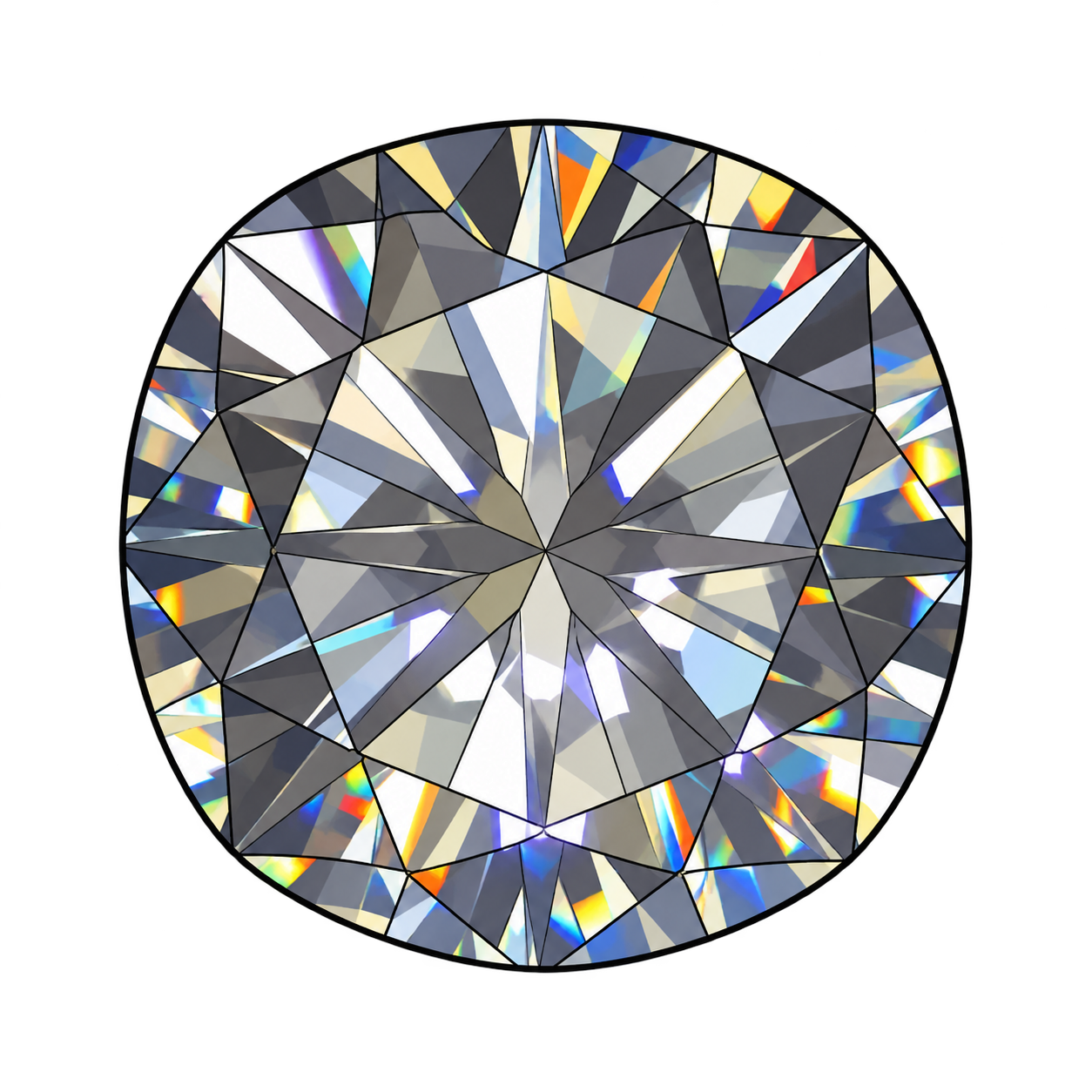
Moissanite brings together two different stories: rare natural silicon carbide and deliberately grown crystals made into brilliant jewelry. Commercial faceted stones ordinarily belong to the second story. Their flashes of spectral color are a property to appreciate in their own right, not evidence that a ring contains a fragment harvested from a meteorite. [1, 2]
Moissanite's best-documented symbolic language is modern jewelry symbolism. A wedding or engagement ring can represent commitment, while durability and brilliance serve as metaphors for endurance and vitality. Charles & Colvard uses these themes in its interpretation of moissanite wedding jewelry; they are contemporary meanings, not proof of an ancient crystal tradition. [4]
The significance of a ring comes through choosing, giving and wearing it. Laboratory growth does not prevent an object from becoming meaningful, just as natural origin does not guarantee that it will carry a particular meaning. Neither origin establishes a therapeutic or supernatural effect.
Moissanite is silicon carbide, SiC; diamond is elemental carbon. Silicon carbide can adopt different stacking sequences known as polytypes. The Handbook records several natural polytypes, sometimes intergrown, and describes hexagonal plates among its crystal forms. A mineral specimen and a modern grown jewelry crystal therefore require more precise descriptions than a single idealized shape. [1]
Published hardness values for gem material are about 9¼–9½, indicating substantial resistance to scratching. Density is roughly 3.2. The familiar high hardness does not mean an edge cannot chip, nor that a ring's metal setting shares the gemstone's durability. Poor cleavage and shell-like fracture are reported for the natural mineral. [1, 2]
The 1997 study reported a dispersion of 0.104: moissanite separates light strongly into spectral colors, producing its conspicuous fire. Cut, illumination and viewing direction shape the visible flashes. [2]
Double refraction can make facet junctions appear doubled in a suitable viewing direction. GIA also describes grayish or yellowish appearances at some angles and the availability of colored material. [3]
Natural moissanite has been reported from meteorite material and particular terrestrial geological settings, including diamond-bearing rocks and some volcanic occurrences. Its name honors Henri Moissan, associated with recognition of the species in Canyon Diablo meteorite material. These natural occurrences are mineralogical evidence, not the ordinary supply route for faceted commercial gems. [1]
Nassau and colleagues found that thermal diamond probes of the 1990s could misidentify moissanite as diamond. Optical examination and appropriate instruments provide the necessary separation; the historical finding does not imply that all modern testers fail. [2]
Look for a clear material name, laboratory-grown disclosure and a description of the individual stone's color and dimensions. Moissanite, cubic zirconia, glass and laboratory-grown diamond are not interchangeable names. Choosing one does not require disparaging the others; their different identities and properties are precisely what make an informed choice possible. [3]
A jewelry description should also distinguish measured weight from a comparison based on the apparent size of another gemstone. If a listing uses an unfamiliar size convention, ask what the number means and request millimeter measurements. Keep the purchase record with the piece so that a future repair or appraisal does not begin with an unsupported assumption.
Charles & Colvard recommends mild soap and water with a soft toothbrush for its jewelry. Cleaning should account for the setting and any accompanying stones, not just the central moissanite. Inspect loose prongs or damaged settings before handling the jewel over a sink, and use a protected container rather than an open drain. [5]
Protect the piece from hard impacts and seek professional advice before repair or stronger cleaning. A durable gem can outlast a neglected mounting, while accumulated surface residue can interfere with the appearance without changing the underlying material. Regular gentle care is more useful than attempting aggressive treatments to restore an assumed lost brilliance.
handbookofmineralogy.org · Reference for the accompanying text · Reference recorded October 15, 2026
gia.edu · Reference for the accompanying text · Reference recorded October 15, 2026
gia.edu · Reference for the accompanying text · Reference recorded October 15, 2026
charlesandcolvard.com · Reference for the accompanying text · Reference recorded October 15, 2026
www2.charlesandcolvard.com · Reference for the accompanying text · Reference recorded October 15, 2026