A Gem with a History Beyond Ruby
Spinel
Magnesium aluminium oxide mineral.
Mineral species; ornamental specimens may include other minerals
Loading this page…
Return homePlease wait while the next page arrives.


A Gem with a History Beyond Ruby
Magnesium aluminium oxide mineral.
Mineral species; ornamental specimens may include other minerals
Spinel does not need to borrow another gemstone's reputation.
Geology · Human history · Spiritual attributes
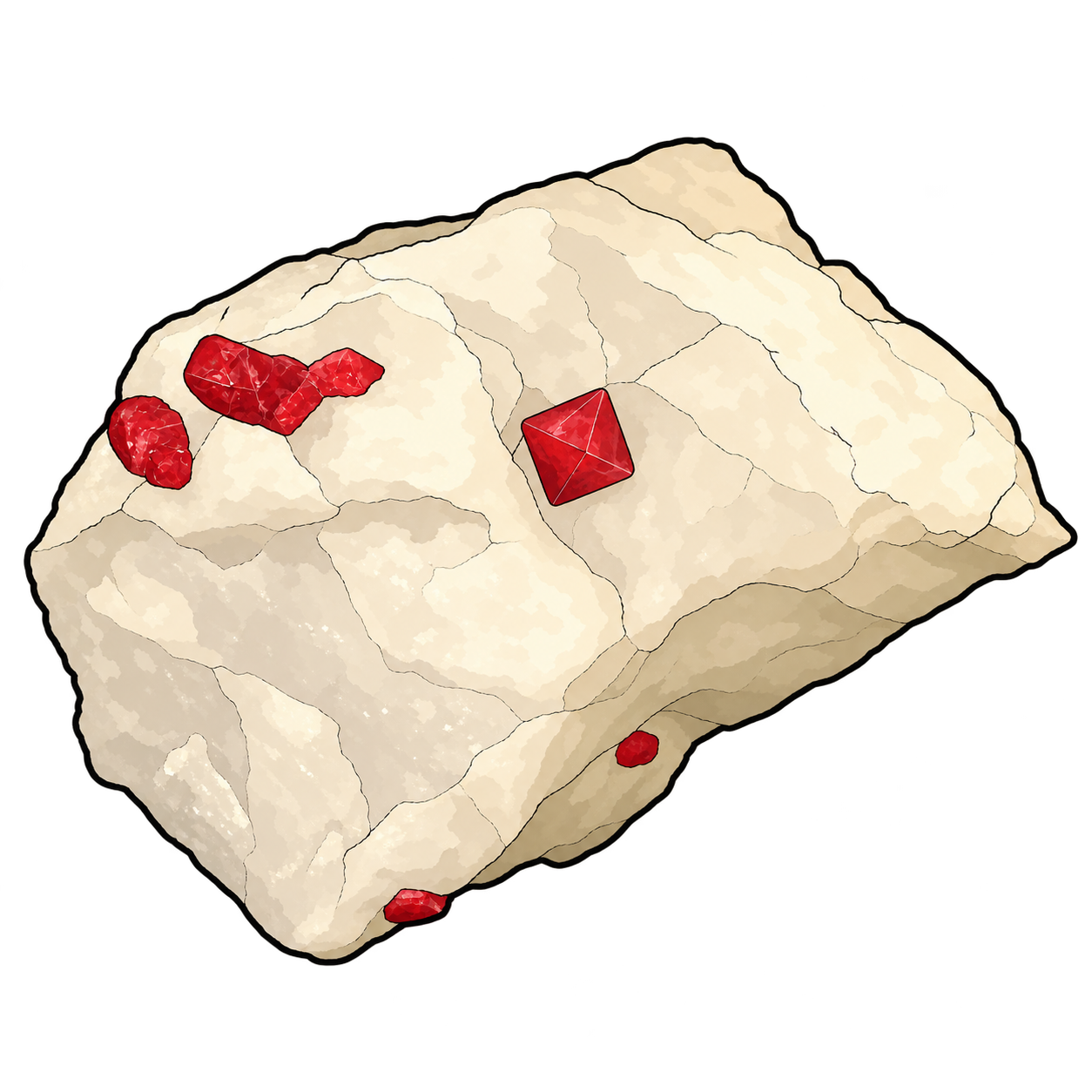
Spinel does not need to borrow another gemstone's reputation. Its reds, pinks, violets and blues, together with handsome natural crystal forms, give it considerable character of its own. Yet one famous example still carries the name Black Prince's Ruby. That historic title records an older way of recognizing a magnificent red jewel; modern mineralogy identifies the stone as spinel. [1, 3]
Modern crystal practice connects spinel with renewed enthusiasm, inner alignment and compassionate engagement with others. Earth symbolism supplies a language of grounding, while its vivid colors offer a focus for intention. These associations belong to spiritual interpretation rather than a demonstrated energy-transfer process. [5]
Someone may carry those meanings through wearing a jewel, contemplating a crystal or setting aside time outdoors. The stone can be a personal reminder without being assigned a power to diagnose imbalance or treat illness. Its mineral identity does not depend on accepting a spiritual interpretation.
Spinel is an oxide with the ideal composition MgAl₂O₄ and cubic symmetry. The mineral species lends its name to a much larger structural family, whose members need not be transparent jewelry gems. Natural spinel commonly forms octahedra, with eight triangular faces, and can also occur as rounded grains or massive material. Twinning produces additional forms. [1, 2]
Its hardness is approximately 7½–8. Spinel is brittle despite good jewelry durability; broken surfaces may be uneven or shell-like, and parting can occur. Composition affects properties such as density, so values for an ideal end member should not be treated as an infallible test for every sample. [2]
Flattened twins can encourage shallow cutting proportions; the geometry of rough influences the finished jewel. [1]
Chromium contributes to pink and red spinel; iron can produce violet and blue tones, while cobalt can yield particularly vivid blue. Color is therefore a consequence of chemistry within the structure, not a separate mineral name for every shade. The relation between appearance and composition is more informative than treating all red examples as ruby substitutes. [1]
Cubic spinel is optically isotropic, unlike doubly refracting ruby. [1]
Spinel occurs in high-temperature igneous assemblages and suitable metamorphic rocks, including metamorphosed limestone and aluminum-rich schist. Minerals such as forsterite, phlogopite and corundum can accompany it. Weathering may later free durable grains into sediment. Gem occurrences include Myanmar and Sri Lanka, among many other regions. [2]
A gem's recovery site and its formation environment are thus different pieces of information. Finding a rounded crystal in gravel describes where a miner encountered it, not necessarily where it crystallized. A matrix specimen retains relationships that a loose gem has lost, while a faceted stone reveals optical qualities that may have been obscured in the rough. Both can be valuable records when their labels are preserved.
Historic Royal Palaces identifies the red stone set in the front cross of the Imperial State Crown as spinel. Its account distinguishes that identity from legends about ownership: a transfer to Edward the Black Prince in 1367 and Henry V's use of the jewel at Agincourt are presented as traditional accounts rather than equally secure observations. [3]
Natural spinel, treated natural spinel and laboratory-grown spinel are separate disclosure categories. GIA's microscopic reference material illustrates all three and documents the importance of internal features. Flame-fusion synthetics are widely available, but a diagnosis should not rest on a single casual observation or a seller's photograph. [6]
GIA regards spinel as suitable for all kinds of jewelry because it combines good toughness with substantial scratch resistance. Warm soapy water is a straightforward cleaning choice. Ultrasonic or steam cleaning can be inappropriate when fractures, sensitive inclusions or filling are present; high heat may also affect some colors. Fracture-filled material requires particularly gentle treatment. [4]
This is a durable gemstone, not an indestructible one. Have a loose setting checked, protect exposed edges during strenuous work and tell a jeweler about any known treatment before repair. A rough crystal on matrix should be handled for the needs of the whole specimen rather than only the hardness of the spinel.
gia.edu · Reference for the accompanying text · Reference recorded October 15, 2026
handbookofmineralogy.org · Reference for the accompanying text · Reference recorded October 15, 2026
hrp.org.uk · Reference for the accompanying text · Reference recorded October 15, 2026
gia.edu · Reference for the accompanying text · Reference recorded October 15, 2026
thecrystalcouncil.com · Reference for the accompanying text · Reference recorded October 15, 2026
gia.edu · Reference for the accompanying text · Reference recorded October 15, 2026