Rock Crystal
Clear Quartz
Quartz, crystalline silica (SiO2).
Colorless or milky crystalline quartz variety
Loading this page…
Return homePlease wait while the next page arrives.


Rock Crystal
Quartz, crystalline silica (SiO2).
Colorless or milky crystalline quartz variety
Clear quartz is the colorless variety of crystalline quartz, also known as rock crystal.
Geology · Human history · Spiritual attributes
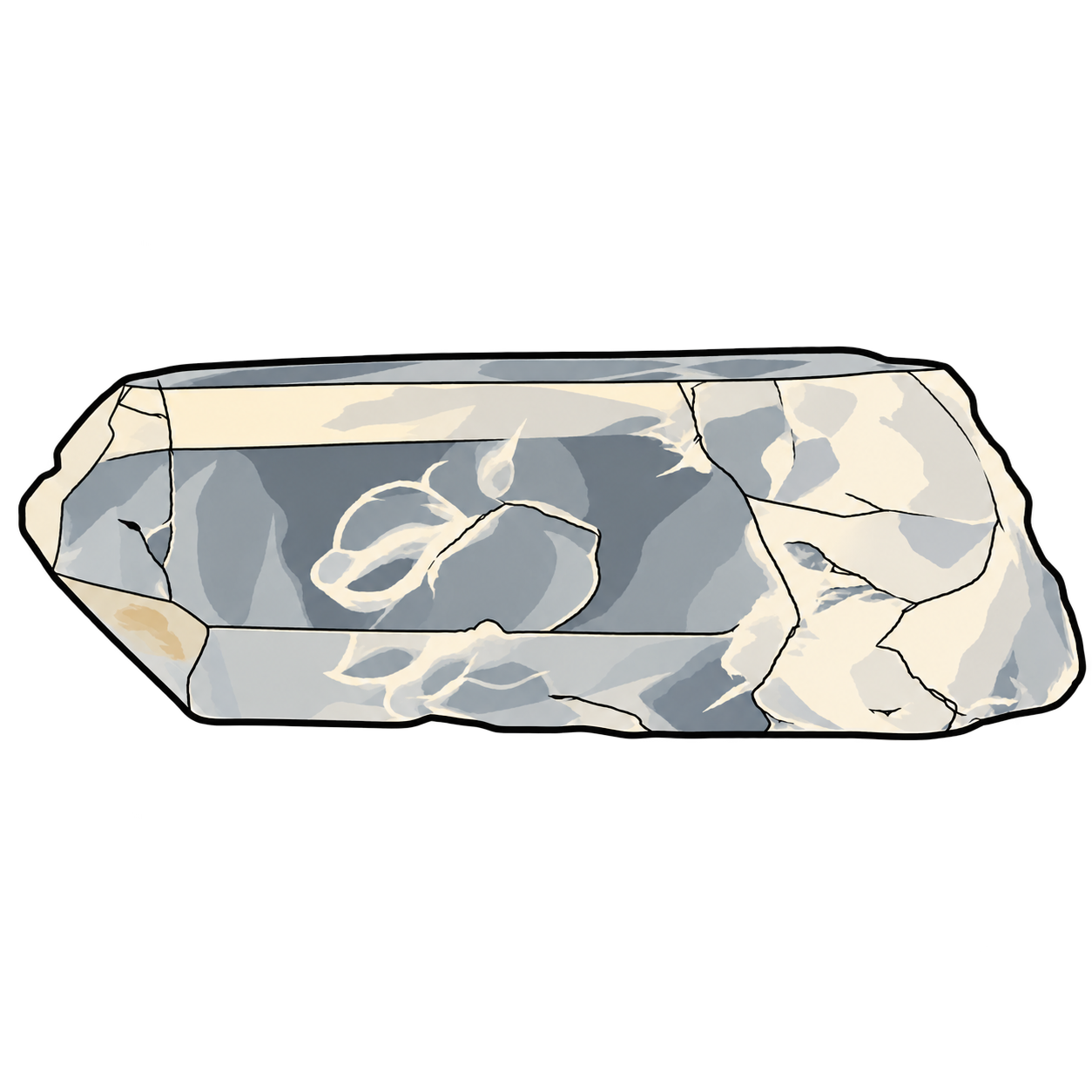
Clear quartz is the colorless variety of crystalline quartz, also known as rock crystal. Its appeal ranges from exceptionally transparent points to specimens filled with pale clouds, fine fractures and mineral inclusions. Collectors value its crystal form and internal detail; in crystal traditions, it is prized for clarity, amplification and spiritual awareness. [1, 2, 5]
Clear quartz is regarded in crystal practice as an amplifier: a stone believed to strengthen intention and the qualities of other crystals used alongside it. Its versatility makes it a common choice for meditation, crystal grids and personal ritual. [5]
Composition: Silicon dioxide, SiO₂ Crystal system: Trigonal Typical form: Six-sided prisms, pointed terminations, clusters and intergrown masses Mohs hardness: 7 Specific gravity: Approximately 2.65 Luster: Glassy, or vitreous Cleavage: Usually not observable Fracture: Commonly curved and shell-like, known as conchoidal fracture Refractive indices: Approximately 1.544–1.553 [1, 2]
The familiar quartz point consists of prism faces meeting sloping faces at its tip, or termination. Fine lines may cross the prism faces at right angles to the crystal's length. These growth markings differ from the curved surfaces left by breakage. A six-sided outline does not make quartz's crystal system hexagonal: its symmetry is classified as trigonal. [1, 2]
Quartz's hardness of 7 describes its resistance to scratching, not its resistance to impact. A crystal can retain a bright, glassy surface yet chip at a projecting point. When it breaks, quartz commonly produces curved fracture surfaces rather than separating into neat sheets. This distinction is useful when examining a tip: a smooth-looking broken surface is not necessarily a natural crystal face. [1]
Specific gravity compares a material's density with water. A value near 2.65 means solid quartz weighs about 2.65 times as much as an equal volume of water. Its refractive indices describe how light travels through the crystal and help gemologists identify it. These are measured properties, not ratings of a specimen's quality; a richly included crystal may be as desirable to a collector as a transparent one. [2, 4]
Quartz is piezoelectric: mechanical strain produces an electrical response, and an applied electrical field can deform the crystal. In an oscillator, a precisely cut quartz element supplies a stable timing reference. This behavior underlies its use in watches and electronic equipment; it should not be confused with the spiritual meaning of amplification. [3, 4]
Quartz crystallizes in igneous rocks such as granite and pegmatite, and from silica-bearing fluids moving through rock. Where crystals have space to grow, recognizable faces can develop. Where growth is crowded, neighboring crystals meet in interlocking masses. The sharply outlined point familiar in a mineral collection is therefore only one of quartz's many natural forms. [3]
Arkansas provides a well-documented example of vein-grown rock crystal. In the Ouachita Mountains, many productive deposits occupy fractures and cavities in sandstone. Mineral-bearing fluids deposited quartz in these openings, producing individual crystals and clusters. Dating of associated feldspar places a major episode of vein formation near the end of the region's mountain-building cycle, during the Late Pennsylvanian to Early Permian. The enclosing sandstone and the crystals within its fractures did not necessarily form at the same time. [10]
Quartz also survives the breakdown of its host rock. Weathering and transport release grains that become part of sands and sedimentary rocks. A rounded quartz pebble and a pointed crystal can share the same mineral identity while preserving very different records of growth, exposure and wear. [3]
Transparency is only one way to appreciate rock crystal. Enclosed minerals, fluid cavities and internal fractures can make a specimen distinctive, and careful examination can reveal features that are difficult to see in a photograph.
Rutile can form fine golden or reddish needles inside quartz. Such inclusions are separate minerals enclosed by the host crystal, not simply colors of quartz itself. Their arrangement may be more visually important than the clarity of the surrounding material. Color alone, however, is not enough to identify every enclosed mineral. [2, 12]
Small cavities can preserve liquid and gas, sometimes together in the same inclusion. Some are trapped as the crystal grows; others remain along fractures that later heal. Under magnification, these features can provide evidence about a crystal's formation and subsequent history. They are not all empty cracks, and they should not all be described as damage. [12]
A phantom resembles the outline of a smaller crystal inside a larger one. It records an earlier growth surface made visible by material deposited on it before further quartz grew around it. Several outlines may preserve successive stages. This is different from a separate, fully formed crystal simply enclosed inside the quartz. [13]
Amethyst, citrine, smoky quartz and rose quartz are familiar colored varieties. Chalcedony has a much finer texture: its constituent crystals are too small to distinguish with the unaided eye. “Rock crystal” identifies the colorless crystalline variety; it does not require every specimen to be perfectly transparent or free of inclusions. [2]
Rock crystal's transparency and hardness made it both attractive and demanding to carve. A tenth-century Egyptian flask in the Metropolitan Museum of Art carries delicately beveled plant decoration. The museum identifies it as a probable perfume container and places it within the Fatimid court's appreciation of rock crystal. Its small scale—only 3.5 centimeters high—makes the workmanship particularly striking. [14]
A different use appears in a medieval reliquary from the Wyvern Collection. Dated around 1200–1230, it combines a rock-crystal vessel with gold and gemstones; the crystal vessel itself may be older. Its transparent body allows the enclosed relic to be seen. These objects document specific uses of the material rather than a single tradition shared by every culture. [7]
Quartz has also served in optical equipment and precision electronics. Clear, suitable natural crystals were strategically important for oscillators and optical instruments during the Second World War. Laboratory-grown quartz later provided a controlled source for technical applications. The requirements of an electronic component are very different from those of a collector: predictable physical behavior matters more than a dramatic inclusion or attractive cluster. [4, 10]
Begin with the form you want to collect. A natural point preserves growth faces; a cluster shows the relationship between neighboring crystals; a carving or polished piece emphasizes an intentionally shaped surface. None needs to imitate another. A useful description should state whether a point has been polished or reshaped rather than presenting every pointed object as a naturally terminated crystal. [4]
For a specimen, examine the termination, face edges, base and any attachments. Ask for photographs from more than one direction so that internal features and surface condition can be assessed separately. Decide whether your priority is transparency, an intact growth form, a distinctive inclusion or a documented locality. These are different collecting interests, not interchangeable grades of quality.
Natural and laboratory-grown quartz can be difficult to distinguish. GIA has documented synthetic rock crystal with inclusions resembling those in natural material, so “it has inclusions” is not sufficient proof of natural origin. For a purchase whose value depends on origin, seek reliable documentation or appropriate gemological examination. [11]
Treatments should also be disclosed. Some quartz receives a thin surface coating that produces colors or iridescence absent from the underlying material. Such a piece can be attractive, but its appearance and care requirements differ from those of untreated rock crystal. Ask about coatings, repairs and other alterations before purchasing. [8, 9]
For untreated quartz in sound condition, use lukewarm water, mild soap and a soft brush. Rinse away soap and dry carefully with a soft cloth. Support a cluster from beneath instead of lifting it by a projecting crystal, and avoid forcing a brush into narrow gaps. [9]
Store pieces separately or in padded compartments so that points cannot strike neighboring specimens. Quartz can scratch softer stones, while impact can damage the quartz itself. Avoid sudden changes in temperature, especially when a specimen already contains fractures. [1, 9]
A quartz cluster may include other minerals, a fragile matrix, adhesive repairs or a surface treatment. Its care should suit the whole object, not just the quartz. Ask the supplier before prolonged soaking, ultrasonic cleaning or steam cleaning; treated and repaired pieces can require gentler handling. Routine display care rarely calls for aggressive cleaning. [9]
handbookofmineralogy.org · Reference for the accompanying text · Reference recorded October 15, 2026
australian.museum · Reference for the accompanying text · Reference recorded October 15, 2026
geology.com · Reference for the accompanying text · Reference recorded October 15, 2026
gem-a.com · Reference for the accompanying text · Reference recorded October 15, 2026
thecrystalcouncil.com · Reference for the accompanying text · Reference recorded October 15, 2026
llewellyn.com · Reference for the accompanying text · Reference recorded October 15, 2026
bowdoin.edu · Reference for the accompanying text · Reference recorded October 15, 2026
gia.edu · Reference for the accompanying text · Reference recorded October 15, 2026
gia.edu · Reference for the accompanying text · Reference recorded October 15, 2026
geology.arkansas.gov · Reference for the accompanying text · Reference recorded October 15, 2026
gia.edu · Reference for the accompanying text · Reference recorded October 15, 2026
gia.edu · Reference for the accompanying text · Reference recorded October 15, 2026
gem-a.com · Reference for the accompanying text · Reference recorded October 15, 2026
metmuseum.org · Reference for the accompanying text · Reference recorded October 15, 2026