Pink and green spodumene, with color that deserves a precise name
Kunzite and Hiddenite
Colored varieties of spodumene.
Colored spodumene varieties within one mineral species
Loading this page…
Return homePlease wait while the next page arrives.


Pink and green spodumene, with color that deserves a precise name
Colored varieties of spodumene.
Colored spodumene varieties within one mineral species
Spodumene is a monoclinic pyroxene, commonly forming flattened, elongated crystals with lengthwise striations.
Geology · Human history · Spiritual attributes
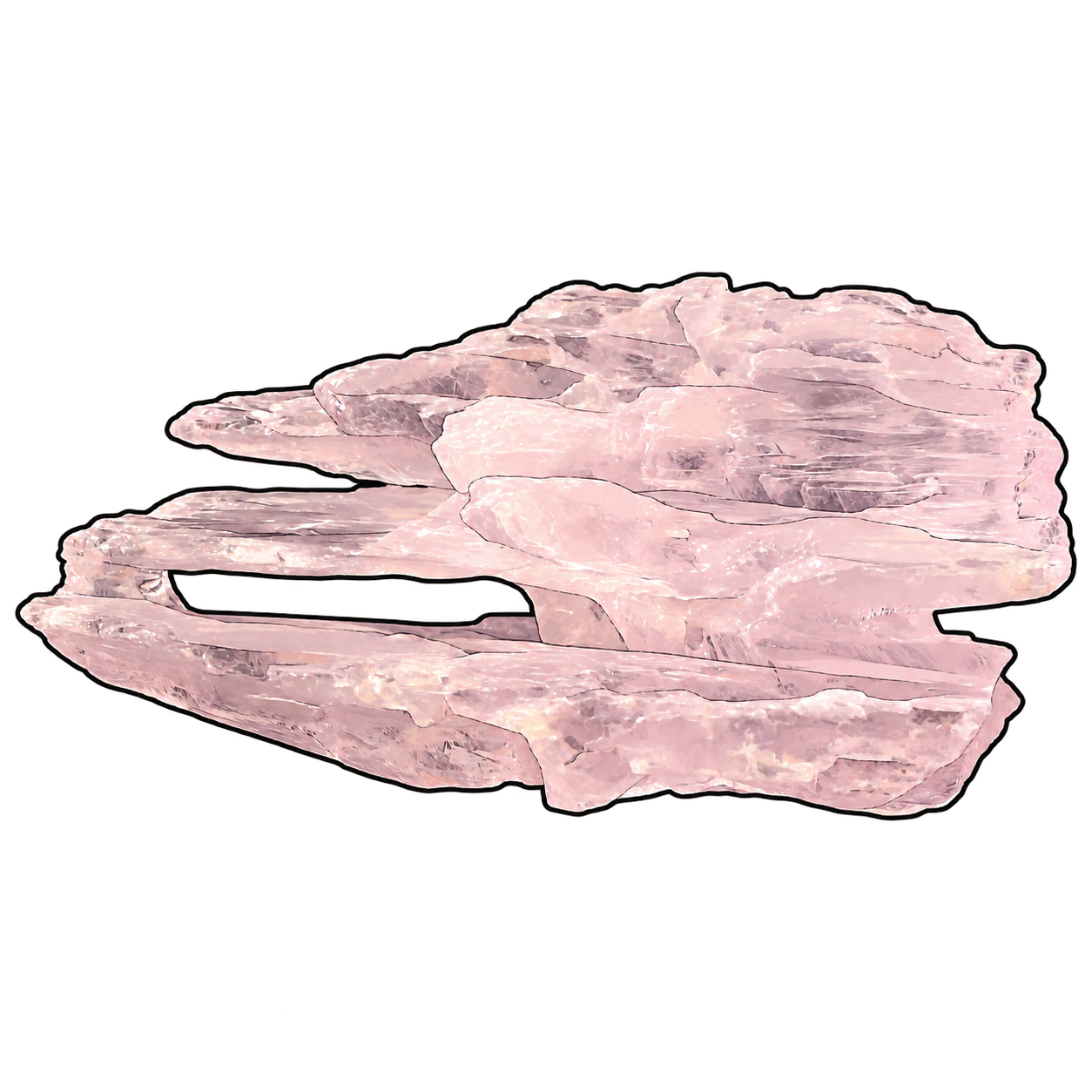
Kunzite and hiddenite have complementary roles in contemporary crystal practice. The Crystal Council places pink kunzite within a heart-centred framework of kindness and receptivity; its account of green hiddenite emphasizes replenishment, self-appreciation and direction. These are attributed spiritual meanings, not demonstrated therapeutic effects. [1,2]
The two colours can represent outward generosity and inward care within the same reflective practice. Their lithium content belongs to mineral chemistry and is not a reason to ingest a specimen or prepare a crystal elixir.
Kunzite and hiddenite are not two separate minerals. Both are varieties of spodumene, whose essential chemistry contains lithium, aluminum, silicon and oxygen. Manganese accounts for kunzite's pink-to-violet coloration. Hiddenite's green is associated with chromium; not every pale green spodumene sold under that name has the same cause of color. The distinction matters because visually similar material can differ in color stability and geological origin. [3,4]
A crystal can look intensely colored from one direction and surprisingly pale from another. This is pleochroism: the absorption of light differs with direction through the crystal. GIA notes that kunzite commonly shows its strongest color along the length of the crystal. A cutter therefore has to reconcile the direction that best displays color with the directions along which the stone is most likely to split. A deep cut may strengthen the visible pink, but a large finished gem is not simply a scaled-up version of an easy-to-cut rough crystal. [5]
Spodumene is a monoclinic pyroxene, commonly forming flattened, elongated crystals with lengthwise striations. Its hardness is 6.5–7, measured density approximately 3.03–3.23 g/cm³, and lustre glassy to pearly on cleavage surfaces. [6]
Two conspicuous cleavage directions meet at nearly a right angle, characteristic of its pyroxene architecture. The mineral is brittle, and its moderate scratch resistance does not make it tough. The same specimen may withstand gentle handling yet split under pressure applied in an unfortunate direction. These properties explain why a long, clear crystal can be both impressive and mechanically vulnerable. [6,7]
Spodumene is characteristic of lithium-rich granitic pegmatites, with associated minerals including quartz, albite, lepidolite, petalite and beryl. Large crystals from such settings are not all gem quality; mineral identity, transparency and suitability for faceting are separate questions. The mineral's geological importance also extends beyond gemstones because lithium-rich pegmatites are lithium resources. [6,3]
Hiddenite: a name that needs evidence Older specialist usage sometimes confined “true hiddenite” to chromium-bearing material from Alexander County, North Carolina. That locality remains historically important, but it is not sound to turn an older geographical definition into a permanent rule. GIA's Winter 2023 Micro-World report identified a chromium-bearing spodumene crystal from Idaho as hiddenite, using Raman analysis and X-ray fluorescence alongside its surface features. The specimen had previously been sold as aquamarine—a useful reminder that an attractive appearance is not a sufficient identification. []
Kunzite's modern name dates to the early twentieth century. GIA recounts that pink crystals from San Diego County reached George Frederick Kunz in 1902; he recognized them as a previously unrecognized color variety of spodumene. Charles Baskerville named the variety in his honor in 1903. The mineral itself was already known: the new recognition concerned its pink gem variety, not the discovery of spodumene as a species. [10]
Its ability to produce large, clear gems made it particularly suitable for dramatic jewelry. The Smithsonian's Paloma Picasso necklace contains a 396.30-carat Afghan kunzite, set in a gold-and-diamond ribbon motif and suspended from South Sea pearls. This is a concrete example of kunzite's role in modern design, distinct from unsupported claims that it carried the same spiritual meanings throughout antiquity. [11]
Kunzite may be irradiated and heated to modify its color. Natural color can fade too, so fading alone does not prove treatment. Avoid prolonged intense light and heat, abrupt temperature changes, steam and ultrasonic cleaning. GIA recommends warm, mild soapy water and protection from hard knocks; a valuable gem benefits from a protective setting or a less exposed form of jewelry. [7]
For a rough specimen, support the entire fragment rather than lifting a projecting blade. Examine color under steady, indirect light while rotating the piece, not by repeatedly moving it between harsh lamps and sunlight. Differences between directions are part of its optical character; preserving that character requires restraint rather than a test of how much exposure the color can survive.
The clearest label records spodumene, the supported variety, locality and any known treatment. Ordinary green spodumene should not automatically acquire the hiddenite name, nor should a new documented locality be rejected merely because an older reference listed fewer sources. This is one of the places where scientific identification and inherited trade language need to be read together rather than treated as interchangeable.
gia.edu · Reference for the accompanying text · Reference recorded October 15, 2026