Chromium-green mica, layered light, and the different stones hidden behind one name
Fuchsite
Chromium-bearing green muscovite variety.
Mineral variety: chromium-bearing muscovite
Loading this page…
Return homePlease wait while the next page arrives.


Chromium-green mica, layered light, and the different stones hidden behind one name
Chromium-bearing green muscovite variety.
Mineral variety: chromium-bearing muscovite
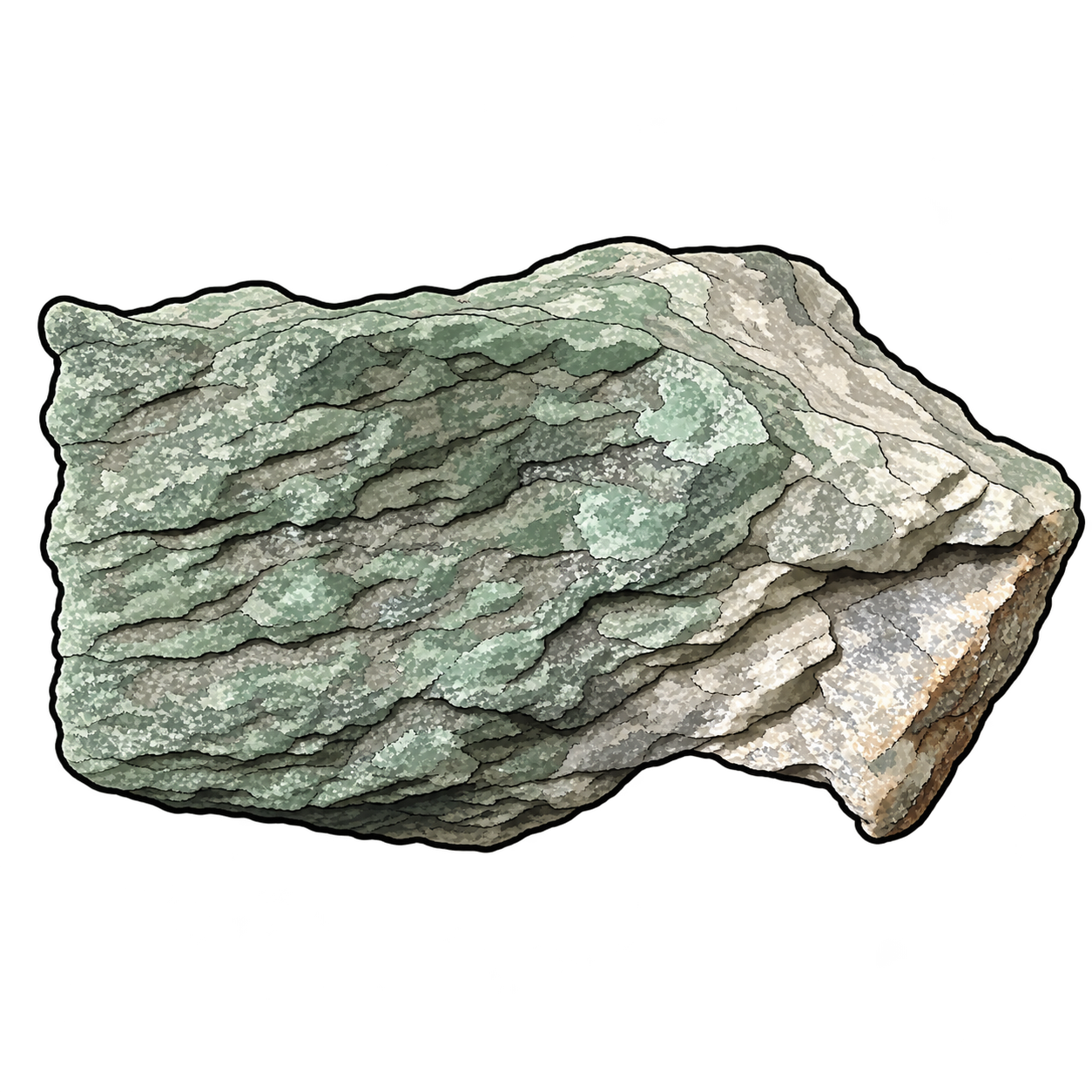
Fuchsite is chromium-colored green muscovite.
Geology · Human history · Spiritual attributes
The Crystal Council connects fuchsite with the heart, compassion, renewal, and greater awareness of one's feelings. Its interpretation emphasizes a gentler relationship with oneself and others. These are contemporary spiritual correspondences, not demonstrated effects of chromium or mica. [2]
Within the same practitioner's system, ruby in fuchsite combines the green stone's heart associations with ruby's symbolism of courage and vitality. This is a spiritual reading of a mineral combination, not evidence that every green-and-red stone is the same material. A person may use a specimen as a visual focus during reflection, but the tradition does not turn it into treatment for distress or illness. [2]
Muscovite has the idealized composition KAl2(AlSi3O10)(OH,F)2. In fuchsite, chromium substitutes within that mica chemistry and provides the characteristic green color. The underlying mineral is still muscovite; fuchsite is a variety name rather than an entirely separate species. Its monoclinic structure is arranged in layers, with exceptionally easy cleavage parallel to their broad faces. [1,5]
Thin muscovite laminae can bend elastically. A book of mica is not equally resistant in every direction: the Handbook of Mineralogy records hardness around 2.5 parallel to its basal orientation and 4 perpendicular to it. It gives muscovite a measured density range of approximately 2.77–2.88. These are mineral data, not guaranteed values for a quartz-rich carving sold under a fuchsite name. [1]
This distinction has practical consequences. A glittering green patch may be soft mica embedded in a much harder host. A polished composite can resist some scratching while its exposed mica flakes still wear or pull away. Good identification describes both the green component and the material holding it, rather than assigning the whole object a single mineral's properties.
Muscovite occurs in schists, gneisses, granitic rocks, pegmatites and alteration products. Green fuchsite additionally requires chromium in its mineral chemistry. [1,5]
Fuchsite can be especially conspicuous beside red corundum. A GIA study of material from India identified green fuchsite, ruby or pink sapphire, and gray-blue kyanite in the same ornamental rock. The colored zones did not all consist of one mineral, and some lighter mica could not be identified to species. That is a useful reminder that attractive commercial names often compress a complicated assemblage. [4]
Resin occurred in two of the three examined pieces, not evidence of universal treatment. Natural minerals and an untreated finished object are separate claims. [4]
Fuchsite is one of the minerals responsible for green aventurine's sparkling inclusions. Vapriikki's Mineral Museum distinguishes these green mica inclusions from the iron-bearing inclusions associated with reddish or orange aventurine. The reflective inclusions and the surrounding quartz play different roles: one supplies the flashes, while the other forms much of the stone's body. [3]
A 2022 gemological examination illustrates why color alone is insufficient. A white-and-green bangle resembling jadeite proved to be a polycrystalline quartz aggregate. Its refractive index of 1.54 and specific gravity of 2.67 pointed toward quartz rather than jadeite; spectroscopy identified chromium-bearing fuchsite among its green inclusions. Calling the object green, jade-like, or fuchsite-bearing would not make it jadeite. [5]
Ruby in fuchsite also needs to be distinguished from ruby in zoisite. Both can combine green material and red corundum, but the green hosts are different minerals. The Indian material studied by GIA showed the mica texture associated with fuchsite and, in some pieces, blue kyanite around the corundum. That observation is helpful context, not a promise that every specimen will display a diagnostic blue rim. [4]
Muscovite's name recalls mica sheets used as Muscovy glass. That documented use concerns the broader mica species, not exclusively green fuchsite. [1]
A useful collection record states whether the object is a mica specimen, an aventurine-type quartz material, or a mixed ruby-bearing rock. Preserve a reliable locality label, the seller's treatment disclosure, and any laboratory identification together. These records tell more about the particular object than an elaborate trade name can.
Support flaky specimens from underneath and avoid rubbing the exposed layers. A soft brush used very lightly is preferable to scrubbing; do not deliberately peel sheets to test the mineral. Store rough mica away from harder stones and loose jewelry.
For a polished composite, care follows its most vulnerable component and any treatment. Avoid steam, ultrasonic cleaning, heat, prolonged soaking, and solvents when fillers or mixed minerals are possible. A lightly dampened soft cloth is the conservative first choice for a stable polished surface. Do not use scratch tests, heated probes, or chemical tests on a finished piece: professional identification can answer the material question without turning the collection into a test specimen.
handbookofmineralogy.org · Reference for the accompanying text · Reference recorded October 15, 2026
thecrystalcouncil.com · Reference for the accompanying text · Reference recorded October 15, 2026
vapriikki.fi · Reference for the accompanying text · Reference recorded October 15, 2026
gia.edu · Reference for the accompanying text · Reference recorded October 15, 2026
gia.edu · Reference for the accompanying text · Reference recorded October 15, 2026