Mineral needles, growth outlines and trapped fluids within quartz
Included Quartz
Quartz containing other minerals or visible growth features.
Quartz with mineral or fluid inclusions and growth textures
Loading this page…
Return homePlease wait while the next page arrives.


Mineral needles, growth outlines and trapped fluids within quartz
Quartz containing other minerals or visible growth features.
Quartz with mineral or fluid inclusions and growth textures
Included quartz is a collecting category rather than a single mineral variety.
Geology · Human history · Spiritual attributes
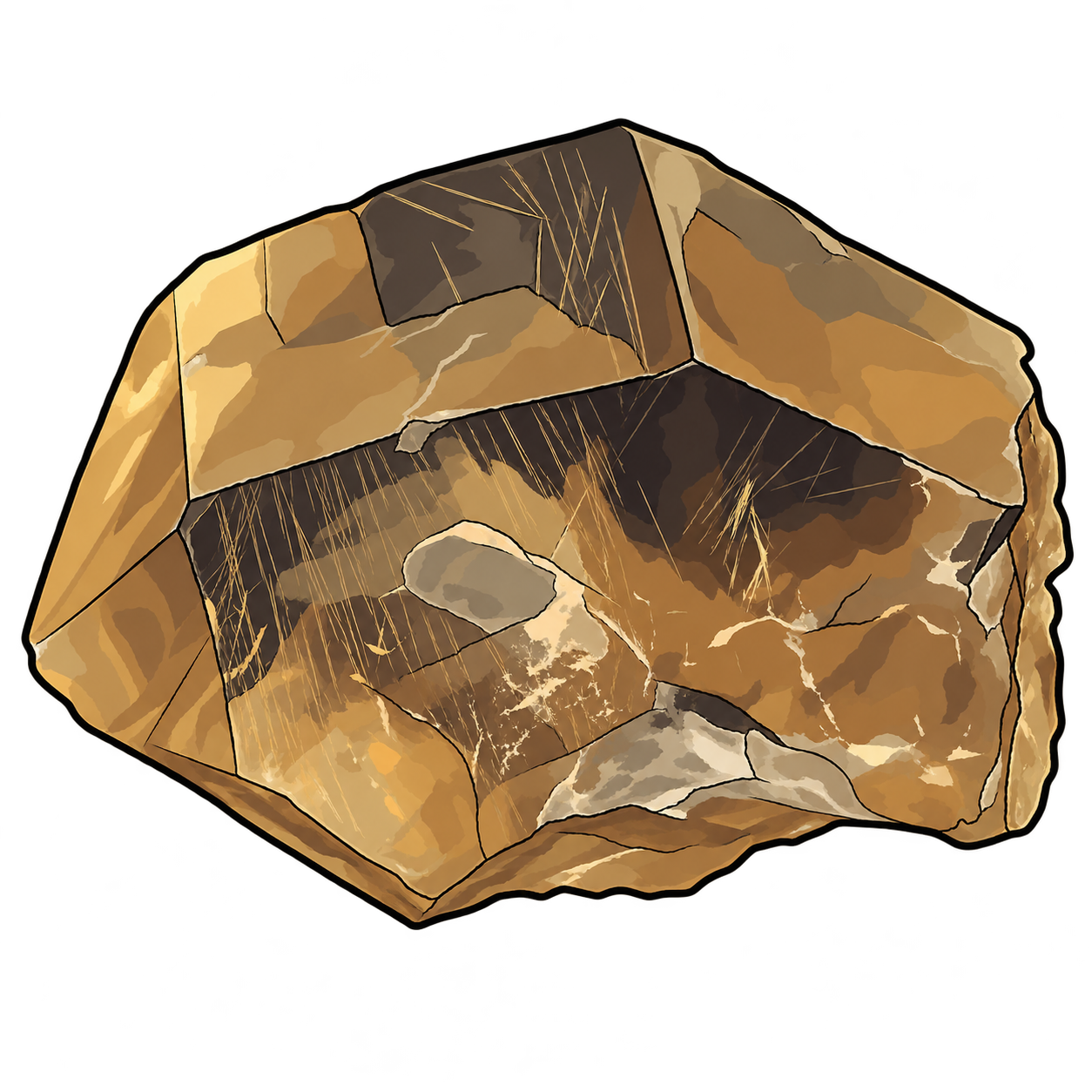
Included quartz is a collecting category rather than a single mineral variety. Its interest lies in what the quartz encloses: another mineral, a fluid-filled cavity, or a feature that records an earlier stage of growth. A golden needle and a moving bubble may be equally striking, but they are different kinds of evidence and should not receive the same explanation. [1]
Spiritual meanings vary with the visible feature and the practitioner's tradition. Included quartz does not have one universal set of attributes. Contemporary interpretations commonly combine the symbolism of quartz with that assigned to its inclusions, or use a growth outline as an image of personal development. [8–10]
These are symbolic associations, not measurements of a specimen's energy or evidence that every similarly colored inclusion is the same mineral. A meaningful personal interpretation can coexist with a cautious material identification.
Quartz host: SiO₂; Mohs hardness 7; density approximately 2.65 g/cm³. [2] Quartz structure: Trigonal; refractive indices approximately 1.544 and 1.553. [12]
The enclosed material has its own composition and properties. Rutile, for example, is titanium dioxide, TiO₂, and crystallizes in the tetragonal system. A rutile needle does not become quartz merely because quartz surrounds it. Likewise, a cavity is an absence of solid host material containing something else, not a new mineral species. [1, 3]
This distinction matters in care and identification. A hardness value for the host does not describe every exposed inclusion, repaired fracture or attached piece of matrix. Density and optical tests must also be interpreted in the context of the specimen being examined, especially where inclusions occupy a substantial part of it.
Rutilated quartz contains rutile crystals, frequently slender enough to resemble threads. They can appear golden or reddish against the transparent host; their metallic-looking color does not make them gold. The Australian Museum records such material from Tingha in New South Wales. [3, 4]
Tourmalinated quartz contains tourmaline, often seen as dark rods crossing the paler host. The resemblance between dark needles in different specimens should not be treated as a universal identification test. Shape and color narrow the possibilities, but a supported mineral name is more informative than an assumption based on a photograph. [1, 8]
A Smithsonian gemstone shows how several inclusions can occur together. Its 3.20-carat quartz, NMNH G10628, from Minas Gerais, Brazil, contains a blue anatase crystal as well as rutile needles. Anatase and rutile are both titanium dioxide, but they have different crystal structures. The specimen therefore preserves a more complex mineral association than “golden threads in quartz” would suggest. [3, 5]
PHANTOMS: AN EARLIER GROWTH SURFACE
A phantom follows the outline of an earlier stage in the host crystal's growth. A layer of other material on that surface becomes enclosed when quartz continues growing, leaving an internal outline that may resemble a smaller crystal. It is not necessarily a separate loose crystal suspended inside the larger one.
Fluid inclusions are small enclosed pockets that can contain liquid, gas and sometimes solids. Some were trapped during growth; others relate to later fractures that healed. Their contents and arrangement can help researchers reconstruct geological conditions, but those conclusions require analysis rather than a trade name alone. [1]
In 2025, Lisa Kennedy described a 16.60-carat Moroccan amethyst with a conspicuous fluid inclusion and a freely moving gas bubble. Its cut placed the feature near the center of the table, making the interior part of the gem's design. The report is a specific observation, not evidence that all quartz sold as “enhydro” contains the same fluid. [7]
“Enhydro quartz” is widely used in the trade for fluid-bearing crystalline quartz. Kennedy notes that stricter gemological usage generally applies enhydro to water-bearing hollow chalcedony nodules or geodes. For a collection label, “quartz with a fluid inclusion and mobile bubble” can communicate the observed feature more precisely. [7]
Inclusions can preserve information that the host's external appearance does not reveal. A mineral may predate the quartz around it, grow alongside it, or develop later through changes within the crystal. Relationships between features can help establish that sequence. [1]
The scientific study of inclusions has a substantial history. Henry Clifton Sorby's 1858 work linked microscopic observations with the origin of minerals and rocks, helping establish petrography. What might be considered an interruption to a gem's clarity can be valuable evidence to a geologist—and the principal attraction to a collector. [1]
Turn the piece slowly under steady light and examine it from several sides. This helps separate internal features from reflections and surface marks. Record polished viewing windows separately from natural crystal faces.
Describe visible features before assigning identities: gold-colored needles, dark rods, green clouds or a mobile bubble. Add confirmed mineral names or analytical results when available.
Names such as garden quartz, lodolite, golden healer and Super Seven are trade descriptions, not precise inventories of included minerals. For a multiple-mineral claim, ask how the constituents were identified.
Inspect surface-reaching fractures, open cavities and repairs. For a fluid-bearing stone, a short video showing the bubble moving is more informative than a still bright spot, which could be a reflection. Keep any laboratory report with the specimen.
Treat included quartz according to its most vulnerable features, not just its host hardness. Heat and ultrasonic cleaning can aggravate fractures or affect sensitive contents and treatments. Gentle hand cleaning is the conservative choice when the inclusion type, repairs or condition are uncertain. [11]
Do not drill, strike or heat a fluid-bearing specimen to investigate what is inside. That would destroy the feature being studied and may fracture the stone. For sound, water-compatible material, use mild soap and a soft brush; take more conservative advice for exposed inclusions or unstable matrix. Keep pieces supported and separated so that tips and edges cannot strike neighboring stones. [11]
gia.edu · Reference for the accompanying text · Reference recorded October 15, 2026
webmineral.com · Reference for the accompanying text · Reference recorded October 15, 2026
handbookofmineralogy.org · Reference for the accompanying text · Reference recorded October 15, 2026
australian.museum · Reference for the accompanying text · Reference recorded October 15, 2026
naturalhistory.si.edu · Reference for the accompanying text · Reference recorded October 15, 2026
gia.edu · Reference for the accompanying text · Reference recorded October 15, 2026
The shape matters: a genuine growth feature relates to the host's crystallographic orientation. In a cut sphere or polished free-form, the original outer faces may be gone even though an internal growth outline remains. The finished shape should not be mistaken for the crystal's original growth habit.
Not every pyramid-shaped interior is natural. A 2020 laboratory report documented laser-engraved phantom imitations made inside natural rock crystal. Examination revealed organized crack patterns and an orientation inconsistent with the supposed growth outline. The host was real quartz, but the apparent phantom was manufactured. This is why identifying the host alone cannot authenticate every feature inside it. [6]
gia.edu · Reference for the accompanying text · Reference recorded October 15, 2026
thecrystalcouncil.com · Reference for the accompanying text · Reference recorded October 15, 2026
thecrystalcouncil.com · Reference for the accompanying text · Reference recorded October 15, 2026
crystal-information.com · Reference for the accompanying text · Reference recorded October 15, 2026
gia.edu · Reference for the accompanying text · Reference recorded October 15, 2026
mints.uwc.ac.za · Reference for the accompanying text · Reference recorded October 15, 2026